

April 7, 2026
Enterprise
Marketplace
TL;DR:
Effective marketplace governance requires structured workflows for onboarding, compliance, and ongoing vendor management.
Automating controls like order splitting, payouts, and fraud detection enhances accuracy and scalability.
Balancing vendor autonomy with centralized oversight through automation and AI optimizes governance at scale.
Poor governance in a multi-vendor marketplace is not just an operational inconvenience. It is a direct threat to revenue, vendor trust, and brand reputation. Split-payment failures drive 18% of disputes, and duplicate SKUs contribute to an estimated $48 billion in annual fraud losses. For e-commerce directors managing complex vendor ecosystems, these figures are a clear signal: without structured governance workflows, risk accumulates faster than revenue. This guide walks you through the core steps to build, automate, and optimise a marketplace governance workflow that protects your platform and scales with your business.
Table of Contents
Key Takeaways
Point | Details |
|---|---|
Structured workflows prevent risk | A clear governance workflow minimises fraud, duplicate SKUs, and operational disputes for enterprise marketplaces. |
Automation streamlines payments | Automated order splitting and payout controls reduce manual errors and improve vendor and customer experience. |
Edge cases demand vigilance | Handling multi-vendor complexities and inventory mismatches is vital for dispute reduction and platform integrity. |
AI boosts efficiency | Integrating AI cuts onboarding time and duplicate listings, supporting faster marketplace growth. |
Balanced governance matters | Choosing the right mix of centralised oversight and vendor autonomy determines scalability and brand control. |
Core elements of marketplace governance workflow
Now that the stakes are clear, let's look at the core elements directors must prepare for a robust governance workflow. A well-governed marketplace does not happen by accident. It starts with a structured approach to vendor onboarding, identity verification, and ongoing profile management.
The vendor onboarding workflow in multi-vendor e-commerce typically involves KYC verification, manual approvals in early stages, profile management, and product setup processes. Getting this right from day one means fewer disputes, fewer fraudulent listings, and a stronger vendor community overall.
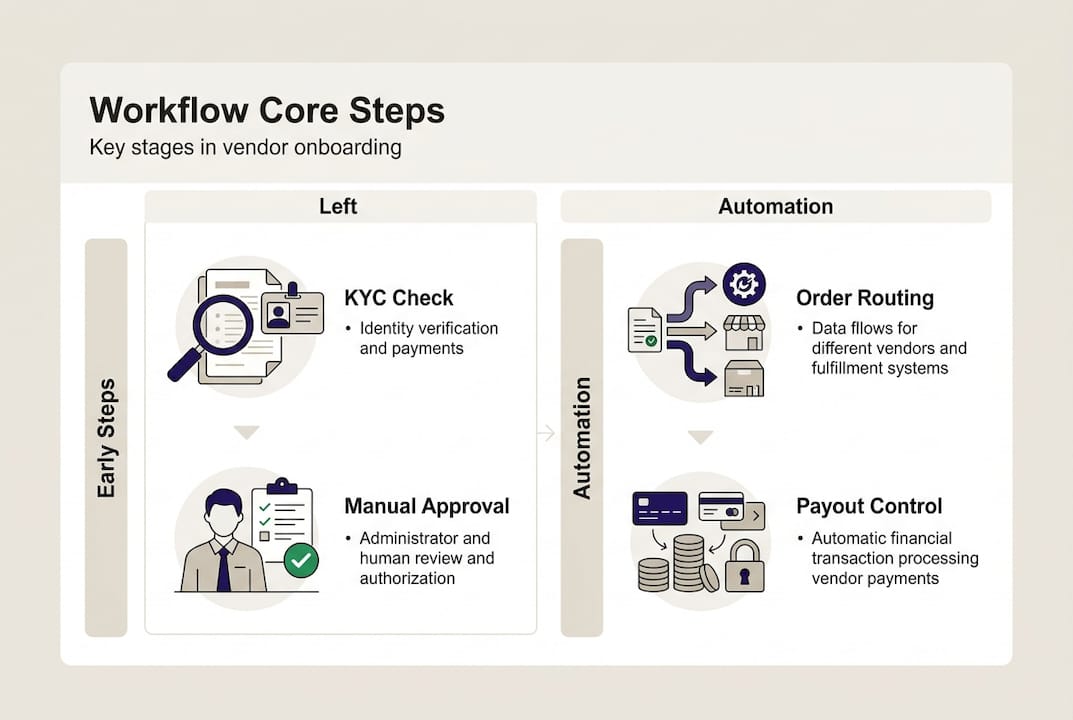
Here is a comparison of manual versus automated onboarding approaches:
Criteria | Manual onboarding | Automated onboarding |
|---|---|---|
Approval speed | 5 to 15 business days | 1 to 3 business days |
Error rate | High (human oversight gaps) | Low (system validation) |
Scalability | Limited | High |
Compliance checks | Inconsistent | Standardised |
Cost per vendor | High | Low at scale |
For e-commerce integration for marketplaces to work effectively, your onboarding process must cover these key requirements:
Identity verification: Government-issued ID and business registration documents
Brand and product review: Ensure vendor offerings align with marketplace standards
Compliance checks: Tax registration, insurance, and regional legal requirements
Payment setup: Stripe or equivalent gateway approval and account linking
Catalogue readiness: Review of product data onboarding essentials before go-live
Pro Tip: In the early stages of your marketplace, prioritise manual curation over speed. Letting vendors through too quickly without proper vetting creates a low-quality vendor influx that is far harder to reverse than it is to prevent.
Automating order splitting, commission, and payout controls
With onboarding established, the next priority is automating the controls that keep payments and commissions transparent and secure. Manual commission tracking and payout processing at scale is a recipe for errors and vendor disputes.
Your order management system should handle the following automatically:
Control type | Configuration detail | Governance benefit |
|---|---|---|
Order splitting | Route line items to respective vendors | Accurate fulfilment and accountability |
Commission tiers | Percentage by category or vendor tier | Fair, transparent revenue sharing |
Payout scheduling | Weekly or fortnightly cycles | Predictable cash flow for vendors |
Dispute holds | Freeze payouts during active disputes | Reduces financial exposure |
Fraud flags | Automated alerts on anomalous transactions | Early risk identification |
According to AWS marketplace governance best practices, centralised admin control with automated order splitting, commission configuration, and payout holds for fraud and disputes are the key methodologies that underpin effective marketplace governance.
Follow these automation steps to get your controls in order:
Configure split order logic so each vendor receives only their relevant order items and fulfilment instructions.
Set commission tiers based on product category, vendor performance, or contract terms to ensure equitable revenue distribution.
Establish payout delay windows of 7 to 14 days in dispute-prone categories such as electronics or high-value goods.
Activate fraud detection rules that flag unusual order volumes, mismatched shipping addresses, or repeated chargebacks.
Audit commission reports monthly to catch configuration drift before it becomes a vendor relations issue.
Pro Tip: Apply payout holds specifically to categories with high return rates. This single control can significantly reduce your financial exposure during peak trading periods when dispute volumes spike.
Dealing with common edge cases and risk mitigation
Even the best workflows face unexpected scenarios. Here is how to tackle critical edge cases head-on before they escalate into operational or financial problems.

Edge cases in multi-vendor marketplaces include split payments across multiple vendors, duplicate SKUs, payout delays, inconsistent inventory data, and fraud risks. Each of these requires a specific response strategy.
Scenario | Typical approach | Advanced approach |
|---|---|---|
Duplicate SKUs | Manual review queue | AI-powered deduplication at upload |
Split payment failures | Retry logic only | Automated fallback routing with alerts |
Inventory mismatches | Periodic manual audits | Real-time sync with vendor ERP systems |
Fraudulent vendors | Post-incident removal | Pre-approval vetting with ongoing monitoring |
Payout disputes | Case-by-case resolution | Structured SLA with escalation tiers |
For a practical multi-vendor payment guide approach, build your risk mitigation strategy around these core tactics:
Inventory accuracy: Require vendors to sync stock levels in real time, not just at the point of listing
Fraud vetting: Run automated checks against known fraud databases at onboarding and at regular intervals post-approval
Dispute handling: Define clear SLAs for dispute resolution and communicate them to vendors upfront
SKU governance: Enforce unique product identifiers (GTINs or MPNs) to prevent duplicate listings from entering your catalogue
Operational monitoring: Use dashboards that surface anomalies in order volumes, return rates, and payout irregularities
Duplicate SKUs cost $48B annually in fraud losses, and split-payment failures account for 18% of marketplace disputes. These are not edge cases in the traditional sense. They are predictable risks that demand proactive governance, not reactive fixes.
When transforming online retail operations at enterprise scale, the difference between platforms that scale well and those that stall often comes down to how thoroughly edge cases are anticipated and systematised.
Enhancing efficiency with automation and AI
Once you have the basics and edge cases covered, the next step is to build efficiency through advanced automation. This is where governance workflows shift from reactive management to proactive optimisation.
AI catalog matching reduces duplicates by 72%, and real-time inventory sync significantly cuts overselling incidents. These are not aspirational outcomes. They are measurable results from governance protocols already in use across enterprise marketplaces. When you consider that average vendor onboarding time-to-first-sale sits at 23 days without automation, the operational case for investing in AI-driven workflows becomes very clear.
Here are the automation tools and methods that deliver the most impact:
AI-powered catalogue sync: Automatically match incoming vendor product data against your master catalogue to flag duplicates and inconsistencies before they go live
Automated inventory updates: Connect vendor inventory systems via API so stock levels reflect in real time, reducing overselling and customer disappointment
Fraud pattern recognition: Use machine learning models trained on historical transaction data to identify suspicious behaviour before payouts are processed
Dynamic commission calculation: Automate tier adjustments based on vendor performance metrics without manual intervention
Automated product classification: Apply consistent taxonomy rules across all vendor submissions to improve search and filtering accuracy for buyers
For directors looking at AI-driven commerce workflows, the integration point matters. Embedding AI at the onboarding stage, rather than adding it as a post-launch layer, produces the fastest time-to-value.
Pro Tip: Prioritise AI catalogue matching as your first automation investment. It directly reduces the duplicate SKU problem, shortens vendor onboarding from weeks to days, and improves buyer search experience simultaneously. You can also review how platform optimisation with OMS supports these outcomes at scale.
Our perspective: Centralised control versus vendor autonomy
After reviewing execution steps and automation, here is our view on governance frameworks and why the tension between control and flexibility is one of the most underappreciated challenges in enterprise marketplace management.
Many directors default to maximum centralisation because it feels safer. And in the early stages, it is. Centralised admin oversight protects brand integrity, enforces consistent product standards, and makes compliance far easier to manage. However, as your vendor base grows, rigid centralisation creates bottlenecks that slow down legitimate vendors and increase operational overhead.
The contrasting approaches of centralised versus federated control reveal a real tension: enterprise marketplaces favour centralised admin oversight for brand integrity, while vendor autonomy through shared catalogues improves buyer experience but complicates governance significantly.
Federated catalogues, where vendors manage their own product data independently, improve listing speed but introduce governance complexity that scales poorly without AI support.
Our view, shaped by working with enterprise marketplace operators, is that the right model is neither fully centralised nor fully federated. It is a governed autonomy model, where vendors operate within clearly defined guardrails enforced by automation. This approach, supported by AI-driven workflow tools, lets you scale vendor count without scaling your governance team at the same rate.
Take your marketplace governance workflow further
If the workflows outlined here resonate with the challenges your team is navigating, you do not have to build these capabilities from scratch. Ultra Commerce is designed specifically for enterprise marketplace operators who need governance, automation, and scalability in a single, integrated platform.

From native multi-vendor catalogue management to automated commission and payout controls, the Ultra Commerce platform gives your team the tools to govern at scale without adding operational overhead. Whether you are running a B2B, B2C, or mixed marketplace, the multi-vendor marketplace platform supports the full governance lifecycle. Explore how our enterprise ecommerce platform can help you move from reactive governance to a proactive, AI-enabled operation.
Frequently asked questions
What is the key distinction between centralised and federated marketplace governance?
Centralised governance gives admins stronger oversight and brand control, while federated governance lets vendors manage their own catalogues and operations. Each approach carries different levels of workflow complexity and scalability trade-offs.
How does automation reduce marketplace onboarding time?
Automation protocols in governance workflows can cut time-to-first-sale from 23 days to as little as 3 to 5 days by streamlining approvals, profile setup, product imports, and inventory sync.
What risks are most common in multi-vendor marketplace governance?
Split-payment failures, duplicate SKUs, inventory mismatches, and unvetted vendors are the most frequent risks. Strong governance protocols and automation help you address these before they escalate into disputes or fraud.
How does AI improve marketplace governance?
AI increases efficiency by automating catalogue matching, which reduces duplicate listings by 72%, and by providing real-time inventory sync that cuts overselling incidents, making oversight far more scalable across large vendor networks.