

March 28, 2026
Enterprise
Multi-Vendor
Marketplace
OMS
Marketplace operations explained: Optimising multi-vendor management
Many executives assume that running a multi-vendor marketplace is simply a matter of connecting buyers with sellers and letting transactions flow. The reality is far more demanding. Marketplace operations are the coordinated management of platform activities across every touchpoint in multi-vendor e-commerce, from vendor qualification through to post-sale service. Getting these operations right is what separates platforms that scale confidently from those that stall under complexity. This guide breaks down the core mechanics, structural models, and strategic levers that enterprise leaders need to master.
Table of Contents
What are marketplace operations?
Key functions in multi-vendor marketplace operations
Marketplace architecture: Models and mechanics
Managing complexity: Inventory, orders, and edge cases
Benchmarks and business impact
Evolving marketplace operations: Trends and strategic recommendations
Optimise your marketplace operation with Ultra Commerce
Frequently asked questions
Key Takeaways
Point | Details |
|---|---|
Marketplace operations scope | Operations span vendor onboarding, cataloguing, inventory, order management, payment, and service. |
Architectural choices matter | Choosing the right model and system architecture drives compliance, resilience, and scalability. |
Real-time synchronisation reduces risk | Real-time inventory and order sync prevents errors and improves customer satisfaction. |
Benchmarks drive optimisation | Key metrics like inventory accuracy and vendor retention guide marketplace improvements. |
Future-proof with automation | Investing in automation and orchestration future-proofs enterprise marketplace operations. |
What are marketplace operations?
Having established that seamless transactions hinge on more than basic connections, let’s clarify what ‘marketplace operations’ truly means in an enterprise context.
At their core, marketplace operations are the full spectrum of coordinated activities that keep a multi-vendor platform running reliably. They are not a single system or department. They are an interconnected set of processes that must work in concert, every hour of every day.
Marketplace operations cover everything from vendor onboarding to fulfilment and customer service. That scope includes:
Vendor onboarding and qualification: Verifying seller credentials, setting up accounts, and defining trading terms
Product cataloguing: Normalising and enriching listings across diverse vendor formats
Inventory synchronisation: Keeping stock levels accurate across all seller feeds in real time
Order management: Routing, splitting, and tracking orders from placement to delivery
Payment and commission processing: Automating split payments and applying dynamic commission structures
Customer service coordination: Managing queries, disputes, and returns across multiple sellers
Performance monitoring: Tracking vendor compliance, fulfilment rates, and buyer satisfaction
Marketplace operations are the operational backbone of any multi-vendor platform. Without them functioning cohesively, even the most sophisticated storefront will underperform.
For organisations exploring the single-vendor to multi-vendor transformation, understanding this full scope is the essential first step. It is also directly relevant to broader digital transformation in shopping centres and other complex retail environments where multiple tenants or brands must coexist on one platform.
Key functions in multi-vendor marketplace operations
With a definition in place, let’s explore the essential moving parts and daily activities that drive successful operations.
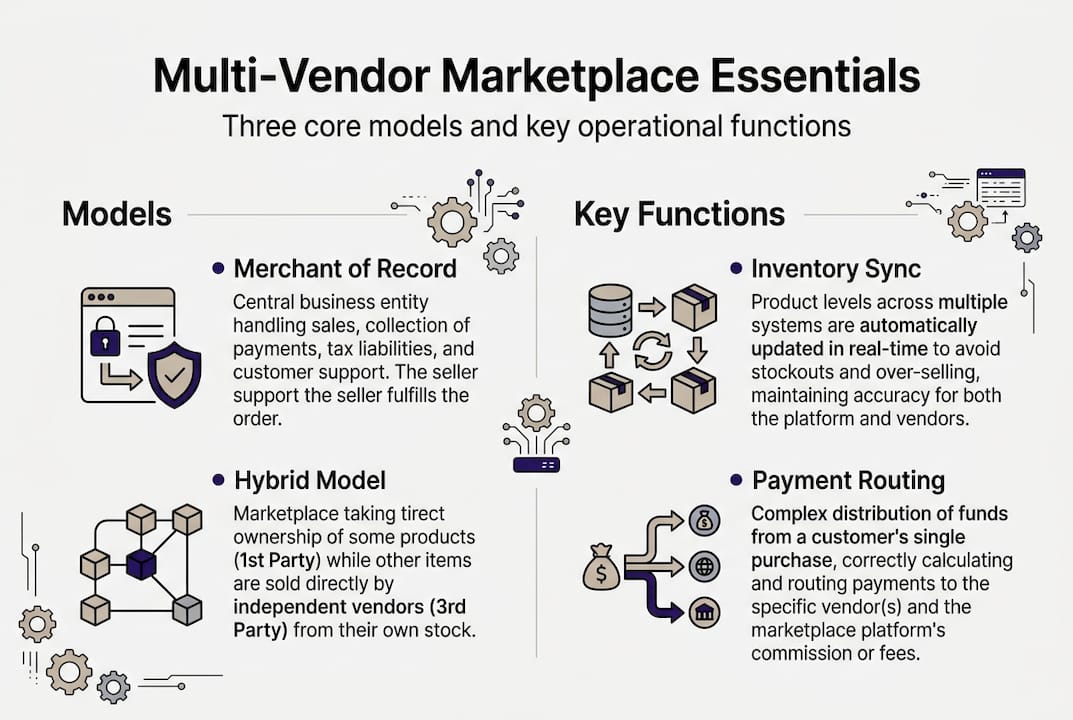
Each operational function carries its own risks and rewards. Core mechanics include real-time inventory sync, automated split payments, centralised order lifecycle management, and dynamic commission structures. When any one of these breaks down, the effects ripple across the entire platform.
Here is how each function contributes:
Vendor onboarding: A structured qualification process reduces downstream compliance risk and accelerates time-to-revenue for new sellers
Catalogue and content management: Consistent product data improves search visibility and conversion rates across all vendor listings
Inventory synchronisation: Batch-based updates introduce dangerous lag. Platforms relying on non-real-time feeds see significantly higher rates of overselling and customer complaints. Investing in integration in multi-vendor platforms is critical here
Automated split payments: Commission models must handle variable rates, promotional adjustments, and multi-currency scenarios without manual intervention
Order coordination: From cart to carrier, order management for B2B and B2C flows require distinct routing logic and SLA management
Performance tracking: Vendor scorecards and real-time dashboards give operators the visibility needed to intervene before issues escalate
Pricing accuracy is equally non-negotiable. Platforms that support real-time price updates reduce buyer friction and protect margin integrity across high-volume catalogues.

Pro Tip: Implement real-time inventory and pricing systems from the outset. Retrofitting these capabilities after launch is significantly more costly and disruptive than building them in early.
Marketplace architecture: Models and mechanics
Next, let’s review the structural decisions that shape marketplace efficiency and adaptability.
The operating model you choose determines how liability, compliance, and revenue flow through your platform. Three primary models exist:
Model | Liability | Compliance burden | Best suited for |
|---|---|---|---|
Merchant of Record (MoR) | Platform | High | Regulated industries, global tax |
Intermediary | Vendor | Low to medium | Domestic, lower-risk categories |
Hybrid MoR | Shared | Medium | Enterprise scale, cross-border |
Hybrid MoR models support compliance and efficiency at scale, making them the preferred choice for most enterprise operators managing cross-border or regulated transactions.
Beyond the commercial model, your technical architecture matters just as much. Composable architectures are preferable to monolithic models for marketplace adaptability, allowing you to swap or upgrade individual components without rebuilding the entire platform.
For enterprise resilience, saga-based workflows are worth understanding. These are sequences of distributed transactions where each step either completes successfully or triggers a compensating action to reverse prior steps. This approach prevents partial failures from corrupting order data or payment records.
Role-based access control (RBAC) is another non-negotiable at enterprise scale. Vendors should only see and manage their own data, while platform operators retain full visibility and governance rights.
When choosing marketplace software, prioritise platforms that support modular architecture and open API layers.
Pro Tip: Integrate your marketplace with ERP and OMS systems using API orchestration rather than point-to-point connections. This approach gives you resilience, flexibility, and a much cleaner path to future upgrades.
Managing complexity: Inventory, orders, and edge cases
After architecture, attention turns to practical realities, solving for complex, high-stakes scenarios.
Order splitting, refunds, fulfilment SLAs, and compensations are critical for edge-case handling. Here is a step-by-step view of how a multi-vendor cart is processed:
Buyer places a single cart containing items from three different vendors
Platform splits the order into three separate vendor sub-orders
Each sub-order is routed to the relevant vendor’s fulfilment system
Shipping labels and tracking are generated per vendor
Payment is split and held in escrow until fulfilment confirmation
Commissions are calculated and disbursed automatically post-delivery
Edge cases are where platforms earn or lose buyer trust. Common failure scenarios include:
Scenario | Risk | Recommended response |
|---|---|---|
Oversell due to inventory lag | Buyer disappointment, refund cost | Real-time sync, safety stock buffers |
Vendor fulfilment failure | SLA breach, churn | Auto-rerouting to backup supplier |
Disputed refund | Escalation, reputational risk | Clear policy, automated compensation |
Partial shipment | Buyer confusion | Proactive communication, split tracking |
Inventory accuracy above 99% is the benchmark for high-performing platforms. Falling below this threshold directly increases refund rates, customer service costs, and vendor disputes. The OMS integration benefits for accuracy and cost control are well documented, and eCommerce and POS integration adds another layer of real-time visibility for omnichannel operators.
The Orion Springfield case study demonstrates how a coordinated multi-vendor approach can bring independent retailers together on a single digital platform without sacrificing operational control.
Best practices for resilience include supplier health dashboards, automated rerouting rules, and structured post-mortem reviews after any fulfilment failure.
Benchmarks and business impact
Once complexity is mastered, success is measured. Let’s examine what top performers achieve and how leaders can track impact.
The numbers make a compelling case for investing in operational excellence. Marketplaces represent over 60% of global e-commerce, with sellers on well-run platforms achieving 156% higher revenue, 20%+ monthly GMV growth, and 85% vendor retention rates.
Key performance indicators for enterprise marketplace operators include:
Inventory accuracy rate: Target above 99% to minimise oversells and refund costs
Gross Merchandise Value (GMV) growth: Month-on-month GMV is the primary health metric for marketplace scale
Take rate: The percentage of GMV retained as platform revenue, typically 10 to 30% depending on category
Vendor retention rate: High retention signals that your platform delivers genuine value to sellers
Order defect rate: Tracks fulfilment failures, late shipments, and negative feedback as a composite quality score
Time to vendor activation: Measures onboarding efficiency and directly impacts supply-side growth
Platforms that invest in operational infrastructure consistently outperform those that treat operations as a secondary concern. The data is clear: operational excellence is a growth strategy, not just a cost centre.
Real-world benchmarks reinforce this. Macy’s marketplace expansion delivered 145% quarter-on-quarter sales growth following a structured operational overhaul. Multi-channel marketplace sales strategies amplify these results further by extending reach without proportionally increasing operational overhead.
Evolving marketplace operations: Trends and strategic recommendations
With evidence of operational value in hand, here is how executives can accelerate impact and future-proof their marketplace strategies.
The most effective platforms in 2026 are those that treat technology as an operational multiplier. ERP and OMS orchestration delivers 30 to 40% cost savings and 99%+ inventory accuracy when implemented with proper API integration.
On the supply side, a structured vendor supply stack covers four stages: discovery, qualification, activation, and growth. Each stage requires distinct tools and metrics. Skipping qualification leads to poor vendor performance. Neglecting growth support accelerates churn.
Strategic recommendations for enterprise leaders:
Automate first: Prioritise automation for order routing, payment splitting, and inventory updates before scaling vendor numbers
Use AI for fraud and pricing: AI-driven anomaly detection and dynamic pricing tools reduce risk and improve margin management
Track LTV:CAC at the vendor level: Scaling effectively requires a vendor lifetime value to acquisition cost ratio above 3:1
Build governance into the platform: RBAC, audit trails, and compliance reporting should be native, not bolted on
Invest in vendor success programmes: Onboarding support, performance coaching, and data sharing increase activation rates and long-term retention
Pro Tip: Monitor 30 to 90 day vendor churn as a leading indicator of marketplace health. Early churn often signals onboarding gaps or unmet expectations that are entirely fixable with the right support structures.
Optimise your marketplace operation with Ultra Commerce
Ready to put advanced marketplace operations into action? Ultra Commerce is built specifically for enterprise operators who need more than a basic platform connection.

From structured vendor onboarding to automated split payments and complex fulfilment routing, the enterprise ecommerce platform from Ultra Commerce supports every layer of multi-vendor operations. The multi-vendor marketplace solution includes native catalogue management, real-time inventory sync, and dynamic commission structures, all without requiring you to replatform your existing tech stack. Pair that with purpose-built order management tools and you have the operational infrastructure to scale with confidence. Book a platform demo today and see how Ultra Commerce supports your digital transformation goals.
Frequently asked questions
How do marketplace operations differ from single-vendor e-commerce?
Marketplace operations require coordinating multiple vendors, more complex order flows, and automated split payments, unlike single-vendor stores where one entity controls all fulfilment and revenue. The network effects and complexity of multi-vendor models introduce both greater opportunity and greater operational demand.
Which marketplace operational model is best for compliance and scale?
Hybrid Merchant of Record models often strike the best balance, sharing liability between the platform and vendors while maintaining compliance at scale. Hybrid MoR models effectively address compliance requirements for large-scale, cross-border marketplaces.
What KPIs indicate successful marketplace operations?
Key indicators include inventory accuracy above 99%, 20%+ monthly GMV growth, and vendor retention rates above 85%, alongside order defect rates and time to vendor activation.
How can automation improve marketplace operations?
Automation minimises manual errors, accelerates order flows, and supports vendor scaling without proportional increases in operational overhead. Automating core activities drives measurable efficiency gains and enables real-time decision-making across the platform.