

March 15, 2026
Enterprise
Ecommerce Strategy
Ultra Commerce
Multi-Vendor
Enterprise multi-vendor marketplaces face mounting pressure to scale operations while managing increasingly complex workflows across hundreds of vendors, thousands of products, and millions of transactions. Traditional manual processes create bottlenecks that limit growth and innovation. Orchestration debt accumulates as fragmented systems struggle to communicate effectively. AI-driven workflows offer a transformative solution, enabling businesses to automate repetitive tasks, optimise campaign performance, and reduce operational costs by up to 45%. This guide walks you through implementing these workflows to accelerate your digital commerce transformation in 2026.
Table of Contents
Preparation: Understanding The Challenges And Prerequisites For AI-Driven Commerce Workflows
Execution: Building And Implementing AI-Driven Digital Commerce Workflows
Verification: Optimising AI-Driven Workflows And Measuring Success In Multi-Vendor Marketplaces
How Ultra Commerce Supports Your AI-Driven Digital Commerce Transformation
What Is Orchestration Debt And How Does It Affect Digital Commerce Workflows?
How Can AI-Driven Workflows Improve Multi-Vendor Marketplace Operations?
What Are The Best Practices For Balancing AI Autonomy And Human Oversight In Commerce Workflows?
Key takeaways
Point | Details |
|---|---|
Speed boost | AI-driven workflows accelerate processes by 30-50% whilst reducing low-value manual work across enterprise operations. |
Orchestration debt | Fragmented legacy systems create workflow complexity that blocks scalability and requires strategic resolution before AI implementation. |
Human-AI balance | Successful operationalisation demands robust orchestration with clear boundaries for AI autonomy and human oversight escalation paths. |
Campaign performance | Automated optimisation lifts CTR by 18% and conversion rates by 9% whilst cutting operational costs significantly. |
Composable complexity | Modular architectures offer flexibility but require unified commerce orchestration to prevent workflow fragmentation. |
Preparation: understanding the challenges and prerequisites for AI-driven commerce workflows
Before implementing AI-driven workflows, you must address fundamental architectural challenges that plague enterprise multi-vendor marketplaces. Orchestration debt represents the accumulated technical burden of fragmented, fragile integrations that slow your ability to adapt and innovate. This debt manifests as inconsistent seller onboarding processes, manual product enrichment bottlenecks, and order routing failures across vendor networks.
Legacy systems compound these issues through rigid architectures that resist modification. When you attempt to modernise using composable commerce approaches, the modular nature can paradoxically increase complexity. Each best-of-breed component introduces new integration points, API dependencies, and workflow handoffs. Without a unifying orchestration layer, these connections become brittle and error-prone.
Operational challenges emerge across your entire commerce lifecycle. Seller onboarding takes weeks instead of days because manual verification and catalogue integration lack automation. Product enrichment suffers from inconsistent data quality as different vendors submit information in varying formats. Order orchestration struggles to route transactions efficiently across multiple fulfilment centres and vendor warehouses. Inventory synchronisation lags create overselling scenarios that damage customer trust.
These workflow inefficiencies directly impact your bottom line through higher operational costs, slower time-to-market for new vendors, and reduced customer satisfaction. Your teams spend valuable time on repetitive tasks rather than strategic initiatives. The lack of real-time visibility across workflows prevents proactive problem-solving.
Addressing these challenges requires strategic preparation:
Audit existing workflows to map dependencies, identify bottlenecks, and quantify orchestration debt
Consolidate fragmented data sources into unified repositories accessible to AI agents
Establish governance frameworks defining acceptable AI autonomy boundaries and escalation triggers
Implement observability infrastructure to monitor workflow performance and AI decision quality
Create cross-functional teams combining commerce operations, data science, and engineering expertise
Pro Tip: Conduct a comprehensive workflow audit before implementing AI. Document every manual handoff, data transformation, and decision point. This baseline reveals orchestration debt hotspots where AI can deliver immediate value whilst highlighting areas requiring architectural simplification first.
Your preparation phase determines AI implementation success. Rushing to deploy AI agents on top of fragmented, debt-laden workflows amplifies existing problems rather than solving them. Take time to build solid orchestration foundations that enable AI to operate effectively within well-defined boundaries.
Execution: building and implementing AI-driven digital commerce workflows
Implementing AI-driven workflows requires systematic execution across five critical phases. Each phase builds upon the previous, creating a robust foundation for AI-augmented commerce operations.
Identify workflow candidates for AI augmentation. Start by analysing your current processes to find repetitive, rules-based tasks consuming significant human effort. Product categorisation, pricing optimisation, inventory forecasting, and campaign management represent ideal starting points. These workflows involve predictable patterns that AI agents can learn and execute reliably. Focus on high-volume, low-complexity tasks first to demonstrate quick wins and build organisational confidence.
Design orchestration architecture. Create a unified control layer that coordinates AI agents, human workers, and existing systems. This architecture defines how data flows between components, where decisions occur, and when escalations trigger. Map clear boundaries for AI autonomy based on risk tolerance and business impact. Low-risk decisions like product tag suggestions can operate fully autonomously, whilst high-value transactions require human approval. Your orchestration layer should support both synchronous and asynchronous workflows to handle varying latency requirements.
Select and configure AI agents. Choose specialised agents for specific workflow tasks rather than attempting to build one universal solution. A product enrichment agent needs different capabilities than a demand forecasting agent. Evaluate agents based on accuracy, explainability, and integration complexity. Configure each agent with appropriate training data reflecting your marketplace’s unique characteristics. Establish performance thresholds that trigger retraining when accuracy degrades.
Implement escalation paths. Design clear handoff mechanisms for situations exceeding AI capabilities. Balancing AI autonomy with human oversight prevents catastrophic failures whilst maintaining operational efficiency. Create tiered escalation levels based on decision complexity and business impact. Simple anomalies might queue for batch review, whilst critical exceptions immediately alert human operators. Document escalation criteria explicitly so teams understand when and why AI transfers control.
Integrate observability and monitoring. Deploy comprehensive logging, metrics collection, and alerting infrastructure across your AI-driven workflows. Track not just outcomes but decision paths, confidence scores, and processing times. This visibility enables rapid diagnosis when workflows underperform. Monitor both technical metrics like latency and business metrics like conversion rates to understand AI’s holistic impact.
The table below compares traditional manual workflows against AI-driven automation across key performance dimensions:
Metric | Traditional Workflow | AI-Driven Workflow | Improvement |
|---|---|---|---|
Processing Speed | 2-4 hours per task | 5-15 minutes per task | 85-95% faster |
Error Rate | 8-12% human error | 2-3% AI error | 65-75% reduction |
Operational Cost | $45 per transaction | $12 per transaction | 73% lower |
Scalability | Linear with headcount | Exponential with compute | 10x capacity |
Consistency | Variable by operator | Uniform across tasks | 100% standardisation |
Pro Tip: Launch AI workflows with limited scope covering 10-20% of transaction volume. This pilot approach lets you refine orchestration paths, validate escalation triggers, and build team confidence before full deployment. Monitor closely for edge cases that reveal gaps in your initial design.
Successful implementation requires patience and iteration. Your first AI agents will make mistakes. Some workflows will need architectural adjustments. Teams will require training to collaborate effectively with AI systems. Treat this execution phase as a learning journey rather than a one-time project. The insights gained during initial deployment inform improvements that compound over time, eventually delivering the 30-50% process acceleration that transforms enterprise commerce operations.

Verification: optimising AI-driven workflows and measuring success in multi-vendor marketplaces
Verifying AI workflow performance requires systematic measurement, continuous optimisation, and proactive scaling strategies. You cannot improve what you do not measure, making robust KPI frameworks essential for long-term success.
Establish comprehensive performance metrics spanning technical and business dimensions. Track click-through rates to measure campaign engagement quality. Monitor conversion rates revealing how effectively AI-optimised experiences drive transactions. Calculate operational cost reductions by comparing pre-AI and post-AI resource requirements. Measure cost-per-click for advertising campaigns to validate budget efficiency. These metrics provide objective evidence of AI impact whilst revealing optimisation opportunities.
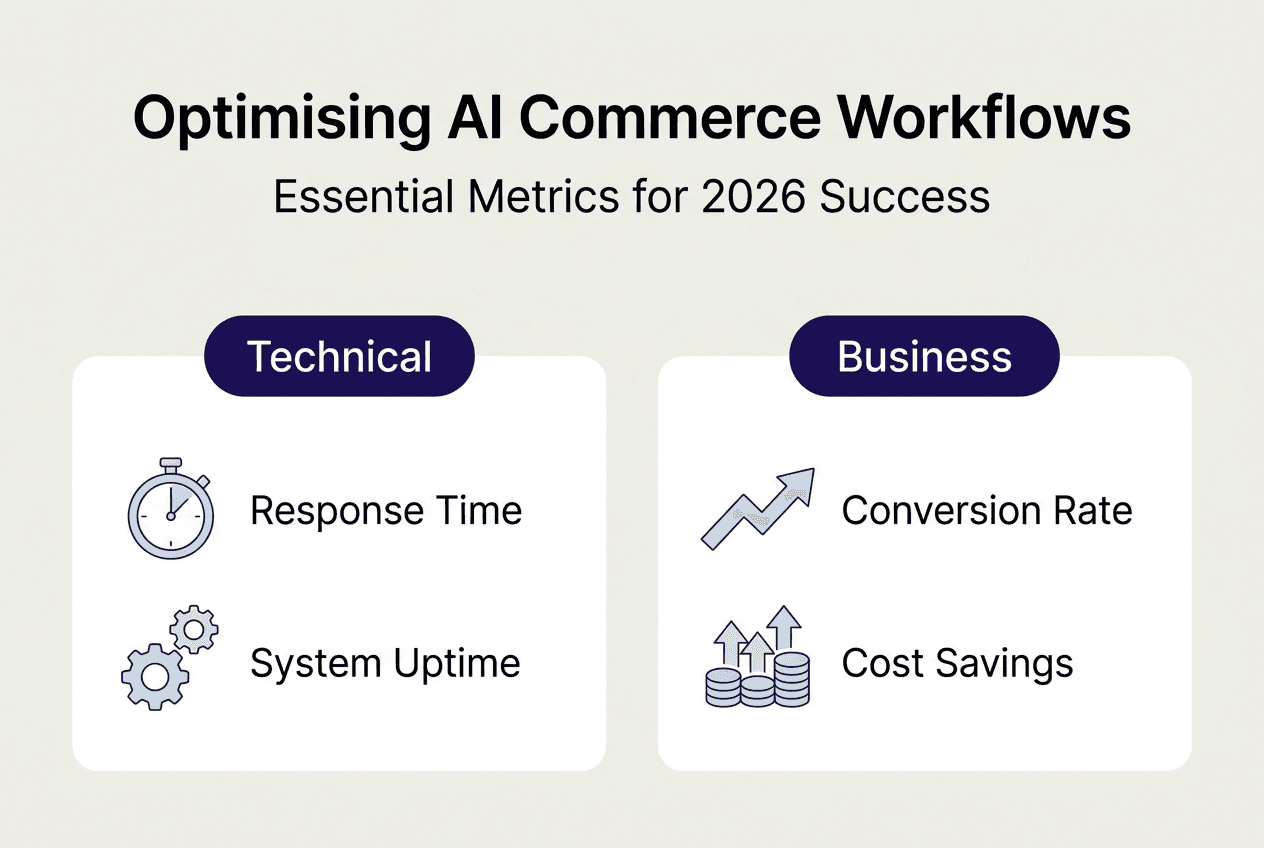
The comparison below illustrates performance differences between manual campaign management and AI-driven automation:
Approach | CTR | Conversion Rate | Operational Cost | CPC | Campaign Setup Time |
|---|---|---|---|---|---|
Manual Management | 3.2% | 2.1% | $82,000/month | $1.85 | 6-8 hours |
AI-Driven Automation | 3.8% | 2.3% | $45,000/month | $1.35 | 15-20 minutes |
Scaling AI workflows across large vendor networks introduces unique challenges. Model drift occurs as consumer behaviours evolve and market conditions shift. What worked brilliantly in January may underperform by June. Automated model retraining becomes essential, continuously updating AI agents with fresh data to maintain accuracy. Your retraining pipeline should trigger based on performance thresholds rather than fixed schedules, ensuring models adapt precisely when needed.
Volatile traffic patterns stress AI systems differently than human operators. Sudden demand spikes during promotional events test whether your infrastructure scales elastically. Monitor resource utilisation closely during peak periods to identify bottlenecks before they impact customer experience. Cloud-native architectures with auto-scaling capabilities handle traffic volatility more gracefully than fixed-capacity deployments.
Implement these best practices for continuous workflow improvement:
Conduct weekly performance reviews analysing KPI trends and identifying anomalies requiring investigation
A/B test workflow variations to validate optimisation hypotheses before full rollout
Collect qualitative feedback from operations teams interacting with AI systems daily
Maintain detailed runbooks documenting escalation procedures and troubleshooting steps
Schedule quarterly architecture reviews assessing whether current orchestration patterns still serve evolving business needs
Invest in explainability tools helping teams understand why AI makes specific decisions
Create feedback loops where human override decisions retrain AI models automatically
Your verification efforts should extend beyond purely technical metrics to encompass business outcomes. Does improved campaign performance translate to higher customer lifetime value? Do operational cost savings fund strategic initiatives? Does faster seller onboarding accelerate marketplace growth? These broader questions connect AI workflow success to enterprise objectives.
Remember that optimisation never ends. Markets evolve, competitors innovate, and customer expectations rise. Your AI-driven workflows must adapt continuously, making verification an ongoing discipline rather than a one-time checkpoint. The businesses that excel treat AI workflow optimisation as a core competency, investing in measurement infrastructure, experimentation capabilities, and organisational learning that compounds advantages over time.
How Ultra Commerce supports your AI-driven digital commerce transformation
Navigating the complexity of AI-driven workflow implementation becomes significantly easier with the right platform foundation. Ultra Commerce delivers enterprise-grade infrastructure specifically designed to support AI-augmented operations across multi-vendor marketplaces. The platform’s composable architecture eliminates orchestration debt through unified workflow control whilst maintaining flexibility to integrate with your existing technology investments.

Our multi-vendor marketplace platform natively supports complex B2C, B2B, and C2C transactions with built-in catalogue management, intelligent routing, and automated settlement. This foundation enables AI agents to operate effectively without wrestling fragmented legacy systems. The advanced agentic execution layer facilitates AI-driven discovery, decision-making, and transaction execution across your entire commerce ecosystem. Commerce orchestration solutions provide the unified control plane essential for balancing AI autonomy with human oversight, ensuring your transformation delivers measurable business outcomes whilst managing operational risk. Whether you are starting your AI journey or scaling existing implementations, Ultra Commerce accelerates your path to operational excellence.
What is orchestration debt and how does it affect digital commerce workflows?
Orchestration debt accumulates when businesses layer new integrations and workflows atop existing systems without architectural consolidation. This technical burden manifests as fragile connections between disparate platforms, inconsistent data flows, and manual handoffs that should be automated. Each new vendor integration or marketplace expansion compounds the problem, creating increasingly complex workflow maps that resist modification. The debt directly impedes your ability to scale operations efficiently, slows innovation cycles, and increases operational costs through higher maintenance overhead and error remediation efforts.
How can AI-driven workflows improve multi-vendor marketplace operations?
AI automates repetitive, rules-based tasks that consume significant human effort across vendor onboarding, product enrichment, inventory management, and campaign optimisation. This automation eliminates error-prone manual work whilst accelerating process speed by 30-50%. Real-world implementations demonstrate 18% CTR improvements and 9% conversion rate gains for advertising campaigns managed by AI agents. Operational expenditure drops substantially, with some organisations achieving 45% cost reductions through workflow automation. These measurable improvements translate directly to competitive advantages in customer acquisition, retention, and profitability.
What are the best practices for balancing AI autonomy and human oversight in commerce workflows?
Successful AI implementation requires designing workflows that grant agents autonomy within clearly defined boundaries based on risk tolerance and business impact. Low-risk decisions like product categorisation suggestions can operate fully autonomously, whilst high-value transactions exceeding confidence thresholds should trigger human review. Scaling AI agents safely demands explicit escalation paths routing exceptions to appropriate human operators. Implement tiered oversight levels where simple anomalies queue for batch review and critical issues generate immediate alerts. Continuous monitoring of AI decision quality maintains operational trust whilst identifying opportunities to expand autonomy boundaries as models improve. This balanced approach maximises efficiency gains whilst managing the risks inherent in delegating business-critical decisions to automated systems.