

April 2, 2026
Enterprise
Multi-Vendor
OMS
Marketplace
Optimise multi-vendor platforms with advanced OMS
Managing inventory, fulfilment, and returns across dozens or even hundreds of vendors is far more operationally demanding than most enterprise leaders anticipate. A single missed stock update or misrouted order can cascade into delayed shipments, frustrated customers, and significant revenue loss. Yet many organisations still rely on legacy systems that were never designed for this level of complexity. A modern Order Management System (OMS) changes that equation entirely. This guide covers the core mechanics, enterprise features, implementation steps, and strategic value of OMS in multi-vendor e-commerce, so you can make informed decisions that drive real growth.
Table of Contents
Understanding multi-vendor e-commerce complexity
Key mechanics: How OMS powers multi-vendor platforms
Enterprise features: What to look for in a modern OMS
Implementing OMS: Practical steps for enterprise e-commerce
What most leaders miss about OMS in multi-vendor transformation
Unlock advanced OMS for your multi-vendor marketplace
Frequently asked questions
Key Takeaways
Point | Details |
|---|---|
OMS unlocks efficiency | Order management systems orchestrate inventory, fulfilment, and returns across vendors, reducing errors and delays for better performance. |
Must-have enterprise features | API-first architecture, AI routing, and scalability are non-negotiables for large-scale, multi-vendor OMS deployments. |
Implementation requires alignment | Successful OMS rollout depends on strategic planning, vendor onboarding, and system synchronisation. |
Leverage OMS as strategy | Treat OMS as a strategic asset to drive customer satisfaction and growth, not just a backend IT system. |
Understanding multi-vendor e-commerce complexity
A multi-vendor platform is a digital marketplace where multiple independent sellers or suppliers list, sell, and fulfil products through a single storefront. Think of it as transforming multi-vendor retail from a simple catalogue into a living, breathing ecosystem with dozens of moving parts operating simultaneously.
The operational challenges multiply quickly. Each vendor maintains its own inventory, uses its own fulfilment processes, and may operate across different warehouses or regions. When a customer places a single order containing products from three different vendors, the platform must coordinate stock checks, routing decisions, shipping timelines, and communication in real time. Without a centralised system, this becomes a manual, error-prone process.
Common pain points enterprises face include:
Manual reconciliation across vendor invoices, shipping confirmations, and payment settlements
Inventory inaccuracies caused by delayed stock updates from vendor systems
Delayed or split shipments that erode customer trust and increase support costs
Returns complexity when products from multiple vendors arrive in a single order but need separate return pathways
Inconsistent customer experience driven by vendor-to-vendor variability in packaging, communication, and delivery speed
Traditional omnichannel retail OMS platforms were built for single-brand or single-warehouse environments. Scaling them to support a shopping centre marketplace model with hundreds of vendors requires workarounds that introduce risk and inefficiency.
“Key mechanics include real-time inventory visibility across vendor inventories, intelligent order routing to optimal fulfilment nodes (warehouses, stores, 3PLs, dropshippers), split/partial shipment handling, and unified returns management.” — OMS Comparison Framework for Retailers
A purpose-built OMS serves as the operational backbone of your multi-vendor environment. It centralises data flows, automates decision-making, and gives your team a single source of truth for every order, regardless of which vendor is fulfilling it.

Key mechanics: How OMS powers multi-vendor platforms
Understanding what an OMS actually does under the hood helps you evaluate solutions with confidence. The core capabilities that matter most in a multi-vendor context are real-time inventory visibility, intelligent order routing, split shipment handling, and unified returns management.
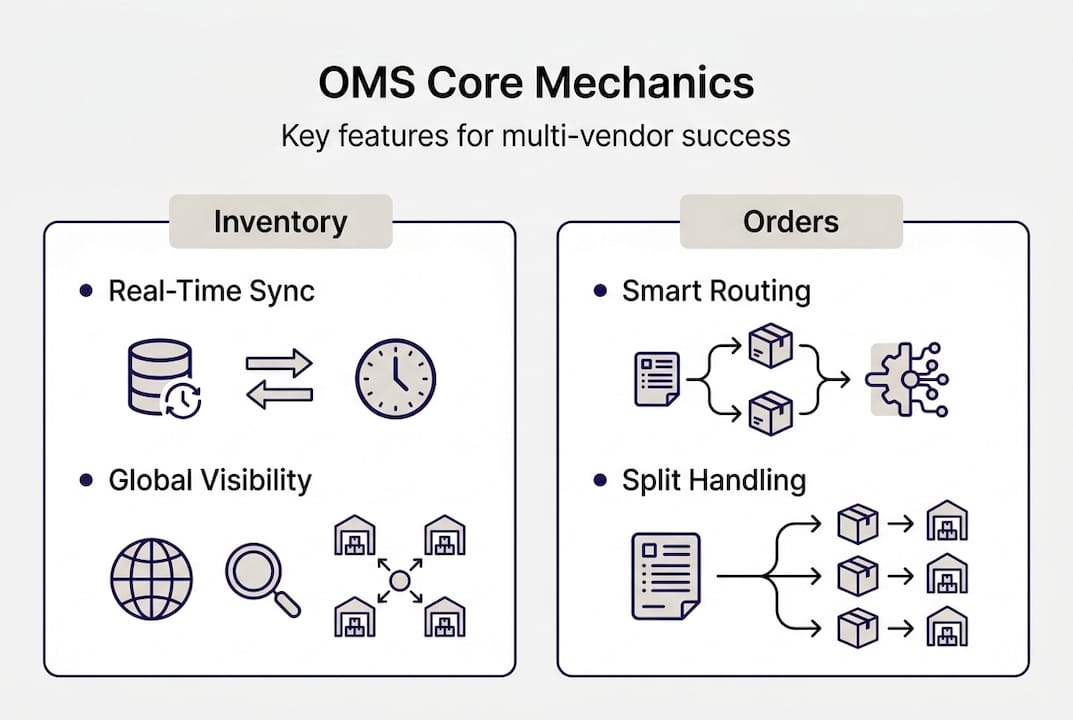
Real-time inventory visibility means your platform always knows what stock is available across every vendor location, warehouse, and third-party logistics (3PL) partner. OMS enables real-time sync across distribution centres, 3PLs, and dropship vendors, allowing dynamic order routing and split shipment optimisation. This eliminates overselling and reduces the costly process of cancelling orders after purchase.
Intelligent order routing goes beyond simply sending an order to the nearest warehouse. A modern omnichannel OMS solution evaluates multiple factors, including stock availability, shipping costs, delivery timeframes, and vendor performance scores, to determine the optimal fulfilment node for each item in an order.
Split and partial shipment handling is where many legacy systems struggle. When a customer orders five products from four vendors, the OMS must decide whether to ship items together, separately, or in stages, while keeping the customer informed throughout. Handled well, this capability actually improves satisfaction. Handled poorly, it creates confusion and returns.
Capability | Legacy OMS | Modern OMS |
|---|---|---|
Inventory sync | Batch updates (hours) | Real-time across all nodes |
Order routing | Manual or rule-based | AI-driven, dynamic |
Split shipments | Limited or manual | Automated with customer notifications |
Returns management | Vendor-specific | Unified across all vendors |
Integration | Point-to-point | API-first, flexible |
Unified returns management is often overlooked but it is a genuine sales differentiator. When customers can return products from multiple vendors through a single process, satisfaction scores rise and repeat purchase rates follow. Understanding order management fulfilment at this level of detail is what separates high-performing platforms from the rest.
Pro Tip: Map your current returns process across all vendors before selecting an OMS. If it takes more than three steps for a customer to initiate a return, your current system is costing you repeat business.
Enterprise features: What to look for in a modern OMS
Not all OMS platforms are built for enterprise scale. When you are managing a multi-vendor marketplace with significant transaction volumes, the features you prioritise will determine whether your OMS becomes a growth enabler or a bottleneck.
Here are the capabilities that matter most:
API-first architecture: An API-first OMS connects seamlessly with your existing ERP, CRM, WMS, and vendor systems without requiring a full replatforming exercise. This flexibility is non-negotiable at enterprise scale.
AI-driven intelligent routing: Automation reduces manual intervention and improves routing accuracy. AI models can factor in real-time carrier performance, weather disruptions, and vendor fulfilment history to make smarter decisions faster.
Scalability for peak loads: Your OMS must handle Black Friday volumes without degrading performance. Automated OMS benefits include elastic scaling that absorbs traffic spikes without manual intervention.
Multi-tenancy and white-labelling: Enterprise platforms often serve multiple business units or branded storefronts. A multi-tenant OMS lets you manage all of them from a single administrative layer.
Security and compliance: Data sovereignty, PCI-DSS compliance, and role-based access controls are baseline requirements for any enterprise deployment.
For enterprise multi-vendor platforms, prioritise OMS with API-first design, AI-driven routing, and scalability for peak loads. Platforms that meet all three criteria consistently outperform those that compromise on even one.
When evaluating OMS options, ask vendors specifically how their platform handles concurrent peak transactions and what their documented uptime SLA looks like during high-demand periods.
Pro Tip: Request a live demonstration of order routing under simulated peak load conditions before signing any enterprise OMS contract. Performance under pressure reveals far more than a feature checklist.
Implementing OMS: Practical steps for enterprise e-commerce
A well-planned OMS implementation delivers measurable improvements across fulfilment speed, inventory accuracy, and customer satisfaction. Rushing the process or underestimating complexity are the two most common reasons enterprise deployments fall short of expectations.
Follow these steps to give your implementation the best chance of success:
Needs assessment: Document your current order volumes, vendor count, fulfilment node locations, and key pain points. This baseline shapes every subsequent decision.
Vendor collaboration: Engage your top vendors early. OMS implementation requires synchronising inventory and order routing logic across stores, vendors, and third-party partners for real-time accuracy. Vendors who are unprepared for integration will slow your rollout.
Integration and data mapping: Define how data flows between your OMS, ERP, WMS, and carrier systems. Poor data mapping is the single most common cause of post-launch errors.
User testing and UAT: Run user acceptance testing (UAT) with realistic order scenarios, including edge cases like partial cancellations and multi-vendor returns.
Phased rollout: Launch with a subset of vendors before scaling to the full catalogue. This limits risk and gives your team time to refine processes.
Implementation phase | Key risk | Mitigation strategy |
|---|---|---|
Needs assessment | Incomplete requirements | Involve operations, IT, and vendor teams |
Data mapping | Field mismatches | Conduct data audits before integration |
UAT | Missed edge cases | Use real historical order data for testing |
Rollout | Vendor readiness gaps | Provide onboarding support and documentation |
For more detail on OMS implementation considerations and how to navigate B2B OMS challenges, reviewing real-world deployment frameworks will save you significant time. Also consider how your multi-vendor payment guide aligns with your OMS configuration, as payment settlement logic must mirror your routing and fulfilment rules. Review enterprise OMS deployment frameworks to benchmark your approach against industry standards.
What most leaders miss about OMS in multi-vendor transformation
Here is a perspective that does not get enough airtime: most enterprise leaders treat OMS as a backend IT project. They assign it to the technology team, set a go-live date, and measure success by whether the system is running. That framing misses the point entirely.
A modern OMS is a strategic asset. When it routes orders intelligently, it reduces fulfilment costs. When it surfaces inventory data in real time, it enables personalised delivery promises that build customer trust. When it automates returns, it converts what was once a friction point into a loyalty driver.
The organisations that gain the most from multi-vendor platform transformation are the ones where the executive team treats OMS decisions with the same rigour as pricing strategy or customer acquisition investment. They ask: how does this system help us fulfil faster, sell more, and retain customers longer?
The uncomfortable truth is that best-in-class OMS technology unlocks growth that no amount of marketing spend can replicate. Speed, reliability, and seamless returns are the new competitive advantages in enterprise e-commerce. Your OMS is either delivering them or holding you back.
Unlock advanced OMS for your multi-vendor marketplace
If this guide has clarified what a modern OMS can do for your multi-vendor operations, the next step is seeing those capabilities in action. Ultra Commerce is purpose-built for enterprise-scale order management, supporting complex B2B, B2C, and C2C transactions across multi-vendor environments without requiring you to replatform.
Explore the Ultra Commerce OMS to see how real-time routing, split shipment handling, and unified returns work at scale. If you are building or scaling a multi-vendor marketplace platform, Ultra Commerce provides the native catalogue management, routing, and settlement tools your operation needs. Ready to modernise your fulfilment? Discover the full enterprise ecommerce solution and take the next step.
Frequently asked questions
What core roles does an OMS serve in a multi-vendor platform?
A modern OMS enables real-time inventory visibility, intelligent order routing, split shipment handling, and unified returns across all vendors. It acts as the central coordination layer that keeps every transaction accurate and every customer informed.
Why is API-first architecture important for enterprise OMS?
API-first design enables seamless integrations with diverse vendor systems, ERPs, and third-party partners without costly custom builds. This flexibility allows your platform to evolve and scale without being constrained by rigid point-to-point connections.
What are the main challenges during OMS implementation for multi-vendor?
Key challenges include onboarding vendors with varying technical capabilities, mapping complex data flows across systems, and ensuring real-time synchronisation for accurate order fulfilment. A phased rollout with strong vendor onboarding support significantly reduces these risks.
How does OMS impact customer experience on multi-vendor platforms?
A robust OMS ensures fast, reliable delivery and hassle-free returns by automating split shipment optimisation and unifying the returns process. Customers experience consistency regardless of which vendor fulfilled their order, which directly improves satisfaction and repeat purchase rates.