

March 12, 2026
Enterprise
Multi-Vendor
Marketplace
Enterprise multi-vendor marketplace integration demands meticulous planning and execution. Without proper architecture, you risk order failures, commission errors, and vendor churn. This guide walks you through preparing your business model, building scalable infrastructure, onboarding vendors systematically, and leveraging AI automation to transform your marketplace into a high-performing revenue engine that scales effortlessly.
Table of Contents
Preparing For Multi-Vendor E-Commerce Integration
Building A Scalable And Robust Marketplace Architecture
Step By Step Multi-Vendor Integration And Vendor Onboarding Process
Implementing AI-Driven Automation For Enhanced Marketplace Performance
Explore Ultra Commerce For Scalable Multi-Vendor Marketplaces
What Is The Best Approach To Start Multi-Vendor Marketplace Integration?
How Can AI Improve The Efficiency Of My E-Commerce Marketplace?
What Are Common Pitfalls To Avoid During Multi-Vendor Integration?
How Long Does It Typically Take To See ROI From AI-Powered E-Commerce Features?
Key takeaways
Point | Details |
|---|---|
Multi-vendor platforms expand product choice while reducing inventory costs | Onboard suppliers to offer more SKUs without holding stock, increasing revenue streams |
A layered, scalable back-end ensures performance and accuracy | Three-layer architecture supports 1,000+ vendors and 1M+ SKUs with reliable order processing |
AI automation enhances search, pricing, and content generation | Natural language search and dynamic pricing boost conversions and margins |
Robust vendor management and onboarding are essential | Systematic workflows prevent catalog chaos and commission disputes |
Start with an agile, API-first integration approach | MVP validation and headless commerce enable faster iteration and omnichannel expansion |
Preparing for multi-vendor e-commerce integration
Before diving into technical implementation, you must align your marketplace strategy with market realities. Selecting the right marketplace model depends on your target audience and transaction complexity. The choice of marketplace model such as B2C, B2B, P2P, services, or crowdfunding should align with your market’s specific needs and purchasing behaviors.
Start by assessing whether a multi-vendor approach truly serves your business goals. Alternatives like dropshipping or single-vendor models may suffice for simpler operations. If your value proposition centers on product variety, competitive pricing through multiple suppliers, or niche specialty goods, multi-vendor integration becomes strategic.
Define clear value propositions for both buyers and sellers. Buyers need seamless discovery, trusted transactions, and broad selection. Sellers require low barriers to entry, transparent commission structures, and efficient fulfillment tools. Map these requirements early to prevent feature bloat and scope creep.
Key preparation steps include:
Conduct competitive analysis to identify differentiation opportunities
Define vendor eligibility criteria and onboarding requirements
Establish commission models ranging from 5% to 30% based on category and volume
Plan compliance frameworks covering data privacy, payments, and consumer protection
Design a phased roadmap starting with MVP features and scaling iteratively
Pro Tip: Begin with a soft launch involving 10 to 20 carefully selected vendors. This controlled pilot validates workflows, uncovers integration gaps, and builds case studies before broader rollout.
Security and vendor experience should inform every decision from day one. Role-based access, data isolation, and audit trails prevent disputes. Vendor dashboards must provide real-time sales analytics, inventory management, and payout transparency. Early attention to these operational details reduces churn and support overhead.
Building a scalable and robust marketplace architecture
Your marketplace’s long-term success depends on a well-engineered back-end architecture that handles complexity gracefully. A scalable multi-vendor marketplace is structured into three layers: Presentation for UI, Application for business logic, and Data Layer for databases. This separation enables independent scaling and maintenance.

The Presentation Layer delivers responsive interfaces across web, mobile, and progressive web apps. The Application Layer orchestrates vendor management, authentication, product catalogs, order processing, and payment routing. The Data Layer stores vendor profiles, product metadata, transactional records, and analytics with optimized indexing for sub-second queries.
Weak back-end architecture leads to order failures, commission errors, and settlement delays impacting profitability. When systems cannot handle peak traffic or complex vendor rules, you lose revenue and reputation simultaneously.
Core modules to implement:
Vendor Management System: Onboarding workflows, approval pipelines, performance tracking
Authentication & Role Management: Multi-tier access for admins, vendors, and customers with granular permissions
Product Catalog Engine: Centralized SKU management with vendor-specific attributes, pricing, and inventory
Order Orchestration: Split order routing, vendor-specific fulfillment, automated notifications
Payment & Settlement: Commission calculation, split payments, automated vendor payouts, refund handling
Your architecture must support 1,000+ active vendors, over 1 million SKUs, and thousands of concurrent users without performance degradation. Apply vendor-level data isolation to prevent cross-contamination. Use indexing strategies like Elasticsearch for fast product search across massive catalogs.
Adopt an agile multi-vendor technology approach prioritizing API-first design and headless commerce. This flexibility allows you to integrate best-of-breed tools for payments, logistics, and marketing without replatforming. Microservices architecture enables independent scaling of high-load components like search and checkout.
Architecture Component | Scalability Requirement | Key Technology |
|---|---|---|
Presentation Layer | Support 10,000+ concurrent users | React, Vue.js, PWA |
Application Layer | Handle 1,000+ vendors | Node.js, Python, microservices |
Data Layer | Manage 1M+ SKUs | PostgreSQL, MongoDB, Redis cache |
Search Engine | Sub-second query response | Elasticsearch, Algolia |
Payment Gateway | Process split transactions | Stripe Connect, PayPal Commerce |
Pro Tip: Implement feature flags and canary deployments to test new functionality with a subset of vendors before full release. This reduces risk and gathers feedback early.
Step by step multi-vendor integration and vendor onboarding process
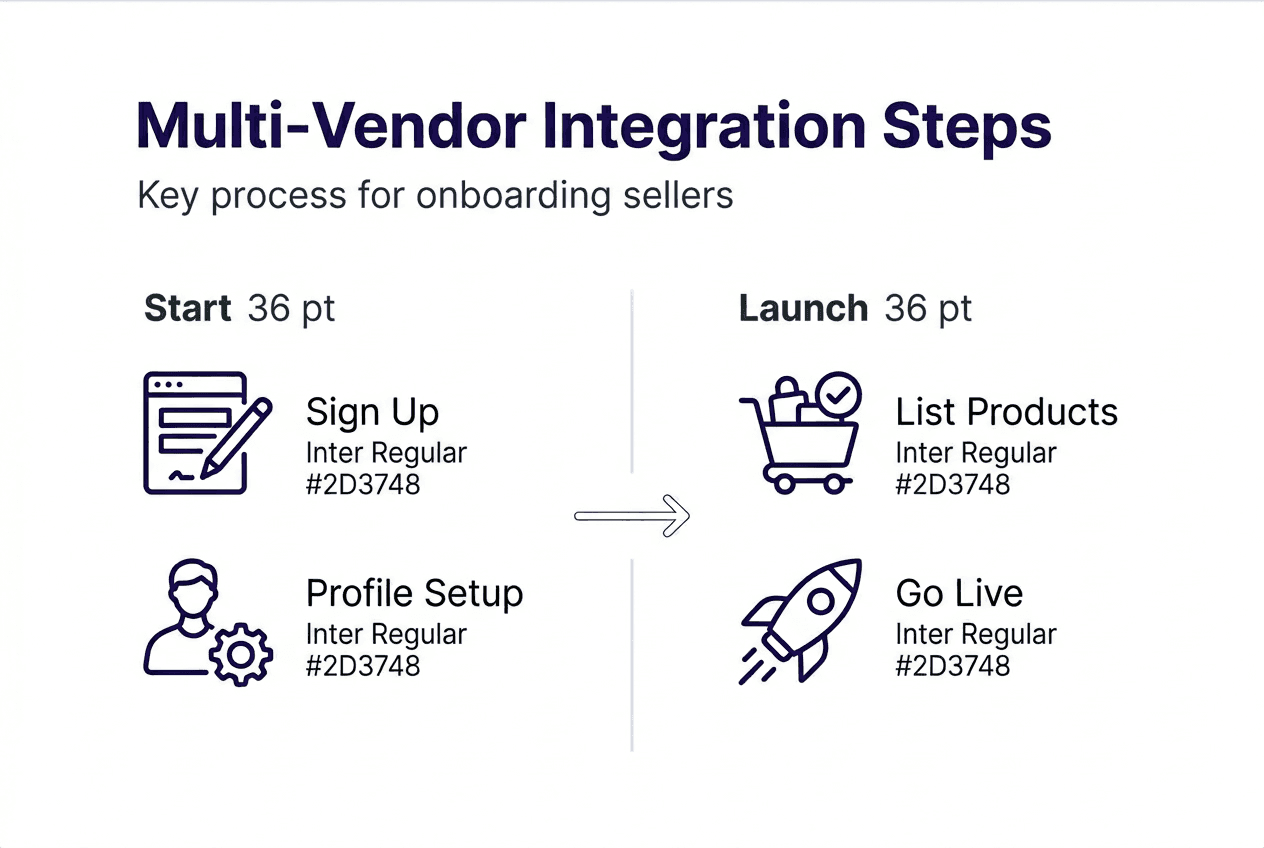
Systematic vendor onboarding transforms potential chaos into streamlined operations. Define clear eligibility criteria covering business legitimacy, product quality standards, and fulfillment capabilities. Create a structured application process capturing tax information, banking details, shipping methods, and return policies.
Your integration process should follow these steps:
Vendor Application & Verification: Collect business documentation, verify credentials, conduct background checks
Contract & Compliance Setup: Establish commission agreements, set payment terms, configure tax collection
Catalog Integration: Enable bulk product uploads via CSV, API, or manual entry with approval workflows
Product Approval & Moderation: Review listings for quality, accuracy, and policy compliance before publication
Payment Configuration: Set up vendor bank accounts, configure commission splits, establish payout schedules
Dashboard Access & Training: Provide vendor portal access, deliver onboarding tutorials, offer ongoing support
Go Live & Monitoring: Activate vendor storefront, track initial performance, gather feedback
Product catalog ingestion requires flexible formats supporting varied vendor capabilities. Offer API integrations for tech-savvy suppliers, CSV templates for smaller merchants, and manual forms as fallback. Implement validation rules to catch pricing errors, missing images, and incomplete descriptions before they reach customers.
Retailers onboard new suppliers and process orders of these suppliers’ products to provide customers more choices without higher inventory costs. This model shifts inventory risk to vendors while you focus on platform operations and customer experience.
Split payment processing distributes transaction amounts automatically. When a customer purchases items from three vendors, the system calculates platform commission for each, deducts payment processing fees, and queues vendor payouts. Commission rates typically range from 5% for high-volume categories to 30% for specialty goods.
Vendor dashboards must provide real-time visibility into:
Sales performance and revenue trends
Order management with fulfillment tracking
Inventory levels and low-stock alerts
Customer reviews and ratings
Payout schedules and transaction history
Order lifecycle orchestration handles the complexity of multi-vendor fulfillment. When an order contains items from multiple vendors, the system splits it into sub-orders, routes each to the appropriate supplier, tracks shipments independently, and consolidates customer communications. Automate refund processing, dispute resolution, and performance monitoring to reduce manual intervention.
Implement vendor onboarding software essentials including data validation, enrichment workflows, and approval pipelines to maintain catalog quality at scale.
Implementing AI-driven automation for enhanced marketplace performance
AI transforms marketplace operations from reactive to predictive, unlocking efficiency gains and revenue growth. Start with high-impact use cases that deliver measurable results quickly.
Personalized product recommendations increase average order value by surfacing relevant items based on browsing history, purchase patterns, and similar customer behavior. Machine learning models analyze millions of data points to predict what each shopper wants next, creating a curated experience that drives conversions.
AI-powered search with natural language and image capabilities boosts conversion by understanding customer intent beyond exact keyword matches. Shoppers can describe what they need conversationally or upload photos to find visually similar products. This reduces friction and improves discovery.
AI-based dynamic pricing optimizes prices by demand and competition, improving revenue without manual intervention. Algorithms monitor competitor pricing, inventory levels, and demand signals to adjust prices in real time, maximizing margins while remaining competitive.
Key AI applications for marketplaces:
Natural Language Search: Understand queries like “blue running shoes for flat feet” and return relevant results
Visual Search: Enable customers to upload images and find matching or similar products
Dynamic Pricing: Adjust prices based on demand, competition, seasonality, and inventory levels
Content Generation: Automatically create product descriptions, SEO metadata, and category pages
Fraud Detection: Identify suspicious orders, payment patterns, and vendor behavior
Demand Forecasting: Predict inventory needs and optimize stock levels across vendors
Automated content generation solves the challenge of maintaining consistent, high-quality product information across thousands of SKUs from multiple vendors. AI writes compelling descriptions, generates SEO-optimized titles and meta tags, and even suggests product categorization.
“AI doesn’t replace human creativity in e-commerce. It amplifies it by handling repetitive tasks and surfacing insights humans would miss in massive datasets.”
Continuous monitoring powered by AI detects anomalies before they escalate. Flag orders with unusual shipping addresses, payment mismatches, or velocity patterns indicating fraud. Track vendor performance metrics like fulfillment speed, return rates, and customer satisfaction to identify underperformers early.
Implement AI strategies for e-commerce that align with your specific marketplace model and customer expectations. Start with one or two high-value applications, measure results rigorously, and expand based on proven ROI.
Explore Ultra Commerce for scalable multi-vendor marketplaces
You’ve learned the step-by-step process for integrating and scaling multi-vendor marketplaces. Now consider how the right platform accelerates your implementation. Ultra Commerce delivers multi-vendor marketplace solutions purpose-built for enterprise complexity, combining native catalog management, routing, and settlement with AI-driven automation.

Our enterprise commerce platform provides modular components including PIM, OMS, and orchestration tools that integrate seamlessly with your existing tech stack without replatforming. The order management system handles split order routing, vendor-specific fulfillment, and automated settlement, reducing operational overhead while scaling effortlessly. Designed for IT decision-makers who need reliable, secure infrastructure that supports diverse commerce models, Ultra Commerce enables you to launch faster, scale confidently, and evolve continuously as your marketplace grows.
What is the best approach to start multi-vendor marketplace integration?
Begin with thorough business model assessment and market validation before committing to technical architecture. Define your value proposition for both buyers and sellers, ensuring the multi-vendor approach truly serves strategic goals rather than adding unnecessary complexity. Adopt an agile MVP methodology that validates core features with a small vendor cohort before scaling.
Prioritize API-first, headless architecture from day one to enable flexibility and future integrations. Select proven technology stacks that support your scale requirements and team expertise. Invest in robust vendor onboarding workflows and dashboard capabilities early, as vendor experience directly impacts catalog quality and retention.
How can AI improve the efficiency of my e-commerce marketplace?
AI optimizes search through natural language understanding and visual recognition, helping customers find products faster and boosting conversion rates. Personalized recommendations increase average order value by surfacing relevant items based on behavior patterns. Dynamic pricing algorithms adjust prices based on real-time demand and competition, maximizing revenue without manual effort.
Automated content generation maintains consistent, SEO-optimized product information across massive catalogs. AI-driven fraud detection and performance monitoring identify issues before they impact operations, reducing support costs and improving trust.
What are common pitfalls to avoid during multi-vendor integration?
Ignoring vendor onboarding complexity leads to catalog chaos, incomplete product data, and poor vendor experience that drives churn. Many enterprises underestimate back-end scalability requirements, resulting in performance issues and order failures during peak traffic. Inadequate role-based access controls and data isolation create security vulnerabilities and compliance risks.
Neglecting commission calculation accuracy and payout automation generates vendor disputes and manual reconciliation overhead. Failing to plan for dispute resolution, returns processing, and customer service workflows creates operational bottlenecks. Address these areas proactively in your architecture and process design.
How long does it typically take to see ROI from AI-powered e-commerce features?
ROI for AI-powered e-commerce typically pays back within 4-6 months as search improvements and dynamic pricing drive immediate conversion and margin gains. Early benefits include increased average order value from personalized recommendations and reduced content creation costs from automated product descriptions.
Measure specific KPIs like search conversion rate, average order value, and margin improvement to track AI impact. Start with high-value applications like search and pricing that deliver quick wins, then expand to content generation and fraud detection as you prove value.