

April 8, 2026
Enterprise
Multi-Vendor
TL;DR:
Effective commerce integration requires resilient frameworks like API-first and microservices architecture.
Preparing for real-world edge cases and building automated fallback strategies improve operational stability.
Scaling multi-vendor marketplaces benefits from phased onboarding, standardized API contracts, and hybrid catalog models.
Enterprise commerce integration is rarely the seamless, plug-and-play process vendors promise. The real picture is far more complex: misaligned data models, fragmented vendor ecosystems, and AI-driven transaction flows that can fail in ways no one anticipated. For e-commerce strategists managing multi-vendor marketplaces, the cost of getting integration wrong is measured in lost revenue, reputational damage, and operational chaos. Microservices reduce downtime by 40% and idempotency prevents duplicate transactions, yet many enterprises still rely on brittle, monolithic approaches. This guide cuts through the noise and delivers the advanced strategies, honest risk assessments, and practical frameworks you need to build resilient, scalable commerce infrastructure.
Table of Contents
Multi-vendor commerce: strategies for scaling and resilience
A new integration mindset: what top enterprises do differently
Key Takeaways
Point | Details |
|---|---|
API-first and microservices | Modern integration frameworks use API-first and microservices to maximise scalability and uptime. |
Edge case readiness | Automated error handling and fallback are essential for preventing costly failures in live operations. |
Multi-vendor scaling | Choosing the right catalogue and inventory model is key to marketplace resilience and growth. |
Balance AI with human oversight | Enterprise adoption of agentic AI works best when paired with robust manual control. |
Understanding core integration frameworks
With the stakes set, the next step is to examine the core frameworks powering effective commerce integration. The difference between an integration that holds under pressure and one that crumbles during a traffic spike often comes down to foundational methodology choices made well before go-live.
API-first integrationmeans designing every component to expose and consume APIs as the primary communication method. This approach decouples systems, so a change in your order management layer does not cascade into your storefront or supplier feeds. Contrast that with point-to-point integrations, which are fast to build but become unmanageable at enterprise scale.
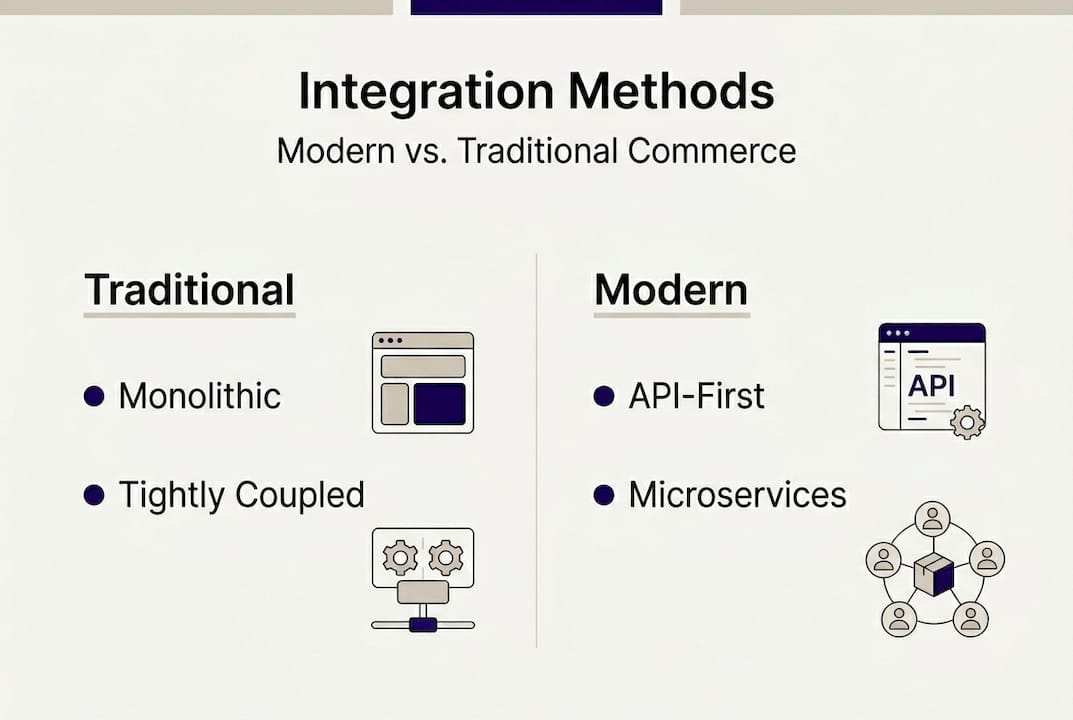
Microservices architecturetakes decoupling further by breaking commerce functions into independently deployable services. The result is targeted fault isolation: if your promotions engine goes down, your checkout keeps running. Integration methodologies emphasising API-first, microservices, idempotency, webhooks for real-time sync, and resilient layers are now considered baseline for enterprise-grade operations.
Framework | Traditional approach | Modern approach |
|---|---|---|
Architecture | Monolithic, tightly coupled | Microservices, loosely coupled |
Communication | Batch file transfers | Real-time APIs and webhooks |
Failure handling | Manual intervention | Automated retries and fallbacks |
Scalability | Vertical scaling only | Horizontal, elastic scaling |
Deployment | Full system releases | Independent service deployments |
Idempotency is a concept that deserves special attention. An idempotent operation produces the same result no matter how many times it is executed. In commerce, this means a payment webhook can be retried safely without charging a customer twice. Without idempotency built into your integration layer, duplicate orders and double charges become a real operational risk.
Webhooks deliver real-time event notifications between systems, replacing the need for constant polling. They are efficient, but they require robust retry logic and dead-letter queues to handle failures gracefully. Explore POS integration strategies to see how these principles apply across physical and digital channels.
Pro Tip: Layer your resilience mechanisms. Use idempotency keys at the transaction level, exponential backoff for webhook retries, and consistency checks to catch inventory drift before it compounds into a customer-facing problem.
Navigating edge cases and integration risks
Having covered integration basics, it is vital to prepare for real-world complexities and how they impact enterprise operations. Edge cases are not rare exceptions in enterprise commerce. They are predictable, frequent, and expensive when left unaddressed.
The most common and costly integration pitfalls include:
Inventory drift: Stock counts diverge between systems during high-volume periods, leading to overselling or unnecessary stockouts.
Currency and refund mismatches: Multi-currency transactions processed in one system but refunded through another create reconciliation nightmares.
Webhook delivery failures: Network timeouts, provider outages, or misconfigured endpoints cause events to be missed entirely.
Multi-vendor cart conflicts: When a single cart spans multiple vendors, tax calculations, shipping logic, and fulfilment routing can produce inconsistent results.
AI agent interruptions: Agentic workflows that stall mid-transaction without a defined recovery path leave orders in ambiguous states.
Edge case testingfor complex integrations is not optional at enterprise scale. It is the difference between a platform that learns from stress and one that fails silently.
"Automation reduces manual cost by 40% across edge case management, yet most enterprises still rely on reactive human intervention rather than proactive automated resolution."
Inventory drift persists even in mature ecosystems because synchronisation is rarely truly real-time. Latency between warehouse management systems, ERPs, and storefronts creates windows where data is stale. The fix is real-time retail data sync combined with reconciliation jobs that run at defined intervals and flag discrepancies automatically.

Agentic AI introduces a new category of risk. When an AI agent is executing a multi-step purchase workflow and encounters an unexpected state, such as a product going out of stock mid-session, it needs a defined fallback path. Agentic AI failures require fallback strategies including retries, graceful degradation, and escalation to human oversight. Without these, AI-driven transactions can stall or complete incorrectly, eroding customer trust rapidly.
The practical takeaway: map every critical transaction flow, identify the failure modes at each step, and build automated resolution paths before you go live. Reactive fixes after a production incident cost far more than proactive design.
Multi-vendor commerce: strategies for scaling and resilience
Tackling the toughest risks leads naturally to the complex world of multi-vendor commerce, where integration choices determine scalability and reliability. Multi-vendor marketplaces amplify every integration challenge because you are managing data, logic, and relationships across multiple independent parties simultaneously.
One of the most consequential decisions is how you structure your product catalogue. Shared catalogues make comparison easier but harder to manage, while vendor-specific catalogues simplify individual vendor management at the cost of cross-vendor consistency.
Catalogue model | Strengths | Weaknesses |
|---|---|---|
Shared catalogue | Easier product comparison, unified search | Complex data governance, vendor conflicts |
Vendor-specific catalogue | Simpler vendor onboarding, flexible attributes | Harder to compare, fragmented buyer experience |
A phased approach to multi-vendor integration reduces risk significantly:
Pilot with a single vendor: Validate your data model, routing logic, and settlement workflows before scaling.
Standardise your API contracts: Define clear schemas for product data, inventory updates, and order events that all vendors must conform to.
Implement centralised settlement: Route all payments through a single settlement layer to simplify reconciliation and reduce financial risk.
Expand incrementally: Onboard additional vendors in cohorts, applying lessons from each phase to the next.
Automate compliance checks: As vendor count grows, manual governance becomes impossible. Automate attribute validation, pricing rule enforcement, and policy compliance.
Centralised inventory models offer a single source of truth but require vendors to push updates in near real-time. Distributed models give vendors more autonomy but increase the risk of inconsistency. Explore multi-vendor catalogue management to understand how leading platforms balance these trade-offs.
Pro Tip: For marketplaces with more than 20 vendors, a hybrid model often works best. Use a shared catalogue for high-volume, standardised products and vendor-specific catalogues for specialised or configurable items. This preserves buyer experience quality without overwhelming your data governance team.
Webhook reliability becomes critical at scale. With dozens of vendors each emitting events, a single misconfigured endpoint can create a cascade of missed updates. Implement event queues with guaranteed delivery and monitor webhook health dashboards continuously.
Optimising with agentic AI: readiness and practical steps
Enterprise-grade marketplaces increasingly lean on AI, but what is real versus hype, and how should you deploy AI now for competitive advantage? The honest answer is that most enterprises are not as ready as they believe.
71% of merchants report limited AI effect, yet 55% of services buyers plan to adopt agentic AI in the near term. The gap between intention and impact is where most organisations lose ground. Dual human-AI optimisation is the bridge strategy that high-performing teams use to close this gap.
Practical steps for evaluating, piloting, and scaling agentic AI in your integration:
Audit your data quality first: AI agents are only as reliable as the data they act on. Inconsistent product data, stale inventory, and fragmented customer records will amplify errors, not reduce them.
Start with constrained workflows: Pilot agentic AI on low-risk, high-volume tasks such as automated reordering or personalised search ranking before applying it to checkout or payment flows.
Define clear success metrics: Establish baseline performance for the workflows you are automating, then measure AI impact against those baselines rigorously.
Build fallback mechanisms from day one: Every AI-driven workflow needs a defined human escalation path for edge cases the model has not encountered before.
Invest in observability: You cannot improve what you cannot see. Implement logging and alerting for every AI decision point in your transaction flows.
Explore AI-driven commerce workflows and how automation delivers seamless user experience to understand where AI adds genuine, measurable value. Partnerships like the Ultra Commerce and Intellify collaboration demonstrate what purposeful AI integration looks like in practice.
Pro Tip: Run human and AI processes in parallel during your pilot phase. Compare outcomes, identify where the AI underperforms, and use those gaps to refine your training data and decision logic before full deployment.
A new integration mindset: what top enterprises do differently
With foundational strategies covered, here is what genuinely sets transformative enterprises apart. Most integration guides focus on the best-case scenario: clean data, cooperative vendors, and smooth launches. The enterprises that consistently outperform their peers design for the opposite.
They build for graceful failure, not perfect execution. They assume webhooks will fail, AI agents will encounter unexpected states, and vendor data will be inconsistent. Rather than treating these as exceptional events, they treat them as routine operating conditions and build accordingly.
The most resilient teams establish incident playbooks before they need them. When an integration fails at 2am on a peak trading day, the response should be a practised procedure, not an improvised scramble. They also create feedback loops between engineering, operations, and commercial teams so that integration failures inform future architecture decisions, not just immediate fixes.
The contrarian view worth considering: rapid rollout is overrated. The future of AI in ecommerce belongs to organisations that prioritise recoverability and adaptability over speed. A platform that launches in six months but fails under real-world pressure is far less valuable than one that takes nine months and holds together when it matters most.
Unlock advanced integration with Ultra Commerce
For enterprises aiming to operationalise the integration strategies above, Ultra Commerce offers proven foundations built for exactly these challenges.

Ultra Commerce's composable architecture addresses the real gaps this guide has outlined, from idempotent transaction handling and resilient webhook management to native multi-vendor catalogue governance and agentic AI execution layers. You do not need to replatform to benefit. The platform integrates with your existing tech stack, adding the modular capabilities you need without disrupting what already works. Whether you are scaling a multi-vendor marketplace or building a more resilient enterprise ecommerce platform, Ultra Commerce gives your team the tools to move with confidence.
Frequently asked questions
What is the API-first approach in commerce integration?
API-first means designing each component to communicate via APIs, promoting flexibility and scalability across commerce systems. This approach ensures that integration methodologies remain adaptable as your tech stack evolves.
How do enterprises manage inventory drift in multi-vendor marketplaces?
They use resilient syncing layers, frequent consistency checks, and automation to detect and resolve discrepancies faster. Combining automated inventory reconciliation with edge case testing significantly reduces the window in which drift causes customer-facing errors.
What are best practices for handling AI failures in commerce integrations?
Set up fallback strategies, including retries and escalation to human oversight, ensuring uninterrupted transaction flows. Agentic AI fallback strategies should be defined before deployment, not after the first production incident.
Are shared or vendor-specific catalogues better for multi-vendor marketplaces?
Shared catalogues make comparison easier, but vendor-specific catalogues offer simpler management. The right choice depends on your business goals, and shared vs vendor-specific catalogues each carry distinct trade-offs that should be evaluated against your vendor mix and buyer experience priorities.