

March 26, 2026
Enterprise
Composable
Multi-Vendor
Master commerce infrastructure basics for multi-vendor success
Enterprise multi-vendor commerce platforms face infrastructure challenges that extend far beyond traditional e-commerce models. Many organisations underestimate the architectural complexity required to support vendor onboarding, split payment processing, and distributed inventory management at scale. The shift towards composable commerce architectures demands foundational understanding of modular systems, API-first integrations, and performance optimisation strategies. This guide equips enterprise decision-makers with essential knowledge to build scalable, AI-enabled commerce infrastructure that handles multi-vendor operations without compromising speed or reliability.
Table of Contents
Key takeaways
Understanding composable commerce and its role in scalable infrastructure
Building and optimising multi-vendor commerce platforms
Performance considerations and hybrid approaches for enterprise commerce
Practical steps to enhance commerce infrastructure with advanced capabilities
Explore Ultra Commerce for enterprise multi-vendor success
FAQ
Key Takeaways
Point | Details |
|---|---|
Composable architecture benefits | Composable architectures offer agility and scalability by using modular components and API first integrations, reducing vendor lock in. |
Multivendor platform features | Multivendor platforms require specialised features such as vendor onboarding, per vendor inventory, and split payments via Stripe Connect. |
Performance optimisation emphasis | Third party service impact necessitates performance optimisation strategies to preserve speed and reliability. |
Hybrid system advantages | Hybrid monolithic composable setups balance benefits and smooth the transition from legacy systems. |
Edge cases and compliance | Robust multivendor setups must handle complex edge cases and compliance requirements. |
Understanding composable commerce and its role in scalable infrastructure
Composable commerce uses MACH architecture for modular best-of-breed components, offering agility, scalability, reduced vendor lock-in, and faster time-to-market compared to monolithic systems. MACH stands for Microservices-based, API-first, Cloud-native, and Headless, representing the foundational principles that enable enterprises to assemble commerce capabilities from independent services rather than relying on single-vendor platforms.
Monolithic systems bundle all commerce functions into tightly coupled codebases, creating dependencies that slow innovation and limit flexibility. When you need to update checkout functionality in a monolithic platform, you risk affecting inventory management, payment processing, and customer data systems simultaneously. Composable architectures eliminate these dependencies by separating concerns into discrete services that communicate through APIs.
The modularity inherent in composable systems supports scalability in ways monolithic platforms cannot match. You can scale payment processing independently during peak transaction periods without provisioning additional resources for your entire commerce stack. This granular control reduces infrastructure costs whilst maintaining performance under variable load conditions.
Pro Tip: Start your composable journey by identifying the highest-value business capability that suffers most under your current monolithic constraints, whether that’s personalisation, search, or checkout flow optimisation.
Reducing vendor lock-in represents another critical advantage. Traditional platforms force you into multi-year contracts with limited flexibility to adopt emerging technologies. Composable commerce lets you swap individual components when better solutions emerge, protecting your technology investment whilst maintaining competitive advantage.
“The biggest misconception about composable commerce is that it increases complexity. Whilst initial setup requires more architectural planning, the long-term flexibility and reduced technical debt far outweigh upfront investment.”
Many organisations mistakenly believe composable systems demand larger development teams or create integration nightmares. Modern API standards and pre-built connectors have simplified integration complexity significantly. The truth about composable commerce reveals that enterprises often achieve faster time-to-market after initial setup compared to customising rigid monolithic platforms.
Building and optimising multi-vendor commerce platforms
Multi-vendor platforms require distinct architecture for vendor onboarding, per-vendor inventory, split payments via Stripe Connect, commission logic, and mixed carts; costs for MVP range from $25,000 to $50,000, whilst full platforms require $100,000 to $250,000. These infrastructure requirements extend beyond standard e-commerce capabilities to support complex vendor relationships and transaction flows.
Core multi-vendor infrastructure elements include:
Vendor management systems with onboarding workflows, verification processes, and performance dashboards
Distributed inventory architecture supporting real-time stock synchronisation across multiple vendor warehouses
Payment orchestration layers handling split disbursements, commission calculations, and escrow management
Order routing engines directing purchases to appropriate vendors based on availability and fulfilment capabilities
Dispute resolution frameworks managing customer complaints, vendor accountability, and refund processing
Vendor onboarding workflows must collect business documentation, verify tax credentials, establish payment accounts, and configure commission structures before sellers can list products. Split payment flows become particularly complex when customers purchase items from multiple vendors in a single transaction. Your platform must calculate individual vendor payments, deduct marketplace commissions, handle payment gateway fees, and manage failed payment scenarios where some vendors receive funds whilst others do not.

Pro Tip: Implement idempotency keys and transaction state machines to ensure payment splits remain atomic operations, preventing scenarios where customers are charged but vendors never receive disbursements.
Designing robust e-commerce systems requires addressing edge cases including overselling from asynchronous inventory, mixed cart splits, payment failures mid-split, vendor disputes, and compliance per-region; solutions include real-time synchronisation, state machines, and role-based access control. Overselling occurs when inventory updates lag behind purchase transactions, allowing multiple customers to buy the same item simultaneously from different vendors.
Real-time inventory synchronisation mitigates this risk but introduces performance trade-offs. You must balance consistency requirements against system responsiveness, often implementing eventual consistency models with pessimistic locking for high-demand items. Mixed cart scenarios where customers combine products from vendors with different shipping policies, return windows, or regional restrictions demand sophisticated order splitting logic.
Platform Scope | Infrastructure Components | Estimated Cost Range | Timeline |
|---|---|---|---|
MVP | Basic vendor onboarding, simple split payments, single-region | $25,000 - $50,000 | 3-4 months |
Mid-tier | Advanced routing, commission automation, multi-region support | $50,000 - $100,000 | 4-6 months |
Enterprise | AI-driven discovery, complex compliance, global operations | $100,000 - $250,000+ | 6-12 months |
Regional compliance strategies must account for varying tax regulations, data privacy requirements, and consumer protection laws across markets. European GDPR mandates differ significantly from Australian Privacy Principles or California Consumer Privacy Act requirements. Your platform architecture needs configurable compliance modules that adapt to jurisdictional requirements without hard-coding regional rules into core systems.
Dispute management becomes exponentially more complex in multi-vendor environments compared to single-seller platforms. When customers file complaints, your system must determine accountability between marketplace operator and individual vendors, manage evidence collection from multiple parties, and enforce resolution outcomes whilst maintaining trust across all stakeholders. Transforming online retail through effective multi-vendor platforms requires addressing these operational complexities from day one.
Performance considerations and hybrid approaches for enterprise commerce
Shopify 2026 benchmark data shows median mobile Lighthouse score around 47, with strong negative correlation (r=-0.658) between third-party services and performance. Each additional third-party integration reduces page speed scores measurably, creating compounding effects as enterprises add analytics tools, personalisation engines, and marketing pixels to their commerce infrastructure.
Third-party service impact manifests most severely on mobile devices where network latency and processing constraints amplify JavaScript execution overhead. A desktop site might maintain acceptable performance with 15 third-party scripts, whilst the same mobile experience becomes unusable. Enterprise commerce platforms typically integrate payment gateways, fraud detection services, customer data platforms, recommendation engines, and marketing automation tools, each adding render-blocking resources.
Pro Tip: Implement server-side tag management to consolidate third-party script loading, reducing client-side execution overhead whilst maintaining marketing and analytics capabilities.
Hybrid monolithic-composable architectures balance speed and stability with flexibility for gradual migration. Rather than attempting wholesale platform replacement, enterprises can maintain core monolithic systems for stable functions like order processing whilst adopting composable frontends for customer-facing experiences requiring frequent updates.
This approach reduces migration risk by limiting blast radius when new composable components fail or underperform. You preserve institutional knowledge embedded in existing systems whilst gaining composable benefits for high-value capabilities. Hybrid models particularly suit organisations with complex customisations in legacy platforms that would require significant investment to replicate in purely composable architectures.
Best practices for speed optimisation include:
Implementing edge caching for static assets and API responses to reduce origin server load
Adopting progressive web app patterns for offline functionality and instant page transitions
Lazy loading non-critical resources below the fold to prioritise initial viewport rendering
Optimising image delivery through modern formats like WebP and responsive sizing
Minimising JavaScript bundle sizes through code splitting and tree shaking
Architecture Type | Performance Score | Flexibility | Implementation Cost | Best For |
|---|---|---|---|---|
Monolithic | 65-75 | Low | Low | Stable, predictable workloads |
Pure Composable | 45-60 | Very High | High | Rapid innovation requirements |
Hybrid | 55-70 | High | Medium | Gradual modernisation initiatives |
Performance monitoring must extend beyond synthetic testing to capture real user experiences across diverse network conditions and device capabilities. Performance benchmark reports reveal significant variance between lab scores and field data, particularly for commerce platforms serving global audiences with varying connectivity quality.
Continuous optimisation requires establishing performance budgets that constrain resource consumption as new features ship. Without explicit budgets, performance degrades incrementally as teams add capabilities without considering cumulative impact. E-commerce performance optimisation demands treating speed as a feature requirement rather than post-launch consideration.
Practical steps to enhance commerce infrastructure with advanced capabilities
Implementing AI and machine learning capabilities starts with identifying high-impact use cases where algorithmic decision-making delivers measurable business value. Product recommendation engines, dynamic pricing optimisation, fraud detection, and demand forecasting represent proven applications that justify initial AI investment. Begin with supervised learning models trained on historical transaction data before progressing to more complex reinforcement learning approaches.
Governance frameworks become critical as you introduce AI-driven automation into commerce operations. Establish clear accountability for algorithmic decisions, implement audit trails for model predictions, and create override mechanisms when automated systems produce unacceptable outcomes. Role-based access control ensures appropriate personnel can review AI recommendations whilst preventing unauthorised modifications to model parameters or training data.
Key systems integration for infrastructure completeness:
Order Management Systems (OMS) centralising order orchestration across channels, vendors, and fulfilment locations
Product Information Management (PIM) maintaining single source of truth for product data, attributes, and digital assets
Customer Data Platforms (CDP) unifying customer interactions across touchpoints for personalisation and analytics
Warehouse Management Systems (WMS) coordinating inventory movements, picking operations, and shipping logistics
Enterprise Resource Planning (ERP) synchronising financial data, procurement, and supply chain planning
Prioritising scalability in your technology roadmap means evaluating every architectural decision against future growth scenarios. Can your payment infrastructure handle 10x transaction volume during flash sales? Will your search functionality maintain sub-second response times as your catalogue grows from 10,000 to 1,000,000 SKUs? Scalability planning requires load testing realistic scenarios rather than assuming linear performance characteristics.
Compliance roadmaps must anticipate regulatory changes across markets where you operate or plan expansion. Payment Card Industry Data Security Standard (PCI DSS) requirements, accessibility standards like WCAG 2.1, and emerging AI governance frameworks demand proactive implementation rather than reactive scrambling when audits reveal gaps.
Monitoring and continuous optimisation techniques include:
Real-time alerting for transaction failures, inventory discrepancies, and performance degradation
Automated testing pipelines validating functionality across browsers, devices, and user journeys
A/B testing frameworks measuring impact of infrastructure changes on conversion and revenue
Distributed tracing identifying bottlenecks across microservices and third-party integrations
Business intelligence dashboards surfacing operational metrics for stakeholder visibility
The ultimate guide to composable commerce provides deeper exploration of implementation strategies that align technology choices with business objectives. Success requires balancing architectural ideals against pragmatic constraints of budget, timeline, and organisational change management capacity. Composable commerce case studies demonstrate how enterprises navigate these trade-offs whilst achieving measurable improvements in agility and customer experience.
Explore Ultra Commerce for enterprise multi-vendor success
Mastering commerce infrastructure basics positions your organisation to capitalise on multi-vendor opportunities, but implementation requires platform capabilities purpose-built for enterprise complexity. Ultra Commerce delivers the modular architecture, AI-driven automation, and multi-vendor management tools discussed throughout this guide, enabling you to execute sophisticated commerce strategies without replatforming existing systems.

Our enterprise e-commerce platform addresses the performance challenges, scalability requirements, and integration complexities that constrain traditional solutions. Native multi-vendor marketplace capabilities handle split payments, vendor onboarding, and distributed inventory management through proven frameworks that eliminate custom development overhead. Explore the Ultra Commerce platform to discover how our composable approach accelerates your digital commerce transformation whilst maintaining enterprise-grade governance and security.
FAQ
What are the key components of commerce infrastructure?
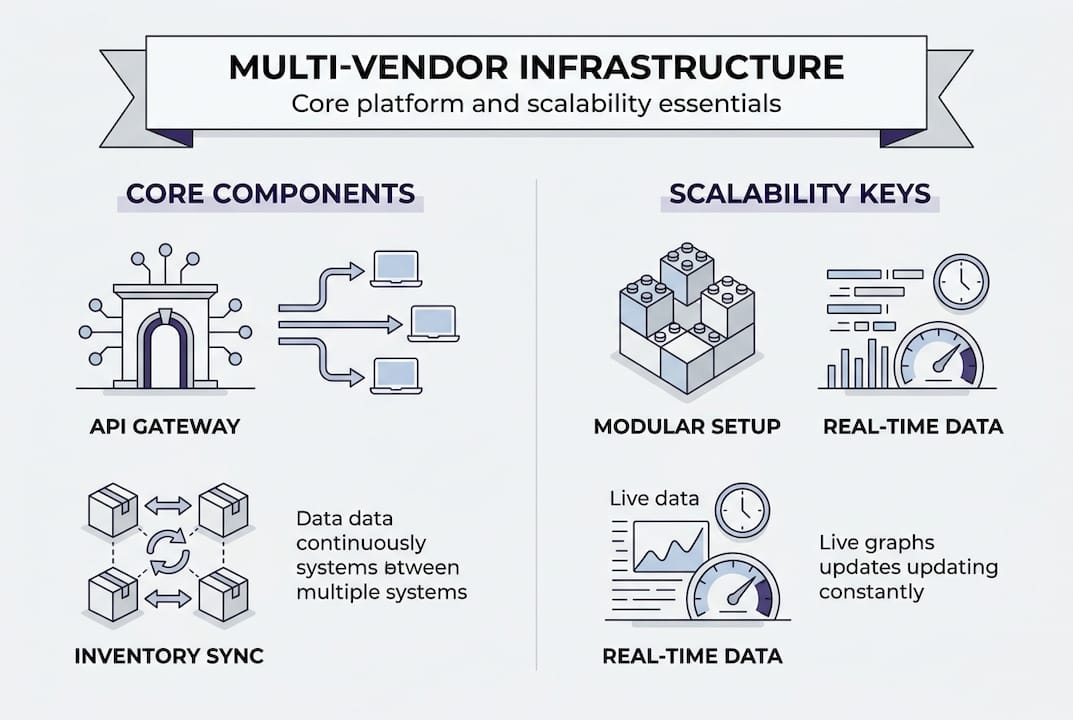
Core components include modular architecture layers separating presentation from business logic, API gateways managing service communication, distributed inventory systems tracking stock across locations, payment orchestration handling transactions and settlements, and vendor management modules coordinating multi-seller operations. These elements must integrate seamlessly whilst maintaining independent scalability and update cycles.
How does composable commerce improve scalability?
Composable architectures separate functions into modular services allowing independent scaling and updates without full system downtime. You can provision additional resources for payment processing during peak periods without scaling your entire commerce stack, reducing infrastructure costs whilst maintaining performance. This granular control enables cost-efficient scaling aligned to actual demand patterns rather than over-provisioning for worst-case scenarios.
What challenges do multi-vendor platforms face?
Challenges include split payment processing across multiple vendors, asynchronous inventory synchronisation causing overselling, compliance requirements varying across regions, and vendor dispute management requiring complex arbitration workflows. Robust architectures deploy real-time data synchronisation, state machines ensuring atomic transactions, and role-based access control preventing unauthorised modifications. Edge cases like payment failures mid-split demand idempotent operations and comprehensive error handling.
Why consider a hybrid monolithic-composable approach?
Hybrid solutions allow leveraging existing monolithic stability for proven functions like order processing whilst adopting composable frontend flexibility for customer experiences requiring frequent updates. This approach facilitates gradual migration, reducing risk by limiting blast radius when new components fail. Enterprises preserve institutional knowledge embedded in legacy systems whilst gaining composable benefits for high-value capabilities, balancing innovation speed against operational stability requirements.