

April 1, 2026
Enterprise
Multi-Vendor
Integrations
Seamless commerce integration for enterprise success
Most enterprise IT leaders assume that connecting APIs is the hard part of commerce integration. It is not. The real challenge is what happens after the connections are made: fragmented data flows, inconsistent ownership, and workflows that buckle under scale. For large enterprises running multi-vendor operations or building AI-driven automation, poorly designed integration is not just an inconvenience — it is a direct threat to revenue and customer experience. This guide cuts through the noise and gives you practical frameworks for building integration that holds up under real-world pressure, including multi-vendor complexity and the demands of intelligent automation.
Table of Contents
What is commerce integration and why does it matter?
Key components for effective commerce integration
Integrating for multi-vendor and automation at scale
Common obstacles and proven solutions
A fresh perspective: why conventional integration wisdom falls short
Next steps: streamline your integration journey
Frequently asked questions
Key Takeaways
Point | Details |
|---|---|
Define sources of truth | Establish distributed ownership and clear data contracts to prevent fragmentation across systems. |
Rigorous testing is vital | Stress and idempotency tests are essential for scalable and reliable commerce integration. |
Adapt for multi-vendor | Multi-vendor operations require advanced integration frameworks, automation flows, and robust governance. |
Think beyond APIs | True enterprise integration needs data strategy, commitment management, and continuous audits—not just API connections. |
What is commerce integration and why does it matter?
Commerce integration is the process of connecting your sales channels, inventory systems, order management platforms, customer data, and vendor networks so they operate as a unified whole. It sounds straightforward. In practice, for large enterprises, it is anything but.
Simple point-to-point connectivity between two systems is manageable. But when you are orchestrating dozens of vendor feeds, multiple fulfilment centres, B2B and B2C sales channels, and real-time customer data, the complexity multiplies fast. A single broken connection or a data mismatch can cascade into order errors, inventory discrepancies, and poor customer outcomes.
For enterprises running omni-channel shopping experiences, integration is the backbone that makes consistency possible. Commerce integration is central for unlocking true omni-channel experiences, and without it, each channel becomes a silo that works against your broader strategy.
Here is what robust commerce integration actually connects:
Sales channels: Online storefronts, marketplaces, physical retail, and mobile apps
Inventory and warehousing: Real-time stock visibility across all locations and vendors
Order management: Automated routing, fulfilment, and returns via order management solutions
Customer data: Unified profiles that follow the customer across every touchpoint
Vendor and supplier systems: Catalogue feeds, pricing, availability, and settlement
Finance and ERP: Billing, reconciliation, and reporting
The business case is compelling. Enterprises with well-integrated commerce operations report fewer manual errors, faster order cycles, and the ability to scale without proportionally increasing operational overhead. Effective channel management tools become far more powerful when the underlying integration is solid. The result is real-time insight, faster decision-making, and a scalable foundation for growth.
Key components for effective commerce integration
With the importance of integration established, let us break down the essential components that prevent fragmentation and support scale.
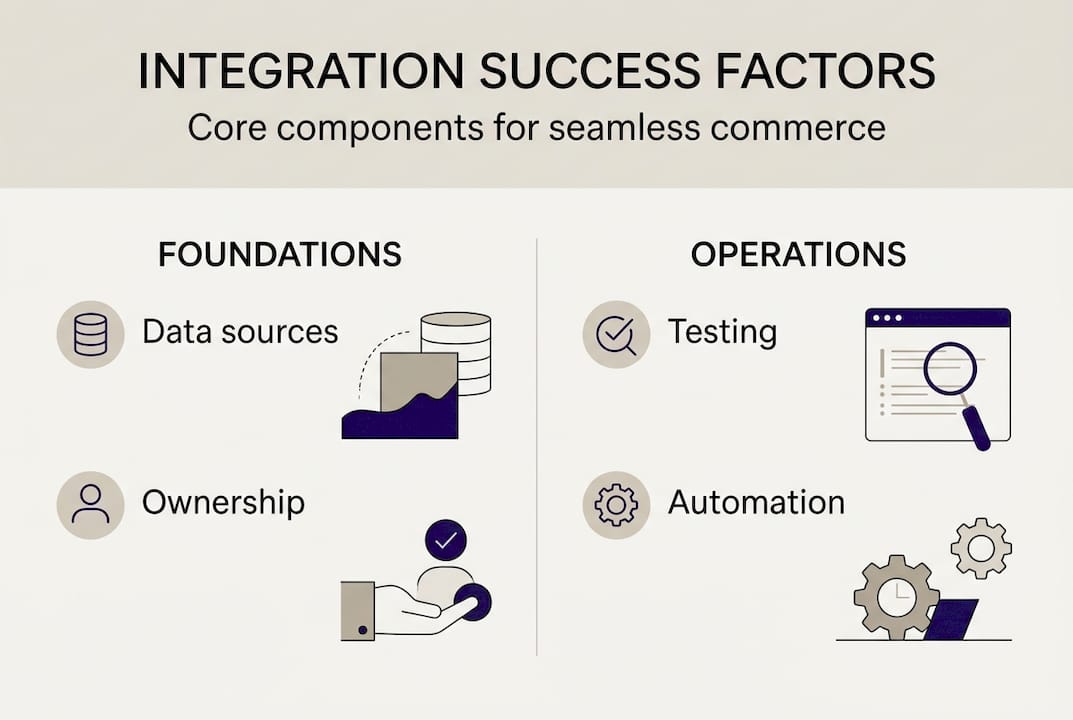
The first and most overlooked component is establishing a single source of truth for distributed data. Enterprises typically have product data living in a PIM, inventory data in a warehouse management system, and order data in an OMS. When these systems do not agree on the same record, errors follow. Defining distributed sources of truth and data contracts is essential for avoiding fragmentation at scale.

Data contracts formalise the agreement between systems: what data will be shared, in what format, at what frequency, and who owns each record. Without these contracts, integration becomes a guessing game that breaks whenever one system updates its schema.
The following table outlines the core components and their function:
Component | Purpose | Risk if neglected |
|---|---|---|
Single source of truth | Eliminates conflicting data records | Inventory errors, order failures |
Data contracts | Formalises inter-system agreements | Schema drift, broken integrations |
API gateway | Centralises and secures API traffic | Security gaps, poor performance |
Stress and idempotency testing | Validates behaviour under load | System failures at peak traffic |
Failover and redundancy | Ensures continuity during outages | Revenue loss, customer impact |
Cross-system audit schedule | Detects integration drift early | Silent failures, compounding errors |
Testing is another area where enterprises consistently underinvest. Stress testing validates that your integration holds up under peak load. Idempotency testing ensures that duplicate requests, which are common in distributed systems, do not cause duplicate orders or payments. Failover testing confirms that your systems recover gracefully when a component goes down.
Addressing multi-system integration challenges requires a disciplined approach to protocol selection and network orchestration. REST, GraphQL, and event-driven architectures each have their place, and choosing the wrong protocol for a given use case creates unnecessary friction.
Pro Tip: Schedule quarterly cross-system audits to identify integration drift before it becomes a production incident. Systems evolve, and what was aligned six months ago may no longer be.
Integrating for multi-vendor and automation at scale
Now, let us move from foundation to advanced integration: addressing multi-vendor operations and automation.
Multi-vendor integration is a fundamentally different challenge from single-vendor setups. The table below illustrates the key differences:
Dimension | Single-vendor | Multi-vendor |
|---|---|---|
Data governance | Centralised, simpler | Distributed, requires strict contracts |
Automation complexity | Moderate | High, with vendor-specific logic |
Testing requirements | Standard | Idempotency, stress, and failover per vendor |
Ownership clarity | Clear | Must be explicitly assigned |
Catalogue management | Uniform | Varied formats, normalisation required |
For enterprises pursuing multi-vendor transformation, automation is not optional. It is the only way to manage the volume. Here is a practical framework for setting up AI-driven automation across multi-vendor data:
Normalise vendor data feeds into a consistent internal schema before any automation touches them.
Define ownership rules for each data entity: who creates it, who can update it, and which system is the master record.
Build event-driven triggers for key workflows such as order routing, inventory sync, and fraud checks.
Implement idempotency keys across all automated transactions to prevent duplicate processing.
Test under simulated peak load before going live, using realistic multi-vendor data volumes.
Monitor and alert on integration health metrics in real time, not just on failures.
Testing for idempotency and stress is crucial to prevent failures when scaling multi-vendor operations. Enterprises that skip this step often discover the gaps during a high-traffic sales event, which is the worst possible time.
Common pitfalls include inconsistent data formats across vendor feeds, unclear ownership when a record exists in multiple systems, and inadequate testing before automation goes live. Exploring multi-vendor marketplace solutions that natively support these governance requirements can significantly reduce the integration burden. A well-designed omnichannel strategy depends on getting these foundations right.
Common obstacles and proven solutions
To implement these strategies effectively, enterprises must navigate a range of integration obstacles. Let us explore solutions.
The most common obstacles in enterprise commerce integration are fragmented data sources, legacy systems with rigid or undocumented APIs, and bespoke integrations built for a previous state of the business. Each of these creates technical debt that compounds over time.
“Rigorous testing and clear data governance prevent scale failures.” This principle holds true across every enterprise integration we have seen succeed or struggle. The difference between a resilient integration and a fragile one almost always comes down to governance and testing discipline.
Here is a practical solution checklist for the most frequent obstacles:
Fragmented data: Implement a canonical data model and enforce it at every integration point
Legacy systems: Use an API gateway or middleware layer to abstract legacy interfaces without replacing them
Bespoke integrations: Document every custom integration and assign a clear owner responsible for its maintenance
Inconsistent testing: Establish a mandatory testing protocol that includes stress, idempotency, and failover scenarios
Vendor changes: Build integration layers that absorb vendor API changes without requiring downstream rewrites
Scaling gaps: Use event-driven architecture to decouple systems and allow independent scaling
Future-proofing your integration means designing for change, not just for today’s vendor list or automation requirements. Multi-channel sales strategies evolve, and your integration architecture needs to evolve with them. When evaluating marketplace options, consider how well each platform supports extensible integration rather than locking you into proprietary connectors.
For enterprises exploring new commerce models, the digital transformation of shopping centres offers a useful case study in how legacy physical and digital systems can be integrated at scale.
A fresh perspective: why conventional integration wisdom falls short
Here is something most integration guides will not tell you: the majority of enterprise integration failures are not technical failures. They are governance failures.
Connecting APIs is a solved problem. What is not solved is the question of who owns the data, who is responsible when two systems disagree, and what happens when a vendor changes their feed format without notice. Conventional wisdom focuses on the technology. Real integration maturity focuses on the operating model around the technology.
We have seen enterprises invest heavily in sophisticated middleware platforms, only to watch integrations degrade within twelve months because no one owned the ongoing health of those connections. The technology was fine. The accountability structure was not.
The lesson is this: build your integration for change, not for the current state. Vendor catalogues will change. Automation requirements will expand. New channels will emerge. If your integration architecture assumes stability, it will fail when reality arrives.
Treat commerce orchestration as a living strategy, not a fixed project. Assign integration ownership at the team level, review it regularly, and invest in testing infrastructure as seriously as you invest in the integrations themselves. That shift in mindset is what separates enterprises that scale smoothly from those that rebuild every two years.
Pro Tip: Treat your integration layer as a product with an owner, a roadmap, and a maintenance budget. Integrations that are nobody’s responsibility become everybody’s problem.
Next steps: streamline your integration journey
Robust commerce integration is achievable, and the right platform makes a significant difference in how quickly and confidently you can get there.

Ultra Commerce is built for exactly the complexity you are managing. Our enterprise ecommerce solutions support multi-vendor operations, AI-driven automation, and distributed data governance without requiring you to replatform your entire stack. The composable commerce platform gives your team the flexibility to integrate modularly, adding capabilities like product information management where they deliver the most value. If you are ready to move from fragile connections to a resilient, scalable integration architecture, we are ready to help you get there.
Frequently asked questions
How does commerce integration support AI-driven automation in large enterprises?
By centralising and synchronising data across sources, commerce integration enables automated decision-making and robust workflow management for AI applications. Data contracts and distributed governance are foundational for automated workflows to function reliably at scale.
What are essential tests when scaling commerce integration for multi-vendor operations?
Stress testing and idempotency checks are critical to prevent failures and ensure systems perform reliably under load. Rigorous testing helps prevent scale failures that typically surface during high-traffic events.
How can fragmented data sources affect commerce integration?
Fragmented data leads to errors, poor customer experience, and integration failures, so enterprises must define clear sources of truth and ownership. Defining distributed sources of truth is critical for avoiding fragmentation across complex vendor and channel networks.
What is the main difference between single and multi-vendor commerce integration?
Multi-vendor integration requires stricter data governance, more complex automation flows, and additional testing frameworks compared to single-vendor setups. Multi-vendor complexity demands explicit ownership assignment and vendor-specific idempotency controls that single-vendor environments rarely need.