

March 16, 2026
Enterprise
Ecommerce Strategy
Multi-Vendor
Ultra Commerce
Composable
Many enterprises underestimate the complexity of scaling ecommerce globally and managing multi-vendor operations. The reality involves intricate architectural decisions, security considerations, vendor management challenges, and operational excellence requirements that go far beyond simply adding new sales channels. This guide reveals the essential elements of an advanced global ecommerce strategy, covering unified commerce architecture, managed cloud services, multi-vendor platform complexities, and AI-driven optimisation to help enterprise leaders navigate these challenges successfully.
Table of Contents
Understanding Unified Commerce And The MACH Architecture
Leveraging Managed Cloud Services For Operational Excellence And Security
Navigating Complexities Of Multi-Vendor Ecommerce Platforms
Implementing AI-Driven Solutions For Enhanced Global Ecommerce Performance
Explore Ultra Commerce For Complex Global Ecommerce Needs
Frequently Asked Questions About Global Ecommerce Strategy
Key takeaways
Point | Details |
|---|---|
Unified commerce integration | Connects multiple channels through MACH architecture for seamless customer experiences across all touchpoints |
Managed cloud foundation | Provides operational excellence, security, and scalability through automated monitoring, encryption, and fault tolerance |
Multi-vendor complexity | Requires robust vendor onboarding, split payment systems, inventory management, and commission tracking capabilities |
AI-driven optimisation | Enhances personalisation, demand forecasting, and inventory management for improved performance at scale |
Understanding unified commerce and the MACH architecture
Unified commerce represents a fundamental shift from traditional multi-channel silos where customer data, inventory, and order systems operate independently. Instead, unified commerce on AWS integrates multiple systems using MACH principles to provide a consistent retail experience across all customer touchpoints. This architectural approach eliminates the fragmentation that plagues legacy enterprise systems.
MACH principles form the foundation of modern enterprise ecommerce architecture. Microservices enable independent deployment and scaling of individual business capabilities. API-first design ensures seamless integration between systems and third-party services. Cloud-native SaaS provides automatic updates and eliminates infrastructure management overhead. Headless architecture decouples the presentation layer from business logic, allowing you to deliver omni-channel shopping experiences across web, mobile, voice, and emerging channels without rebuilding core systems.
This modular architecture delivers tangible benefits for global enterprises. You gain the flexibility to swap components without disrupting the entire system. Your teams can deploy new features independently, accelerating time to market. The architecture scales horizontally to handle traffic spikes during peak seasons or market expansion. Most importantly, customers experience consistency whether they browse on mobile, purchase in-store, or engage through social commerce.
A typical MACH-based unified commerce architecture includes:
Headless content management for dynamic content delivery
API gateway managing authentication and routing
Microservices handling catalogue, pricing, inventory, and orders
Event-driven architecture for real-time data synchronisation
Cloud-native data stores optimised for specific workloads
Pro Tip: Start your MACH transformation with customer-facing capabilities like product catalogue and checkout. These deliver immediate value while your team builds expertise before tackling complex backend systems.
The composable nature of MACH architecture means you can integrate best-of-breed solutions rather than settling for the limitations of monolithic platforms. This becomes critical as your enterprise expands into new markets with unique requirements for payment methods, tax regulations, and localisation needs.
Leveraging managed cloud services for operational excellence and security
Managed cloud services provide the operational backbone that enables enterprise ecommerce platforms to scale globally whilst maintaining reliability and security. The architecture leverages managed services for operational excellence including EC2 metrics, CloudWatch alarms, auto scaling, and RDS failure recovery. These services eliminate the operational burden of infrastructure management, allowing your teams to focus on customer experience and business logic.

Scalability and fault tolerance become automatic rather than manual engineering challenges. Auto scaling groups monitor application metrics and adjust capacity in real time. Load balancers distribute traffic across multiple availability zones. Database replication ensures data durability even during infrastructure failures. These managed capabilities handle traffic spikes during flash sales or seasonal peaks without manual intervention.
Monitoring and observability tools provide comprehensive visibility into system health and performance. CloudWatch collects metrics from every layer of your architecture. Application Performance Monitoring tools track user experience and identify bottlenecks. Log aggregation services centralise troubleshooting across distributed microservices. Automated alerting notifies teams of anomalies before they impact customers.
Security represents a critical concern for enterprises handling customer data and payment information across multiple jurisdictions. Security is enhanced using encrypted data, IAM roles, Cognito for identity, and tools like GuardDuty and Security Hub for monitoring. These managed security services provide defence in depth:
Data encryption at rest and in transit using managed keys
Identity and access management with least privilege principles
Web application firewalls protecting against common exploits
Threat detection analysing network traffic and API calls
Compliance monitoring against industry standards and regulations
Managed cloud services transform operational excellence from a resource-intensive challenge into an automated capability, enabling enterprises to maintain global ecommerce platforms with smaller, more focused teams.
The operational benefits extend beyond security and scalability. Managed databases handle backups, patching, and version upgrades automatically. Content delivery networks cache static assets globally, reducing latency for international customers. Managed container orchestration simplifies deployment and rollback procedures. These capabilities become essential as enterprises managing AWS marketing and commerce competency requirements scale across regions.
Cost optimisation becomes more predictable with managed services. You pay only for resources consumed rather than maintaining excess capacity for peak loads. Reserved capacity options reduce costs for baseline workloads. Automated rightsising recommendations identify opportunities to optimise resource allocation. This financial flexibility supports the business case for global expansion.
Navigating complexities of multi-vendor ecommerce platforms
Building a multi-vendor ecommerce platform involves vendor management, split payments, inventory per vendor, commissions, and seamless storefronts. These capabilities introduce architectural and operational complexity that single-vendor platforms avoid. Understanding when and how to implement multi-vendor functionality determines success in marketplace strategies.
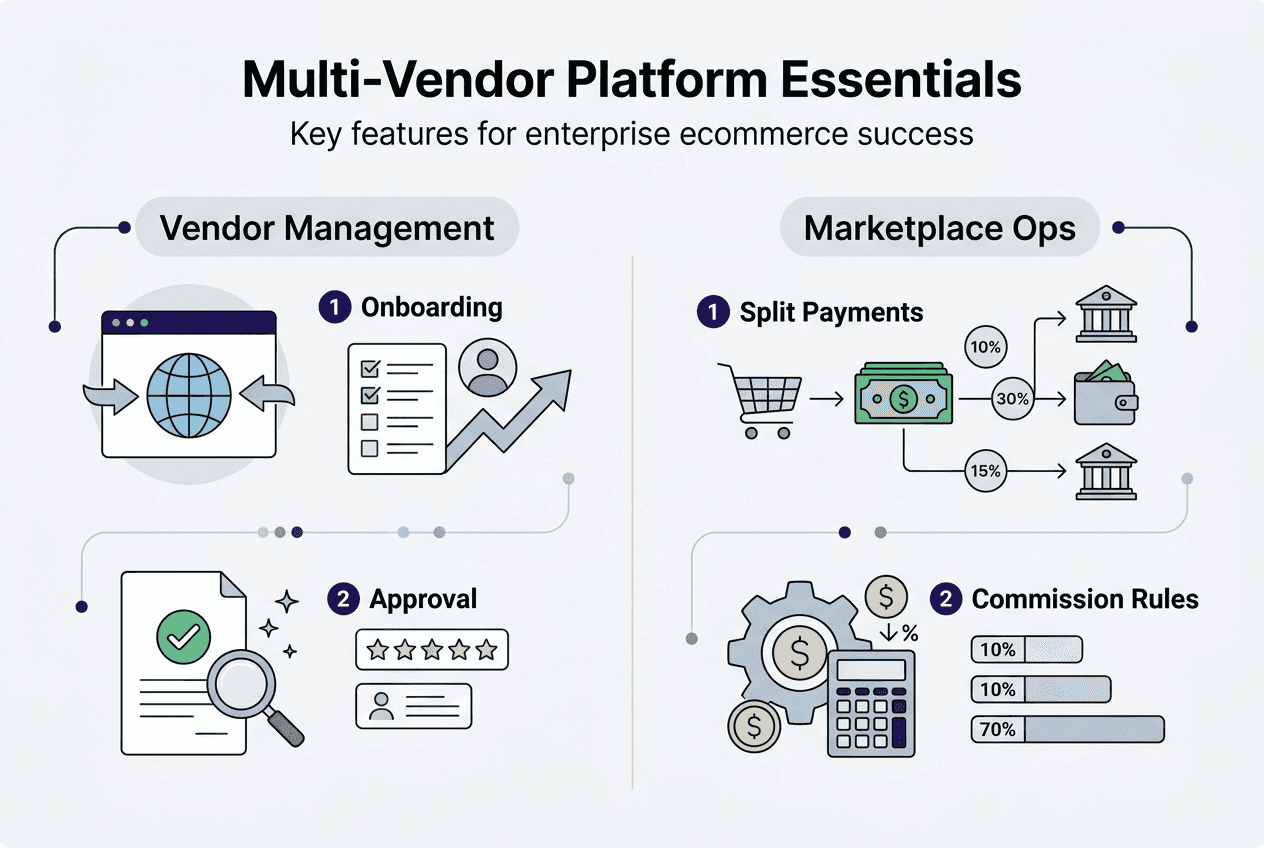
Core multi-vendor features create the foundation for marketplace operations. Vendor onboarding workflows manage registration, verification, and approval processes. Split payment systems route transactions to multiple recipients whilst handling platform fees. Inventory management tracks stock levels per vendor and location. Commission engines calculate and distribute earnings based on configurable rules. Vendor dashboards provide sellers with analytics, order management, and catalogue tools.
Feature | Single-vendor platform | Multi-vendor platform |
|---|---|---|
Operational complexity | Lower, centralised control | Higher, distributed management |
Payment processing | Direct to merchant | Split between vendors and platform |
Inventory management | Unified catalogue | Per-vendor stock tracking |
Vendor relationships | Not applicable | Onboarding, support, compliance |
Revenue model | Direct sales margin | Commission-based earnings |
Scalability requirements | Moderate | High, supports multiple sellers |
Before committing to multi-vendor architecture, assess true need based on seller numbers and commission needs. Follow this evaluation framework:
Quantify the number of independent sellers you plan to support within 24 months
Define commission structures and determine if they justify platform complexity
Evaluate whether vendor relationships add strategic value or operational burden
Analyse if your target market expects marketplace functionality or prefers curated selection
Calculate the technology investment required versus expected marketplace revenue
Common pitfalls plague enterprises rushing into multi-vendor implementations. Inadequate vendor vetting processes allow poor quality sellers that damage brand reputation. Insufficient payment reconciliation tools create disputes and administrative overhead. Lack of vendor performance monitoring enables bad actors to persist. Weak fulfilment coordination results in inconsistent delivery experiences. These challenges require dedicated operational teams and robust technology platforms.
Vendor dashboard capabilities determine seller satisfaction and platform efficiency. Effective dashboards provide real-time sales analytics, inventory alerts, order processing workflows, customer communication tools, and payout tracking. Sellers need mobile access for on-the-go management. Integration with their existing systems reduces friction. The dashboard experience directly impacts vendor retention and catalogue growth.
Pro Tip: Implement tiered vendor programmes with different commission rates and feature access based on performance metrics. This incentivises quality whilst generating competitive dynamics that benefit customers.
Multi-vendor platforms enable powerful business models for enterprises transforming online retail or building multi-vendor marketplaces for shopping centres. The complexity investment pays dividends when you need rapid catalogue expansion, geographic coverage through local sellers, or specialised product expertise that in-house teams cannot provide.
Implementing AI-driven solutions for enhanced global ecommerce performance
Artificial intelligence and machine learning capabilities transform global ecommerce from reactive operations to predictive, personalised experiences. AI integration addresses challenges that manual processes cannot scale to handle across diverse markets, vendor networks, and customer segments.
Personalisation represents the most visible AI application for customers. Machine learning algorithms analyse browsing behaviour, purchase history, and contextual signals to recommend relevant products. Natural language processing powers conversational commerce through chatbots and voice assistants. Computer vision enables visual search where customers upload images to find similar products. These capabilities increase conversion rates whilst improving seamless customer experience priorities for B2B and B2C buyers.
Demand forecasting accuracy improves dramatically with AI models trained on historical data, seasonality patterns, market trends, and external factors. Traditional forecasting relies on simple averages and manual adjustments. AI incorporates hundreds of variables simultaneously, identifying subtle patterns humans miss. This precision reduces stockouts during peak demand and minimises excess inventory carrying costs.
Inventory optimisation extends beyond forecasting to dynamic allocation across fulfilment centres, vendors, and sales channels. AI determines optimal stock levels per location based on shipping costs, delivery speed requirements, and regional demand patterns. For multi-vendor platforms, these algorithms coordinate inventory across independent sellers to present unified availability to customers.
Key AI-driven capabilities for global ecommerce include:
Dynamic pricing adjusting to competitor actions, demand signals, and inventory levels
Fraud detection identifying suspicious transactions in real time
Customer service automation handling routine enquiries at scale
Content generation creating product descriptions and marketing copy
Supply chain optimisation predicting delays and suggesting alternative routing
AI capability | Key performance indicator | Typical improvement |
|---|---|---|
Personalised recommendations | Conversion rate increase | 15-25% uplift |
Demand forecasting | Forecast accuracy improvement | 20-30% reduction in error |
Dynamic pricing | Revenue optimisation | 5-10% margin improvement |
Fraud detection | False positive reduction | 40-60% fewer manual reviews |
Data requirements for effective AI implementation include clean, structured datasets with sufficient historical depth. Most algorithms need at least 12 months of transaction data for reliable patterns. Real-time data pipelines feed models with current information. Data governance ensures privacy compliance across jurisdictions. Integration with existing systems provides the context AI needs for accurate predictions.
Future-proofing your ecommerce strategy requires embedding AI capabilities into your architecture from the start. Cloud-native platforms provide managed AI services that eliminate the need for specialised infrastructure. API-first design allows you to swap AI providers as technology evolves. Modular architecture lets you implement AI incrementally rather than requiring platform-wide transformation.
Explore Ultra Commerce for complex global ecommerce needs
Navigating the architectural, operational, and strategic complexities outlined in this guide requires a platform purpose-built for enterprise scale. Ultra Commerce delivers the unified, composable infrastructure that global enterprises need to manage multi-vendor marketplaces, omnichannel experiences, and AI-driven commerce operations without replatforming existing investments.

Our enterprise ecommerce platform provides the modular components discussed throughout this article. Native multi-vendor marketplace platform capabilities handle vendor onboarding, split payments, and commission management. Advanced order management system functionality orchestrates fulfilment across vendors, channels, and geographies. These enterprise-grade modules integrate seamlessly with your existing tech stack, enabling you to evolve at your own pace whilst maintaining operational continuity.
Frequently asked questions about global ecommerce strategy
How do I choose between unified commerce and traditional multi-channel approaches?
Unified commerce makes sense when you need consistent customer experiences across channels and real-time inventory visibility. If your customers expect to buy online and pick up in-store, return across channels, or access the same promotions everywhere, unified commerce delivers that seamlessness. Traditional multi-channel works for simpler operations where channels operate independently without cross-channel customer journeys.
What are the biggest challenges in managing multi-vendor platforms?
Vendor quality control and payment reconciliation create the most operational friction. You need robust vetting processes, performance monitoring, and clear policies for removing underperforming sellers. Split payment systems must handle complex scenarios like partial refunds, chargebacks, and commission adjustments whilst maintaining accurate financial records. Invest in automated tools for these processes before scaling your vendor base.
How can enterprises ensure security across global ecommerce operations?
Implement defence in depth using managed cloud security services, encryption for data at rest and in transit, identity management with least privilege access, and continuous monitoring for threats. Compliance requirements vary by jurisdiction, so work with legal teams to map data residency rules, payment regulations, and consumer protection laws. Regular security audits and penetration testing identify vulnerabilities before attackers exploit them.
When should AI capabilities be integrated into ecommerce platforms?
Start with AI for high-impact, data-rich use cases like personalised recommendations and fraud detection. These deliver immediate ROI whilst building organisational AI expertise. Expand to demand forecasting and inventory optimisation once you have clean historical data and stable operations. Avoid implementing AI for its own sake; focus on solving specific business problems where manual processes cannot scale.
How do I transition from single-vendor to multi-vendor architecture?
Begin by validating market demand for a marketplace model and identifying your first vendor cohort. Implement core multi-vendor capabilities including vendor onboarding, split payments, and per-vendor inventory tracking. Launch with a limited vendor group to test processes and technology before opening to broader participation. Monitor vendor performance metrics closely and iterate on policies based on early learnings. This single-vendor to multi-vendor transition requires patience and operational discipline to succeed.