

March 19, 2026
Enterprise
Multi-Vendor
PIM
Many enterprise leaders believe multi-vendor catalogues create more chaos than value, deterring them from marketplace expansion. This misconception stems from outdated manual processes that plagued early platforms. Modern enterprise solutions have transformed catalogue management through automation, governance frameworks, and intelligent architecture. You’ll discover what multi-vendor catalogues truly entail, how they enable commission-based marketplaces without inventory risk, and proven strategies for scaling to millions of SKUs. We’ll explore vendor onboarding mechanics, SKU governance that cuts errors by 90%, architectural choices between shared versus vendor-specific models, and real-world performance benchmarks from leading platforms.
Table of Contents
What Is A Multi-Vendor Catalogue And Why It Matters For Enterprise Marketplaces
Core Mechanics And Technology Of Multi-Vendor Catalogue Management
Comparing Vendor-Specific Versus Shared Catalogue Models
Managing Complexity And Scaling Multi-Vendor Catalogues With Pim And Automation
How Ultra Commerce Empowers Enterprise Multi-Vendor Catalogues
Frequently Asked Questions
Key takeaways
Point | Details |
|---|---|
Multi-vendor catalogues centralise diverse vendor listings to streamline marketplace operations | A unified repository enables multiple sellers to list products while platform owners avoid inventory holding costs |
Enterprise solutions rely on product information management for unified catalogue governance | PIM systems serve as authoritative sources supporting 100k+ SKUs per vendor with localisation capabilities |
Effective SKU governance and automation reduce manual effort by up to 90% | Immutable naming conventions and lifecycle quality gates prevent typical 10%+ error rates in catalogue management |
Start with vendor-specific catalogue models before evolving to complex shared catalogues | Initial simplicity accelerates launch while mature commodity markets benefit from consolidated product comparison experiences |
Benchmarking performance and architecture choices ensures scalability at millions of SKUs | PostgreSQL-based microservices architectures handle >10k product searches efficiently with sub-second response times |
What is a multi-vendor catalogue and why it matters for enterprise marketplaces
A multi-vendor catalogue allows multiple independent vendors to list products centrally without platform owners holding inventory. This architectural approach transforms traditional retail by enabling marketplace operators to facilitate sales through commission-based models. You expand product assortment exponentially while vendors maintain ownership of stock, pricing, and fulfilment responsibilities.
The business case centres on risk mitigation and revenue diversification. Platform owners generate income through transaction fees, subscription tiers, and premium placement services without capital tied up in unsold inventory. Vendors gain access to established customer bases and marketing infrastructure. This symbiotic relationship has powered the multi-vendor retail transformation across B2C, B2B, and hybrid commerce models.
Enterprise operators managing global marketplaces require sophisticated capabilities beyond basic product listings. Your platform must orchestrate complex workflows:
Vendor onboarding with identity verification, compliance screening, and self-service dashboard provisioning
Product listing management supporting rich media, variant configurations, and localised descriptions
Dynamic pricing controls allowing vendors to adjust rates while respecting platform-wide promotional rules
Order routing logic that directs purchases to appropriate vendors based on inventory, geography, and service levels
Split payment processing that calculates commissions, handles multi-currency settlements, and manages tax obligations
These interconnected systems form the operational backbone of successful marketplaces. The multi-vendor ecommerce guide details technical requirements, but the strategic value lies in enabling rapid catalogue expansion without proportional increases in operational overhead. You achieve scale through technology rather than headcount.
Core mechanics and technology of multi-vendor catalogue management
Vendor onboarding establishes the foundation for catalogue quality and operational efficiency. Vendor onboarding workflows typically complete in under 30 minutes excluding compliance checks, with automation reducing manual overhead by 40%. Your platform should provide self-service dashboards where vendors configure storefronts, upload product data via CSV or API, and set pricing rules within guardrails you define.
Know Your Customer verification and tax documentation collection happen asynchronously, preventing bottlenecks in time-sensitive product launches. Automated identity checks cross-reference business registrations against government databases. Payment processing integration validates bank account details before enabling transaction settlement. These parallel workflows accelerate vendor activation while maintaining compliance standards.
SKU governance separates high-performing marketplaces from chaotic catalogues plagued by duplicates and errors. SKU governance involves immutable naming conventions and lifecycle quality gates for error prevention. Establish mandatory attribute schemas that vendors must complete before products go live. Category-specific templates ensure jewellery listings capture metal purity while electronics include warranty terms and compatibility specifications.
Lifecycle stages with quality gates prevent incomplete products from reaching customers:
Draft stage allows vendors to save work in progress without validation
Pending review triggers automated checks for required fields, image resolution, and policy compliance
Active status requires manual approval for first-time vendors or high-risk categories
Archived state preserves historical data while removing products from search indexes
Exception handling workflows route policy violations to moderation queues. You define thresholds for automatic approval versus human review based on vendor reputation scores and product categories. Marketplace software considerations should include configurable approval workflows that scale with catalogue growth.
Search infrastructure becomes critical beyond 10,000 products. Elasticsearch powers fast faceted navigation, autocomplete suggestions, and relevance ranking across millions of SKUs. Your architecture must support real-time inventory updates, price changes, and promotional badges without degrading search performance. Caching strategies balance freshness requirements against query load.
Pro Tip: Invest heavily in SKU naming conventions during platform design. Retrofitting governance rules across existing catalogues costs 10x more than implementing them upfront, and typical error rates drop from 15% to under 2% with proper automation.
Onboarding Approach | Time to First Sale | Error Rate | Vendor Satisfaction |
|---|---|---|---|
Manual review and data entry | 3-5 business days | 12-18% | 62% |
Self-service with automated validation | 4-8 hours | 3-5% | 87% |
API integration with PIM sync | Under 1 hour | 1-2% | 94% |
Commission calculations and split payments require precision to maintain vendor trust. Your platform must track multiple fee structures simultaneously: percentage-based commissions, flat listing fees, premium placement charges, and payment processing costs. Transparent reporting dashboards show vendors exactly how platform fees are calculated, preventing disputes that erode relationships. Automated product data cleaning ensures accurate pricing flows through checkout and settlement systems.
Comparing vendor-specific versus shared catalogue models
Architectural decisions about catalogue structure have lasting implications for user experience, operational complexity, and competitive positioning. You face two primary approaches, each with distinct trade-offs that align with different marketplace strategies.
Shared catalogues consolidate identical products from multiple vendors into single listings, mirroring Amazon’s model. Customers view one product page showing all available sellers with pricing, shipping options, and ratings. This approach delivers superior comparison shopping experiences. Buyers quickly identify the best value proposition without navigating duplicate listings. Search results remain uncluttered even when hundreds of vendors stock popular items.

The governance challenge lies in product matching and deduplication. Your platform must determine when vendor submissions represent the same product versus legitimate variants. Universal Product Codes provide reliable matching for manufactured goods, but handmade items, services, and custom configurations require fuzzy matching algorithms. Attribute normalisation becomes critical as vendors describe identical products using different terminology. One seller’s “midnight blue” equals another’s “navy” in colour taxonomies.
Vendor-specific catalogues maintain separate listings for each seller, following Etsy’s approach. Every vendor controls their product pages, descriptions, and media. This simplicity accelerates onboarding and eliminates complex deduplication workflows. Vendors appreciate autonomy over brand presentation and product positioning. You avoid contentious decisions about which vendor’s description or images appear on shared listings.
The user experience trade-off manifests in search result clutter and comparison friction. Customers encounter multiple listings for functionally identical products, requiring manual evaluation of each vendor’s offering. This works well for unique, artisan goods where vendor reputation and craftsmanship differentiate products. It frustrates buyers seeking commodity items where price and delivery speed drive decisions.
Feature | Shared Catalogue | Vendor-Specific Catalogue |
|---|---|---|
User comparison experience | Excellent: single page shows all sellers | Poor: requires manual navigation between listings |
Vendor onboarding complexity | High: requires product matching algorithms | Low: vendors list independently |
Duplicate management | Automated deduplication essential | Duplicates expected and acceptable |
Best for product types | Commodities, branded goods, standardised items | Unique items, handmade goods, custom services |
Governance overhead | Significant: attribute normalisation, matching rules | Minimal: vendor autonomy with basic quality checks |
Scalability considerations | Requires sophisticated PIM infrastructure | Scales linearly with vendor count |
Startups often choose vendor-specific catalogues for simplicity, then migrate to shared models for better user experience at scale. This evolutionary path lets you validate marketplace demand without building complex matching infrastructure. Once you’ve established product-market fit and accumulated catalogue data, the investment in shared catalogue technology delivers measurable conversion improvements.
Hybrid approaches offer middle ground for diversified marketplaces. You might implement shared catalogues for electronics and appliances where UPC matching works reliably, while maintaining vendor-specific listings for fashion and home decor where style differentiation matters. Category-specific rules let you optimise user experience based on buying behaviour patterns. Multi-vendor marketplace onboarding strategies should align catalogue architecture with your dominant product categories.
Pro Tip: Map your governance model before writing code. Document matching rules, attribute hierarchies, and conflict resolution policies. Socialise these decisions with early vendors to identify edge cases. Refactoring catalogue architecture post-launch typically requires 6-12 months of engineering effort and risks vendor churn.
Managing complexity and scaling multi-vendor catalogues with PIM and automation
Product Information Management systems serve as the authoritative source for catalogue data across channels, geographies, and vendor relationships. Top enterprises use master catalogues as a single source of truth, supporting 100k+ SKUs per vendor with multi-site localisation. Your PIM orchestrates data flows between vendor submissions, enrichment workflows, translation services, and customer-facing storefronts.
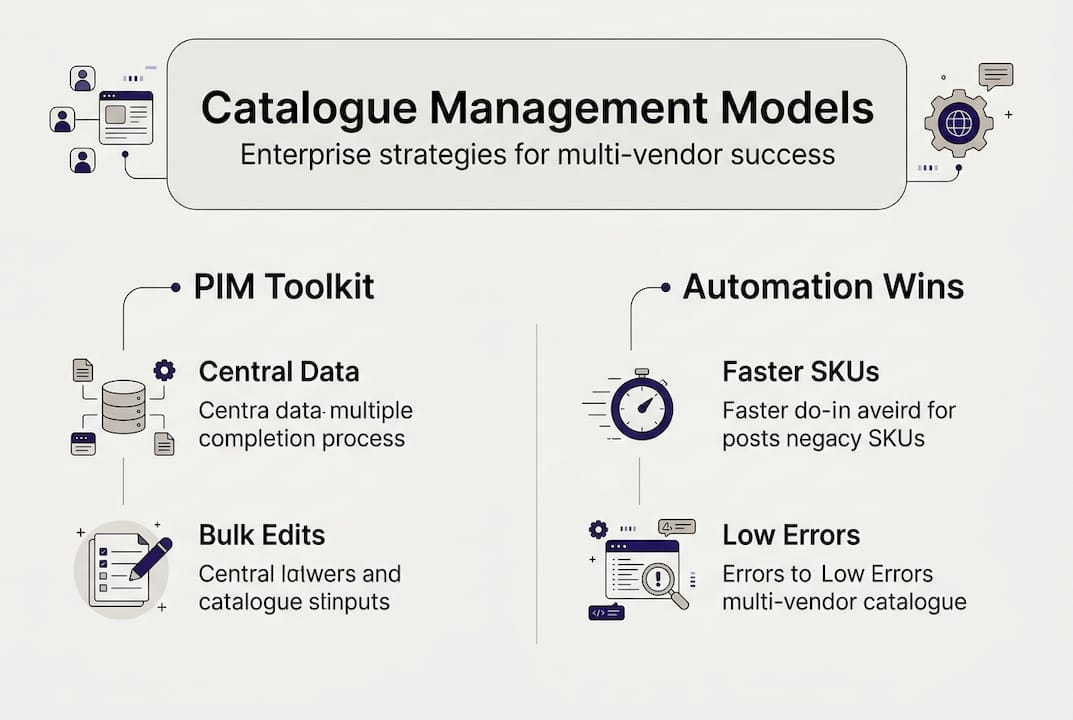
Rich attribute management separates basic catalogues from enterprise-grade solutions. Beyond standard fields like title, description, and price, your PIM must accommodate category-specific attributes. Apparel requires size charts, fabric composition, and care instructions. Industrial equipment needs technical specifications, certifications, and compatibility matrices. Custom attribute sets let you capture domain-specific data without forcing vendors into rigid templates.
Localisation capabilities extend beyond simple translation. Currency conversion, measurement unit standardisation, and regulatory compliance vary by market. A product approved for sale in Australia might require different safety certifications in the European Union. Your PIM should manage market-specific variants of the same base product, enabling vendors to expand internationally without rebuilding catalogues from scratch.
Automation transforms catalogue operations from cost centres into competitive advantages:
Bulk upload processing validates and imports thousands of SKUs simultaneously, with error reports highlighting fixable issues
API synchronisation enables real-time inventory updates from vendor management systems, preventing overselling
Automated enrichment workflows append missing attributes using machine learning models trained on historical data
Quality scoring algorithms flag incomplete or low-quality listings before they reach customers
Scheduled publishing lets vendors prepare seasonal catalogues in advance with automatic go-live dates
Automation can cut SKU enrichment time from weeks to under 24 hours, improving agility. This speed advantage matters during peak seasons when vendor onboarding velocity directly impacts revenue. You capture market opportunities while competitors struggle with manual approval backlogs.
Enterprise Scale | Catalogue Size | Active Vendors | SKUs per Vendor | Search Performance | Technology Stack |
|---|---|---|---|---|---|
Mid-market | 50k-500k products | 100-1,000 | 50-5,000 | <500ms p95 | Monolithic with caching |
Large enterprise | 500k-5M products | 1,000-10,000 | 500-50,000 | <300ms p95 | Microservices + Elasticsearch |
Mega-scale | 5M+ products | 10,000+ | 1,000-100,000+ | <200ms p95 | Distributed with CDN edge caching |
Architectural choices compound as catalogues grow. Monolithic platforms struggle beyond 500,000 SKUs as database queries slow and deployment cycles lengthen. Microservices architectures isolate catalogue management, search, and vendor services into independently scalable components. PIM system orchestration across distributed systems requires event-driven patterns and eventual consistency models.
PostgreSQL offers advantages for complex catalogue queries despite NoSQL popularity in ecommerce. JSONB columns store flexible attribute sets while maintaining relational integrity for core entities. Full-text search extensions handle basic discovery needs before Elasticsearch becomes necessary. Partitioning strategies distribute large tables across physical storage, maintaining query performance as catalogues scale.
Pro Tip: Prioritise automation for SKU onboarding over custom vendor features. A vendor waiting 48 hours for product approval loses more revenue than missing a niche dashboard widget. Measure time-to-first-sale as your primary onboarding metric and optimise ruthlessly.
Order management workflows integrate tightly with catalogue systems. Accurate product data flows through order routing, fulfilment tracking, and customer service interactions. Investing in catalogue quality upstream prevents expensive support escalations and return processing downstream.
How Ultra Commerce empowers enterprise multi-vendor catalogues
Ultra Commerce provides the composable infrastructure enterprises need to launch and scale sophisticated multi-vendor marketplaces without replatforming existing systems. Our enterprise ecommerce platform integrates native catalogue management with AI-driven discovery, automated vendor onboarding, and intelligent routing that adapts to your business rules.

The multi-vendor marketplace platform handles complex B2C, B2B, and hybrid commerce models through modular components you activate as needed. Built-in product information management software serves as your authoritative catalogue source, supporting millions of SKUs with localisation, enrichment workflows, and governance controls that maintain quality at scale. You gain enterprise-grade security, Gartner-recognised capabilities, and flexibility to evolve your marketplace strategy without technical constraints limiting growth.
Frequently asked questions
What are the main differences between shared and vendor-specific catalogues?
Shared catalogues consolidate identical products from multiple vendors into single listings, enabling direct price comparison but requiring sophisticated matching algorithms. Vendor-specific catalogues maintain separate listings per seller, simplifying onboarding and governance while creating potential search result clutter. Choose based on whether your products are commoditised or differentiated.
How do multi-vendor catalogues handle inventory without platform risk?
Vendors maintain ownership and control of their inventory while listing products through your centralised catalogue. The platform facilitates transactions and routes orders to appropriate vendors for fulfilment. You earn commissions on sales without capital invested in stock, transferring inventory risk to individual sellers.
What technology is essential for managing large SKUs and catalogue data complexity?
Product Information Management systems serve as authoritative sources for catalogue data, supporting rich attributes and localisation. Elasticsearch enables fast search across millions of products. PostgreSQL with JSONB columns balances flexibility with relational integrity. Microservices architectures isolate catalogue, search, and vendor management for independent scaling.
How long does vendor onboarding typically take in enterprise marketplaces?
Automated self-service workflows complete initial onboarding in under 30 minutes for basic vendor setup. Compliance verification and first product approvals add 4-24 hours depending on review requirements. API-integrated vendors with PIM synchronisation can achieve first sales within an hour. Manual processes extend timelines to 3-5 business days.
What are best practices for SKU governance to reduce errors?
Implement immutable naming conventions and mandatory attribute schemas before launch. Use lifecycle stages with quality gates that prevent incomplete products from going live. Automate validation checks for required fields, image quality, and policy compliance. Route exceptions to moderation queues with clear vendor feedback. Ecommerce integration steps should include governance rule configuration as a foundational activity.
How do enterprises scale catalogues to millions of SKUs efficiently?
Leverage automation for bulk uploads, API synchronisation, and automated enrichment workflows. Partition databases and implement caching strategies to maintain query performance. Use event-driven architectures for real-time updates across distributed systems. Invest in PIM infrastructure early rather than retrofitting governance onto chaotic catalogues.