

April 12, 2026
Enterprise
Marketplace
TL;DR:
Settlement delays and errors can hurt vendor relationships and cash flow in marketplaces.
Automating settlement workflows with proper APIs, reconciliation, and compliance reduces errors and speeds payouts.
Effective management requires ongoing monitoring, clear vendor communication, and blending technology with human oversight.
Settlement delays and reconciliation errors are quietly costing enterprise marketplaces real money. When funds sit unallocated, vendors grow frustrated, cash flow tightens, and your operations team spends hours untangling payout discrepancies. For e-commerce managers running multi-vendor platforms, these inefficiencies compound fast. This guide walks you through every stage of a modern settlement workflow, from understanding core components to automating splits and monitoring compliance. You will come away with practical strategies to reduce errors, accelerate payouts, and build a settlement process that scales with your business.
Table of Contents
Understanding marketplace settlement workflows: Key concepts and challenges
Preparing for automation: Requirements, platforms, and integration essentials
Executing your settlement workflow: Step-by-step automation guide
Verifying results and troubleshooting: Monitoring, compliance, and common pitfalls
What most guides miss: The human factor and future of settlement workflows
Key Takeaways
Point | Details |
|---|---|
Two main workflows | Choose between aggregated and split payment methods based on your marketplace’s needs. |
Automate for efficiency | Automation via APIs significantly reduces errors, costs, and manual bottlenecks in settlement. |
Monitor and adapt | Ongoing reconciliation and compliance monitoring ensures accuracy and smoother vendor relations. |
Handle edge cases | Prepare for scenarios like refunds, FX risk, and insufficient balances to avoid cash flow surprises. |
Understanding marketplace settlement workflows: Key concepts and challenges
A marketplace settlement workflow is the end-to-end process of moving funds from a customer's payment through to each vendor's net payout. It sounds straightforward, but the reality is layered with complexity. The transition from single-vendor to multi-vendor retail introduces compounding financial obligations that require careful orchestration at every step.
The core components of any settlement workflow include order capture, payment processing, commission calculation, vendor disbursement, and reconciliation. Each stage must connect cleanly to the next. A failure at any point, say a miscalculated commission or a delayed disbursement trigger, can cascade into payout errors that take days to resolve.
"Multi-vendor carts triple payout costs... effective take rate drops from 12% to 6.3%" — illustrating just how quickly complexity erodes margin when settlement processes are not tightly managed.
One of the most important architectural decisions you will face is choosing between aggregated and split payment approaches. The Stripe Connect methodology overview explains both clearly: aggregated payments see the platform hold all funds centrally before batching payouts to vendors, while split payments route funds directly to vendor accounts in near real time. Each has trade-offs around control, compliance complexity, and payout speed. Your multi-vendor payment guide can help you map these options to your specific business model.
Settlement stage | Common pain point |
|---|---|
Order capture | Duplicate or missing order records |
Payment processing | Gateway failures, FX conversion errors |
Commission calculation | Manual formula errors, rule mismatches |
Vendor disbursement | Delayed payouts, insufficient balance holds |
Reconciliation | Mismatched records, audit trail gaps |
The most common bottlenecks enterprise teams encounter include:
Delayed payouts caused by manual approval steps or platform cash flow management
Reconciliation failures when order data and payment data do not align
Foreign exchange (FX) risk on cross-border transactions where rates shift between capture and payout
Multi-vendor cart complexity where a single customer order spans multiple vendors requiring simultaneous splits
Regulatory holds triggered by incomplete KYC (know your customer) or AML (anti-money laundering) checks
Understanding these pain points is the first step. Solving them requires a structured, automated approach.
Preparing for automation: Requirements, platforms, and integration essentials
Before you automate anything, you need to confirm that your foundation is solid. Rushing into API integrations without the right prerequisites in place leads to compliance gaps and reconciliation headaches down the track.
Here is what you need to have in order before you begin:
KYC and AML compliance frameworks for all vendors on your platform
A payment processor selection that supports marketplace-specific flows
Signed merchant agreements that clearly define commission structures and payout schedules
Reconciliation routines that can be automated or semi-automated via API
Vendor onboarding documentation including bank account verification and tax identification
When it comes to platform selection, Stripe Connect benchmarks show it is one of the most widely adopted solutions for marketplace settlements, offering both aggregated and split payment models with strong API support. Adyen for Platforms is a strong alternative, particularly for enterprises operating across multiple regions, given its localised compliance features. Both Stripe Connect and Adyen for Platforms support the major settlement methodologies and offer robust APIs that can integrate with your existing order management infrastructure.
Approach | Integration complexity | Payout speed | Fee control | Platform control |
|---|---|---|---|---|
Aggregated | Lower | 1 to 7 days | High | High |
Split payments | Higher | Near real time | Moderate | Moderate |
For integration steps for multi-vendor marketplaces, the sequencing matters. Start with vendor onboarding and KYC automation before you connect payment flows. Localised KYC processes, where identity verification is adapted to each vendor's country of operation, significantly reduce onboarding friction and compliance risk.

Pro Tip: Automate as much of your reconciliation and settlement logic as possible from day one. API-based tools eliminate the manual matching that consumes your team's time and introduces human error. Even a partial automation of reconciliation routines can reclaim hours each week.
Executing your settlement workflow: Step-by-step automation guide
With your requirements confirmed and your platform selected, you are ready to build or upgrade your automated settlement workflow. Here is a practical sequence to follow.
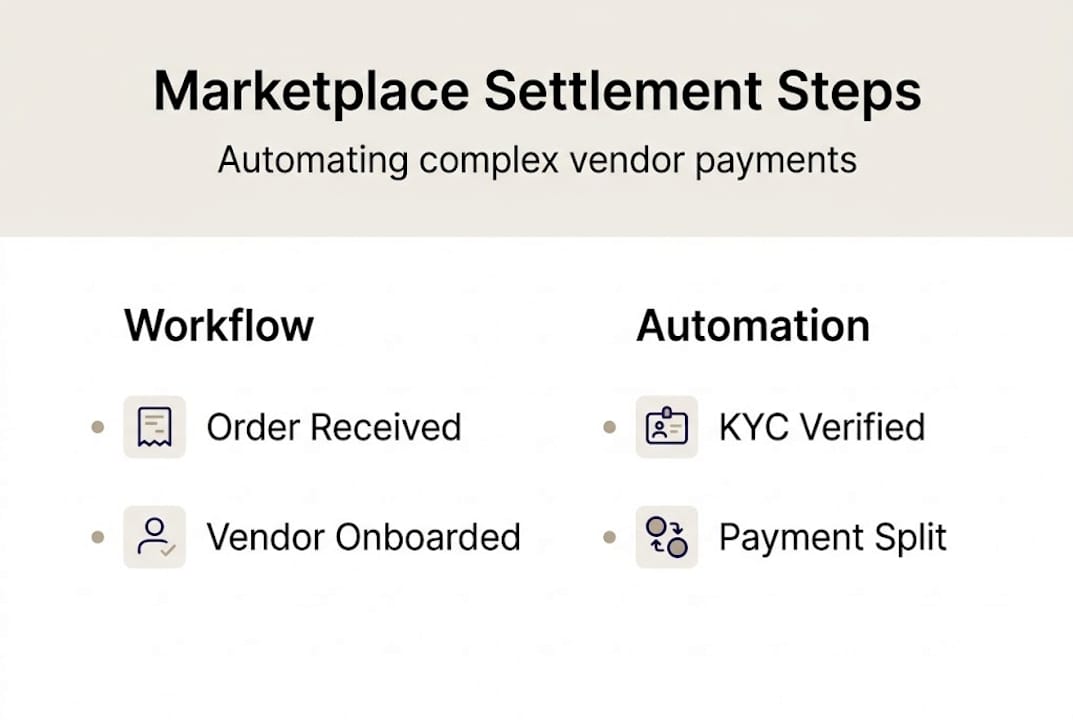
Configure vendor accounts and split rules in your payment platform. Define commission percentages, payout schedules, and currency preferences for each vendor.
Set up payment capture with delayed capture enabled where appropriate. This creates an escrow-like hold that aligns settlement with actual order fulfilment rather than the moment of purchase.
Automate vendor splits via API so that each transaction triggers an immediate calculation and routing instruction without manual intervention.
Integrate your Order Management System (OMS) to pass fulfilment status signals to your payment platform, ensuring payouts only release when orders are confirmed as dispatched or delivered.
Enable multi-currency handling for cross-border transactions, including automated FX conversion at a defined rate or real-time rate with hedging rules.
Build reconciliation routines that automatically match payment gateway records against OMS order data on a daily or near-real-time basis.
Generate payout reports for vendors and internal finance teams, with clear breakdowns of gross sales, commissions, fees, and net disbursements.
The value of automated order management becomes most visible at step four. When your OMS communicates fulfilment status directly to your payment platform, you eliminate the lag between delivery and disbursement. Optimising multi-vendor platforms with advanced OMS tools shows that automating splits and reconciliation through APIs, combined with delayed capture for escrow-like holds, delivers measurable efficiency gains.
On the compliance side, localised KYC automation produces a 16% improvement in vendor onboarding rates, meaning fewer drop-offs during the onboarding process and faster time to first payout for new vendors.
Pro Tip: Use delayed capture to sync your settlement timing with order fulfilment milestones. This significantly reduces your exposure to refund and chargeback risk because funds are not fully committed until the order is confirmed complete.
For enterprises managing payment methods for B2B e-commerce, the same principles apply. Automated splits, reconciliation APIs, and OMS integration reduce operational overhead regardless of whether you are serving business buyers or consumers.
Verifying results and troubleshooting: Monitoring, compliance, and common pitfalls
Automation does not mean set and forget. Once your workflow is live, ongoing monitoring is what keeps accuracy high and compliance intact.
Your monitoring practice should cover:
Daily reconciliation reports comparing payment gateway data against OMS records
Payout auditing to confirm vendor disbursements match calculated net amounts
API log reviews to catch failed calls, timeout errors, or webhook delivery failures
Vendor feedback loops so that payout discrepancies are surfaced quickly rather than building into disputes
Audit trails that satisfy KYC, AML, and local tax reporting obligations
Staying current with latest payment trends is also important, as regulatory requirements and platform capabilities evolve regularly.
"Delayed capture aligns payment with business state" — meaning your settlement timing should reflect operational reality, not just transaction timestamps.
Edge cases require specific attention. Partial fulfilment, refunds, disputes, FX volatility, and insufficient balances each require defined handling rules built into your workflow rather than manual intervention each time.
Error type | Resolution approach |
|---|---|
Reconciliation mismatch | Cross-reference API logs and OMS order records |
Failed vendor payout | Check balance sufficiency and retry with alert trigger |
Chargeback received | Deduct from vendor's next payout per merchant agreement |
FX conversion error | Apply fallback rate rule and flag for finance review |
Partial fulfilment | Release proportional payout based on fulfilled items only |
The multi-vendor cost benchmarks reinforce that delays of seven to twenty-one days create genuine cash flow gaps for vendors. Resolving edge cases quickly is not just good operations practice, it directly affects vendor satisfaction and retention. Using automation and machine learning for UX can further support anomaly detection in settlement data, flagging irregularities before they become costly problems.
What most guides miss: The human factor and future of settlement workflows
Most articles on settlement automation focus almost entirely on tools and speed. That is understandable, but it misses something important. The enterprises that get the most from their settlement infrastructure are the ones that invest equally in people and process alongside technology.
Vendor communication during onboarding and payout cycles is consistently underestimated. When vendors do not understand why a payout was delayed or adjusted, trust erodes fast. Transparent, automated payout notifications with clear line-item breakdowns reduce support queries and strengthen vendor relationships. This is an area where maximising your IT budget thinking applies: the right investment in communication tooling pays back in reduced operational overhead.
AI will continue to drive efficiency gains in settlement workflows, particularly in dynamic risk scoring and exception handling. But routine audits and human review of flagged transactions remain essential. The future belongs to teams that blend powerful OMS automation with accessible reporting, giving both internal finance teams and vendors genuine visibility into settlement status. Real-time settlement, multi-currency fluidity, and dynamic risk scoring are coming fast. The organisations that will lead are those building the human oversight structures now to govern those capabilities well.
Take the next step with advanced marketplace tools
Streamlining your settlement workflow is one of the highest-leverage improvements you can make to your marketplace operations. The right technology makes it achievable at scale.

Ultra Commerce is built for exactly this challenge. Our enterprise ecommerce platform supports complex, global settlement workflows with native automation, reconciliation, and governance tools. The multi-vendor marketplace platform handles vendor splits, commission management, and payout scheduling out of the box. Combined with our order management system, you get end-to-end visibility from order capture to vendor disbursement. Connect with our enterprise specialists to explore how Ultra Commerce can support your settlement goals.
Frequently asked questions
What is a marketplace settlement workflow?
A marketplace settlement workflow is the process of distributing customer payments to the appropriate vendors minus platform fees, commissions, and applicable taxes. It covers every step from payment capture through to final vendor disbursement.
How do split and aggregated payments differ in settlement workflows?
Split payments route funds directly to vendor accounts in near real time, while aggregated methods hold all funds centrally on the platform and batch payouts on a scheduled basis. The right choice depends on your compliance requirements and payout speed priorities.
Which platforms are widely used for marketplace settlements?
Stripe Connect and Adyen for Platforms are the most widely adopted options, both offering API-based automation, compliance features, and support for aggregated and split payment models.
What is the main reason for delays in multi-vendor settlement payouts?
Delays of 7 to 21 days typically stem from reconciliation steps, regulatory compliance holds, or platform cash flow management practices that batch disbursements rather than releasing funds in real time.
How do you manage refunds and chargebacks in marketplace settlements?
Refunds and chargebacks are typically debited from the vendor's balance or deducted from future payouts, often including commission clawbacks, in line with the terms set out in the merchant agreement.