

March 27, 2026
Ultra Commerce
Enterprise
Ecommerce Strategy
Gartner Magic Quadrant for ecommerce: A CTO’s guide
The Gartner Magic Quadrant is one of the most cited documents in enterprise technology procurement, yet it is also one of the most misread. Many CTOs treat a vendor’s quadrant position as a performance guarantee or a shortcut to a shortlist. It is neither. As Gartner explicitly states, its research represents analyst opinion, not endorsement, and enterprises must evaluate findings within their own context. This guide breaks down what the Magic Quadrant actually reveals about the state of digital commerce in 2026, with a focus on AI and agentic capabilities, so you can use it as a strategic lens rather than a vendor scorecard.
Table of Contents
What is the Gartner Magic Quadrant for ecommerce?
Key trends from the 2025 report: AI, agentic commerce, and revenue growth
How to interpret vendor positioning for your enterprise
Mapping Quadrant insights to enterprise needs and AI-driven goals
Taking the next step with Ultra Commerce
Frequently asked questions
Key Takeaways
Point | Details |
|---|---|
Quadrant is a framework | Use the Magic Quadrant as a structured evaluation tool, not a ranking or endorsement list. |
AI and agentic matter | Modern digital commerce success depends on strong AI and agentic capabilities in chosen platforms. |
Interpret for your needs | Vendor positioning should be analysed against your enterprise’s goals, not generic hype. |
Apply findings strategically | Contextualise Magic Quadrant insights with internal priorities for maximum impact. |
Vendors are dynamic | Challenger, Visionary and Niche providers can match enterprise objectives, not just Leaders. |
What is the Gartner Magic Quadrant for ecommerce?
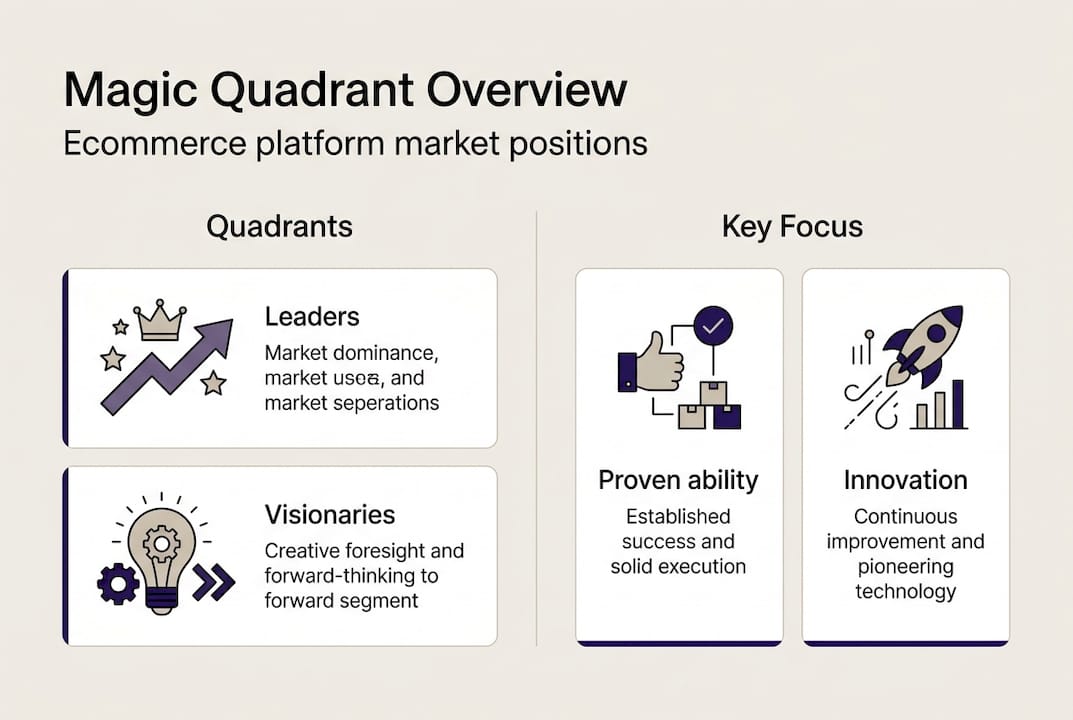
The Magic Quadrant is a visual framework Gartner uses to assess technology markets. It plots vendors on two axes: Completeness of Vision (horizontal) and Ability to Execute (vertical). The result is four quadrants: Leaders, Challengers, Visionaries, and Niche Players. Each position tells a different story about a vendor’s current capabilities versus their strategic direction.
The 2025 report evaluates 19 vendors across a broad set of criteria including product capability, market responsiveness, customer experience, and commercial viability. This is not a simple ranking. A vendor sitting in the Leaders quadrant has demonstrated both strong execution and a credible forward-looking vision, but that does not mean they are the right fit for your specific architecture or commerce model.
Understanding the types of digital commerce platforms available is essential context before reading any quadrant placement. The criteria Gartner applies span:
Headless and composable architecture support
B2B, B2C, and marketplace transaction models
AI and personalisation capabilities
Global scalability and multi-site management
Integration with existing enterprise tech stacks
Quadrant position | Strength | Watch out for |
|---|---|---|
Leaders | Strong execution and vision | May be over-engineered for your use case |
Challengers | Proven delivery, narrower vision | May lack innovation roadmap depth |
Visionaries | Strong innovation, less proven | Execution risk at enterprise scale |
Niche Players | Specialist fit | Limited breadth or market reach |
“Gartner does not endorse any vendor, product or service depicted in its research publications and does not advise technology users to select only those vendors with the highest ratings.” — Gartner Magic Quadrant for Digital Commerce 2025
This distinction matters enormously. The quadrant is a starting point for structured evaluation, not a finishing line.
Key trends from the 2025 report: AI, agentic commerce, and revenue growth
The 2025 edition of the Magic Quadrant signals a clear market shift. Platforms are enhancing AI and agentic commerce offerings, and digital commerce market revenue grew steadily through 2024. For CTOs, this is not background noise. It is a signal about where vendor investment is flowing and which capabilities will separate competitive platforms from legacy ones within the next two to three years.

Agentic commerce is the standout theme. Unlike traditional personalisation, which reacts to past behaviour, agentic systems act autonomously. They discover products, make decisions, and execute transactions on behalf of users or business processes. Think of it as the difference between a recommendation engine and an AI that can actually complete a purchase workflow without human intervention.
The practical implications for automation and machine learning in commerce are significant. Enterprises that invest in platforms with genuine agentic capability now will have a structural advantage as AI-native buying behaviours become mainstream. The vendors leading in the 2025 quadrant are those who have moved beyond chatbot-style AI into orchestration-level intelligence.
Here are the key trends shaping vendor evaluations in 2025:
Agentic execution layers that support autonomous discovery, decision-making, and transaction completion
Composable commerce architecture enabling modular deployment without full replatforming
AI-driven personalisation at scale across B2B and B2C channels simultaneously
Multi-model commerce support covering marketplace, direct, and hybrid transaction types
Governance and security frameworks built for enterprise compliance requirements
Pro Tip: When reviewing vendor AI claims in the quadrant, ask specifically whether their AI operates at the orchestration layer or only at the presentation layer. Surface-level personalisation is table stakes. Orchestration-level AI is the differentiator worth evaluating.
For a deeper look at where this is heading, the future of AI in ecommerce is shifting faster than most procurement cycles can accommodate. Building AI extensibility into your selection criteria now protects your investment over a longer horizon. You can also explore AI-driven digital commerce workflows to understand what implementation actually looks like at the enterprise level.
How to interpret vendor positioning for your enterprise
Here is where most enterprise procurement processes go wrong. A CTO sees a vendor in the Leaders quadrant and assumes the evaluation is done. In reality, the quadrant position is the beginning of the analysis, not the conclusion.
Gartner is explicit that its research is opinion, not fact, and that enterprises must evaluate platforms in the full context of their own requirements. A Leader in the Magic Quadrant may have achieved that position through strengths that are irrelevant to your commerce model. Conversely, a Visionary may have exactly the AI architecture your roadmap demands, even if their current execution metrics are lower.
Consider what each quadrant position actually signals for your context:
Quadrant | Best suited for | Potential risk |
|---|---|---|
Leaders | Enterprises needing proven, broad capability | Vendor lock-in, higher cost, slower innovation cycles |
Challengers | Organisations prioritising reliability over innovation | May not keep pace with AI-driven market shifts |
Visionaries | Enterprises with strong internal tech teams | Higher implementation complexity, less mature support |
Niche Players | Specific vertical or regional requirements | Scalability ceiling, limited ecosystem |
Pro Tip: Build your own evaluation matrix before consulting the quadrant. Define your top ten requirements, weighted by strategic priority. Then use the quadrant to identify which vendors are worth a deeper proof-of-concept, rather than letting the quadrant define your requirements for you.
The ecommerce platform features infographic is a useful reference for mapping platform capabilities against enterprise criteria. When reviewing vendor positioning, focus on:
Whether their AI capabilities are native or bolted on via third-party integrations
How their composable architecture handles your existing tech stack without full replatforming
Their track record with enterprises of similar scale, transaction volume, and commerce complexity
Roadmap transparency, particularly around agentic and AI investment over the next 18 months
The new digital commerce trends reshaping the market in 2026 also provide useful context for stress-testing vendor roadmaps against where the market is actually heading.
Mapping Quadrant insights to enterprise needs and AI-driven goals
Once you understand the quadrant framework and the 2025 trends, the real work begins: translating those insights into a structured vendor selection process aligned with your enterprise’s digital maturity and AI ambitions.
The 2025 report covers 19 vendors, each with distinct strengths across composability, AI capability, marketplace support, and global scalability. No single vendor is optimal for every enterprise. Your job is to match platform strengths to your specific transformation priorities.
“The best platform is not the one with the highest quadrant position. It is the one whose capability roadmap most closely aligns with your commerce strategy over the next three to five years.”
Follow this process to move from quadrant insights to a credible shortlist:
Define your AI maturity baseline. Assess where your current commerce stack sits on the AI adoption curve before evaluating vendor claims.
Identify your critical commerce models. B2B, B2C, marketplace, or multi-brand? Each model has different platform requirements that the quadrant criteria weight differently.
Evaluate composability requirements. Can you adopt modular components like PIM, OMS, and orchestration tools without replatforming your entire stack?
Assess total cost of ownership. Include integration costs, ongoing AI innovation investment, and the cost of switching if the platform cannot scale with your ambitions.
Run a structured proof-of-concept. Use the quadrant shortlist to identify two or three vendors for a real-world test against your highest-priority use cases.
For enterprises managing multibrand ecommerce, composable architecture is non-negotiable. The ability to manage multiple brand storefronts from a single platform, with shared AI and catalogue infrastructure, is a capability that separates enterprise-grade solutions from mid-market ones. Similarly, payment trends in ecommerce are evolving rapidly, and your platform selection must account for B2B payment complexity, not just consumer checkout flows.
The path to accelerating commerce with AI runs through platform selection decisions made today. Enterprises that treat the quadrant as a strategic input rather than a procurement shortcut will be better positioned to build AI-native commerce infrastructure that scales.
Taking the next step with Ultra Commerce
The Magic Quadrant gives you a market map. What it cannot give you is a platform built specifically for the complexity of enterprise AI-driven commerce. Ultra Commerce is designed for exactly that challenge.
Ultra Commerce aligns directly with the criteria Gartner evaluates: composable architecture, native agentic AI capabilities, multi-vendor marketplace support, and modular components including PIM, OMS, and orchestration tools that integrate with your existing stack without replatforming. For CTOs and e-commerce directors navigating the 2026 landscape, the enterprise ecommerce platform from Ultra Commerce is built to meet Quadrant-class requirements across B2B, B2C, and marketplace models. Explore the full Ultra Commerce platform overview to see how the platform’s agentic execution layer and governance capabilities map to your digital transformation roadmap, then book a demo to see it in action.
Frequently asked questions
How often is the Gartner Magic Quadrant for digital commerce updated?
Gartner publishes the Magic Quadrant annually, reviewing the 19 evaluated vendors and incorporating current market trends and capability shifts each time.
Does Gartner recommend which ecommerce platform to choose?
No. Gartner does not endorse any vendor and explicitly advises enterprises to evaluate platforms against their own specific requirements and context.
What is ‘agentic commerce’ in the context of the Magic Quadrant?
Agentic commerce refers to autonomous AI capabilities, such as dynamic workflow automation and self-directed transaction execution, that leading vendors are enhancing as a core differentiator in the 2025 report.
Why might a Challenger or Visionary platform be better than a Leader?
A Challenger or Visionary may address your specific innovation priorities, regional requirements, or composable architecture needs more directly than a vendor whose Leader status reflects broad market strength rather than your use case.
How should CTOs align Quadrant insights with complex multi-brand or omnichannel needs?
Review platform criteria for composability, multi-site management, and AI extensibility, then map those capabilities explicitly against your digital roadmap and commerce model priorities for the strongest alignment.