

March 22, 2026
Enterprise
B2C
PIM
Many enterprise leaders assume B2C ecommerce is simpler than B2B because individual shoppers make faster decisions. The reality is far more complex. B2C transactions involve intricate multi-step processes where friction at any point can cost millions in abandoned carts and lost revenue. With cart abandonment averaging 70% and fraud losses reaching billions annually, enterprises must master transaction mechanics, leverage AI strategically, and balance frictionless experiences with robust fraud prevention to capture the full potential of direct-to-consumer commerce.
Table of Contents
Key takeaways
Understanding the core mechanics of B2C transactions
Common challenges and edge cases in B2C transactions
Leveraging AI to enhance B2C customer engagement and transaction efficiency
Best practices for enterprises to optimise B2C transactions
Discover Ultra Commerce for enterprise B2C success
FAQ
Key Takeaways
Point | Details |
|---|---|
Cart abandonment impact | Cart abandonment sits around seventy per cent, causing significant revenue losses across the checkout journey. |
Fraud driven losses | Fraud losses exceed eighty nine billion dollars annually, driven by account takeover, friendly fraud and promo abuse. |
Multi stage checkout | The core transaction flow includes cart review, shipping and billing entry, payment method selection, authorisation, fraud checks and settlement. |
AI drives personalisation | AI enhances personalised engagement and improves conversion rates across key touchpoints. |
Understanding the core mechanics of B2C transactions
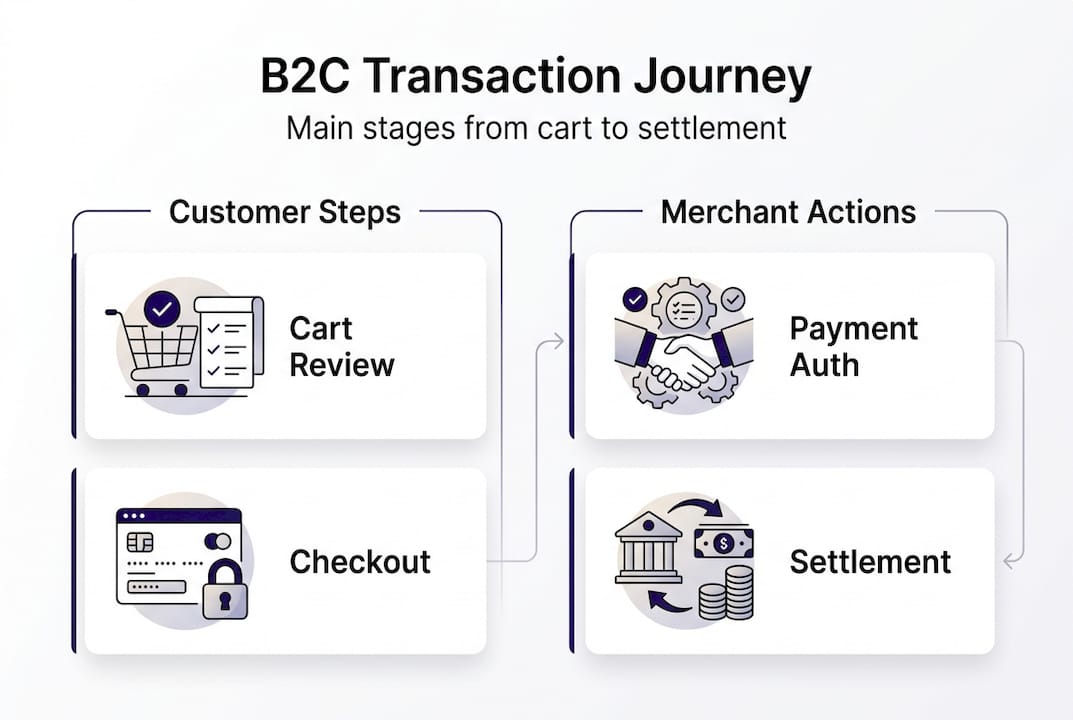
Every B2C transaction follows a sequential path that determines whether a customer completes their purchase or abandons their cart. The core mechanics involve cart review, entering shipping and billing details, selecting payment methods, authorisation, fraud checks, and settlement. Each step creates an opportunity for friction that can derail the sale.
The process begins when a customer reviews their cart and proceeds to checkout. They enter shipping information, which the system validates against address databases. Next comes billing details, followed by payment method selection. Modern enterprises must support diverse options including credit cards, digital wallets like Apple Pay and Google Pay, and buy now pay later services. This variety matters because payment preferences vary significantly across demographics and regions.
Once payment details are submitted, the authorisation phase begins. Payment gateways communicate with issuing banks to verify funds and approve the transaction. Simultaneously, fraud detection systems analyse hundreds of signals including device fingerprints, IP addresses, purchase patterns, and behavioural biometrics. These checks happen in milliseconds but represent critical decision points.
Transaction speed directly impacts user experience and conversion rates. Delays during authorisation or fraud screening frustrate customers and increase abandonment. Failed payments due to expired cards, insufficient funds, or overzealous fraud filters create immediate revenue loss. Understanding these differences between B2B and B2C ecommerce helps enterprises optimise each touchpoint.
The final settlement phase transfers funds from the customer’s account to the merchant’s account, typically within 24 to 72 hours. While invisible to customers, settlement timing affects cash flow and financial planning for large enterprises processing thousands of daily transactions. Technical interruptions at any stage, from server timeouts to payment gateway failures, can abort transactions and damage customer trust.
Common challenges and edge cases in B2C transactions
Cart abandonment represents the single largest revenue leak in B2C ecommerce. With abandonment rates averaging 70%, enterprises lose seven out of every ten potential sales before completion. Causes range from unexpected shipping costs and complicated checkout processes to security concerns and comparison shopping behaviour. Each abandoned cart represents not just lost revenue but wasted marketing spend acquiring that customer.
Fraud poses an equally serious threat with multiple attack vectors. Account takeover fraud occurs when criminals gain access to legitimate customer accounts and make unauthorised purchases. Friendly fraud involves customers disputing legitimate charges to receive refunds whilst keeping products. Promo abuse exploits discount codes and loyalty programmes through fake accounts or stolen credentials. Total fraud losses exceed $89 billion annually, with enterprises bearing both direct financial costs and reputational damage.
Technical failures create unexpected transaction disruptions:
Payment gateway timeouts during peak traffic periods
Address verification mismatches due to formatting inconsistencies
Declined transactions from overly aggressive fraud filters
Browser compatibility issues with payment forms
Session timeouts that erase cart contents
These technical edge cases disproportionately affect mobile shoppers who face connectivity challenges and smaller screens that complicate data entry. Mismatched billing and shipping information triggers automatic declines even for legitimate customers, particularly those purchasing gifts or using business addresses.
“The cost of fraud extends beyond direct financial losses to include chargeback fees, increased payment processing costs, and the operational burden of dispute resolution. Enterprises must implement layered defence strategies that detect fraud without creating friction for legitimate customers.”
Recognising these patterns requires sophisticated monitoring systems that track transaction success rates, decline reasons, and abandonment triggers across customer segments. Enterprises that implement strategies to reduce cart abandonment and fraud simultaneously protect revenue whilst improving customer experience. The key lies in understanding that each challenge demands targeted solutions rather than one-size-fits-all approaches.
Leveraging AI to enhance B2C customer engagement and transaction efficiency
Artificial intelligence transforms B2C transactions from static processes into dynamic, personalised experiences that adapt to individual customer behaviours. AI-driven personalisation analyses browsing history, purchase patterns, and contextual signals to present relevant products and offers at precisely the right moment. This targeted approach builds trust and satisfaction whilst significantly improving conversion rates.
Recommendation engines powered by machine learning algorithms predict customer preferences with increasing accuracy. These systems identify cross-sell and upsell opportunities that human merchandisers might miss, presenting complementary products based on sophisticated pattern recognition. AI implementations boost conversion rates between 5% and 23% depending on the sophistication of personalisation and the quality of training data.
Conversational AI through chatbots provides instant customer support during the transaction process. These intelligent assistants answer product questions, resolve checkout issues, and guide customers through complex decisions without human intervention. The result is reduced abandonment and higher customer satisfaction scores, particularly for after-hours shoppers who previously faced delays.
Agentic commerce represents the next evolution, where AI agents autonomously complete transactions on behalf of customers. These agents learn individual preferences, monitor prices, and execute purchases when conditions meet predefined criteria. Agentic commerce is projected to reach $1 trillion by 2030, fundamentally disrupting traditional payment and checkout norms.
Operational efficiency gains extend beyond customer-facing interactions:
Inventory management systems predict demand and optimise stock levels
Dynamic pricing algorithms adjust in real-time based on market conditions
Fraud detection models identify suspicious patterns with minimal false positives
Logistics optimisation reduces shipping costs and delivery times
Pro Tip: Start with AI applications that deliver immediate measurable value like personalised product recommendations or chatbot support, then expand to more complex implementations as your team builds expertise and confidence with the technology.
Balancing AI benefits with privacy concerns requires transparency about data collection and usage. Customers increasingly demand control over their information whilst still expecting personalised experiences. Enterprises must implement robust governance frameworks that protect customer data whilst enabling AI systems to function effectively. Understanding emerging payment trends in ecommerce helps contextualise how AI integrates with evolving transaction technologies.
Best practices for enterprises to optimise B2C transactions
Checkout flow design directly impacts conversion rates and revenue. Guest checkout options eliminate registration friction for first-time buyers who resist creating accounts before completing purchases. One-page checkout consolidates all required information into a single view, reducing cognitive load and abandonment risk. These streamlined approaches reduce abandonment by 20% compared to multi-step processes that force customers through unnecessary pages.

Payment method diversity addresses varying customer preferences and regional requirements. Credit and debit cards remain dominant but digital wallets appeal to mobile shoppers seeking speed and convenience. Buy now pay later services attract younger demographics and enable larger purchases by spreading costs. Offering diverse payment options delivers 12% to 15% conversion lift as customers find their preferred method available.
Optimisation tactic | Impact | Implementation complexity |
|---|---|---|
Guest checkout | 15-20% abandonment reduction | Low |
One-page checkout | 10-15% conversion improvement | Medium |
Digital wallet integration | 12-15% mobile conversion lift | Medium |
Address autocomplete | 8-12% form completion improvement | Low |
Real-time fraud scoring | 60-70% promo abuse prevention | High |
Fraud prevention requires layered detection that balances security with customer experience. Rule-based systems flag obvious red flags like mismatched addresses or unusual purchase patterns. Machine learning models analyse hundreds of variables to assign risk scores without creating friction for legitimate customers. Sophisticated implementations block 60% to 70% of promotional abuse whilst maintaining low false positive rates that might otherwise alienate good customers.
Revenue per visitor (RPV) provides more comprehensive performance measurement than conversion rate alone. RPV accounts for average order value and repeat purchase behaviour, revealing the true financial impact of optimisation efforts. A lower conversion rate with higher order values might generate more revenue than high conversion with small purchases.
Pro Tip: Implement progressive profiling that collects customer information gradually across multiple interactions rather than demanding everything upfront, reducing initial friction whilst building comprehensive profiles over time.
Mobile optimisation cannot be overlooked as smartphones dominate B2C traffic. Responsive design ensures checkout forms adapt to smaller screens without requiring excessive scrolling or zooming. Autofill capabilities leverage device data to populate fields instantly. Touch-friendly buttons and form elements accommodate finger navigation rather than precise mouse clicks. Enterprises that master payment methods for B2C optimisation position themselves to capture maximum value from every customer interaction.
Discover Ultra Commerce for enterprise B2C success
Navigating the complexities of B2C transactions demands a platform built specifically for enterprise scale and sophistication. Ultra Commerce delivers composable architecture that adapts to your unique requirements without forcing you into rigid templates or requiring complete replatforming.

Our enterprise ecommerce platform integrates advanced fraud prevention, diverse payment processing, and AI-powered personalisation within a unified system. The modular design lets you implement exactly the capabilities you need today whilst maintaining flexibility to evolve as your strategy develops. Native multi-vendor support facilitates complex B2C operations alongside B2B and marketplace models.
The Ultra Commerce platform includes sophisticated order management systems that handle high transaction volumes whilst maintaining the speed and reliability enterprise customers demand. Our agentic execution layer enables AI-driven transaction automation that positions you at the forefront of commerce innovation.
FAQ
What causes most B2C transaction failures?
Payment declines due to insufficient funds, expired cards, or fraud filter triggers represent the primary failure mode. Technical issues like gateway timeouts and address verification mismatches create additional friction. Implementing robust retry logic and clear error messaging helps recover failed transactions.
How can enterprises safely implement AI in checkout processes?
Start with low-risk applications like product recommendations and chatbot support that enhance rather than control critical functions. Implement rigorous testing protocols and maintain human oversight for high-value transactions. Ensure transparent data practices that comply with privacy regulations whilst building customer trust.
What distinguishes B2C from B2B transaction requirements?
B2C transactions involve shorter decision cycles with individual buyers making impulse purchases, whilst B2B features longer sales cycles with multiple stakeholders and complex approval workflows. B2C prioritises speed and convenience whereas B2B emphasises relationship management and custom pricing. Payment terms differ significantly with B2C requiring immediate settlement and B2B often extending credit.
Which fraud prevention techniques work best for large enterprises?
Layered approaches combining rule-based systems, machine learning models, and behavioural biometrics deliver optimal results. Device fingerprinting identifies suspicious patterns whilst velocity checks flag unusual purchase frequencies. Real-time risk scoring adapts to emerging threats without creating friction for legitimate customers. Regular model retraining ensures detection accuracy as fraud tactics evolve.
How can enterprises strategically reduce cart abandonment?
Implement proven conversion optimisation techniques including transparent pricing with no surprise fees, guest checkout options, and progress indicators that show customers how close they are to completion. Offer multiple payment methods including digital wallets and buy now pay later options. Deploy exit-intent popups with targeted incentives and automated email recovery campaigns for abandoned carts.