

April 6, 2026
Enterprise
Ecommerce Strategy
Marketplace
TL;DR:
Retailers adopting AI are gaining significant competitive advantages through improved personalization and operational efficiency.
Effective AI implementation depends on strong data quality, governance, and strategic alignment rather than just technology.
AI-driven growth and marketplace expansion are accelerated when built on solid foundations that support scalability and compliance.
Retailers who delay AI adoption are already paying a price. 51% of retailers are actively deploying AI across their e-commerce platforms, and those sitting on the sidelines are watching market share erode in real time. For enterprise decision-makers managing multi-vendor marketplaces, the question is no longer whether to adopt AI, but where to focus first and how to evaluate the options with rigour. This article walks you through a practical evaluation framework, the key areas where AI delivers measurable advantage, a comparison of AI versus traditional approaches, and the executive takeaways that matter most for scaling complex commerce operations.
Table of Contents
Personalisation and customer experience: AI's biggest advantage
Operational efficiency gains: Automation, classification, and inventory
Supercharge your e-commerce marketplace with AI-powered tools
Key Takeaways
Point | Details |
|---|---|
AI boosts conversions | AI-driven personalisation increases e-commerce conversions by up to 22% and drives customer loyalty. |
Operational efficiency | AI automation reduces manual tasks, lowers costs, and protects market share in complex marketplaces. |
Scalability made simple | AI tools enable multi-vendor and multi-market expansion with streamlined onboarding and catalogue management. |
Foundation is crucial | Successful AI adoption depends on strong data, governance, and clear strategic goals to truly unlock ROI. |
How to evaluate AI opportunities in enterprise e-commerce
Not every AI investment delivers equal returns. The research is clear that AI can generate 11x ROI, but that figure comes with a significant caveat: it requires solid data foundations, mature governance structures, and a realistic view of the risks involved. Before you commit budget, your evaluation process needs to be grounded in criteria that go beyond vendor promises.
Start by assessing strategic fit. Does the AI capability you are considering align with your core commerce objectives? A personalisation engine is only valuable if your catalogue data is clean and your customer data is structured well enough to feed it meaningful signals. Similarly, an AI-powered inventory forecasting tool will underperform if your order management data is fragmented across legacy systems.
The AI readiness factors that matter most include:
Data quality and availability: AI models are only as good as the data they learn from. Inconsistent product data, siloed customer records, or incomplete transaction histories will limit outcomes.
IT infrastructure readiness: Can your current stack support real-time data pipelines? AI at enterprise scale requires low-latency data flows.
Scalability: Will the AI solution perform under peak traffic conditions and across multiple vendor catalogues simultaneously?
Governance and compliance: Do you have policies in place to monitor model behaviour, flag anomalies, and manage ethical trade-offs?
That last point deserves more attention than it typically gets. Governance risks in AI deployments include model bias, over-optimisation for short-term revenue at the expense of customer fairness, and false positives in fraud detection that block legitimate transactions. Dynamic pricing is a good example: AI can optimise margins effectively, but without ethical guardrails, it can also generate reputational damage when customers perceive pricing as exploitative.
Before you sign off on any AI initiative, ask your team: what happens when this model gets it wrong? If you cannot answer that clearly, your governance framework is not ready.
Exploring AI governance and workflows in detail will help you build the internal controls needed to protect both your operations and your customer relationships. A measured, criteria-driven evaluation approach will always outperform an impulse to chase the latest AI feature.
Personalisation and customer experience: AI's biggest advantage
With a framework in place, let's explore AI's most transformative advantage: personalisation. The numbers are compelling. AI personalisation boosts conversions by 22% compared to non-AI competitors, and with 51% of retailers now deploying AI, the gap between leaders and laggards is widening fast.
In a B2C context, AI personalisation works by analysing browsing behaviour, purchase history, and real-time session data to surface the most relevant products, promotions, and content for each individual shopper. In a B2B setting, the logic is similar but the complexity increases. Buyers often have negotiated pricing, approval workflows, and category restrictions that must be factored into every recommendation. AI systems that understand these constraints can dramatically reduce friction in the buying process.

For multi-vendor marketplaces, personalisation becomes even more powerful. When you have hundreds of vendors and thousands of SKUs, the ability to surface the right product from the right vendor at the right moment is a genuine competitive differentiator. AI can weigh factors like vendor performance scores, stock availability, delivery time estimates, and margin contribution to serve recommendations that benefit both the buyer and the platform.
The personalisation benefits extend well beyond the product page. Consider these high-impact applications:
Search relevance: AI-powered search learns from query patterns and click behaviour to return more accurate results over time.
Email and push notifications: Personalised messaging based on lifecycle stage and browsing intent drives significantly higher engagement.
Homepage and category curation: Dynamic layouts that adapt to individual user profiles reduce bounce rates and increase session depth.
Post-purchase recommendations: AI can identify cross-sell and upsell opportunities based on what similar buyers purchased next.
The improvements to user interaction that come from well-implemented personalisation are measurable within weeks, not months. Pairing AI-driven personalisation with seamless customer experience design creates a compounding effect on retention and lifetime value.
Pro Tip: Start your personalisation programme with a single high-traffic touchpoint, such as site search or the homepage hero. Measure the lift before expanding to more complex use cases. This approach builds internal confidence and generates the data you need to justify broader investment.
Operational efficiency gains: Automation, classification, and inventory
Personalisation is only one side of the coin. AI transforms operational efficiency at scale in ways that directly reduce cost and protect market share. Non-AI retailers are losing 2.3% market share as competitors automate the back-office tasks that slow them down.
Here are the operational areas where AI delivers the most immediate value for enterprise marketplaces:
Product classification and tagging: Manually categorising thousands of vendor-submitted products is slow and error-prone. Automated product classification uses AI to assign attributes, categories, and tags at scale, improving search and filter accuracy without the overhead.
Catalogue management: AI can identify duplicate listings, flag incomplete product data, and enrich descriptions using structured data sources, keeping your catalogue clean as vendor volume grows.
Inventory forecasting: Machine learning models analyse sales velocity, seasonality, and supplier lead times to generate more accurate stock predictions, reducing both overstock costs and stockout events.
Fraud detection: AI monitors transaction patterns in real time, flagging anomalies that rule-based systems would miss, without generating the volume of false positives that frustrate legitimate customers.
Task | Manual approach | AI-driven approach |
|---|---|---|
Product classification | Hours per batch, inconsistent | Seconds per SKU, standardised |
Inventory forecasting | Spreadsheet-based, reactive | Predictive, automated alerts |
Catalogue enrichment | Manual data entry | Automated attribute population |
Fraud detection | Rule-based, static | Adaptive, real-time pattern matching |
The e-commerce data analytics that underpin these capabilities are only useful when the underlying data is structured and accessible. This is why operational AI and data governance are inseparable.
Pro Tip: Before deploying AI for catalogue management, audit your existing product data for completeness and consistency. Even a basic data quality review will significantly improve the accuracy of your AI outputs from day one.
AI advantages for scalability and marketplace expansion
Efficiency sets the stage for growth. AI directly enables next-level marketplace expansion by removing the manual bottlenecks that slow vendor onboarding, catalogue scaling, and cross-border operations.
With 51% of retailers deploying AI in their platforms, the competitive pressure to scale faster is real. AI-powered onboarding workflows can validate vendor data, map product attributes to your taxonomy, and flag compliance issues automatically, reducing the time it takes to bring a new vendor live from weeks to days.
Cross-border expansion introduces additional complexity: currency conversion, localised product descriptions, regional compliance requirements, and translated catalogues. AI handles much of this at scale, applying natural language processing to generate localised content and flagging products that may not meet regional regulatory standards.
For multibrand and marketplace expansion, AI also plays a critical role in maintaining brand consistency across a growing vendor base. Automated content moderation, image quality checks, and brand guideline enforcement ensure that your marketplace maintains a consistent customer experience even as the catalogue grows.
Capability | Traditional approach | AI-enabled approach |
|---|---|---|
Vendor onboarding | Manual review, weeks to complete | Automated validation, days to complete |
Catalogue translation | Human translators, high cost | AI-assisted, scalable and cost-effective |
Compliance checking | Periodic manual audits | Continuous automated monitoring |
Brand consistency | Style guides, manual enforcement | AI content moderation at scale |
The risks that typically accompany rapid marketplace growth, such as catalogue chaos, inconsistent product data, and brand dilution, are significantly reduced when AI is embedded into your scaling infrastructure from the outset. The key is to treat AI not as a bolt-on feature but as a foundational layer of your marketplace architecture.
AI in e-commerce: What most executives overlook
Here is something you rarely hear in vendor pitches or analyst reports: most AI rollouts in enterprise e-commerce do not fail because of the technology. They fail because of poor data practices and under-resourced governance.
The promise of 11x ROI is real, but it is conditional. Organisations that chase AI features without first investing in e-commerce analytics foundations consistently underperform against their projections. The AI model is only the final layer. What sits beneath it, your data pipelines, your taxonomy, your governance policies, determines whether the model produces value or noise.
The executives who get the best outcomes from AI are not the ones who move fastest. They are the ones who build deliberately, test rigorously, and treat governance as a strategic asset rather than a compliance checkbox. Practical insights from experienced practitioners consistently reinforce this point: measured, well-governed AI adoption outperforms rushed, feature-driven deployments every time. Start with the foundations. The returns will follow.
Supercharge your e-commerce marketplace with AI-powered tools
The insights in this article point to one clear conclusion: AI delivers measurable advantages in personalisation, operational efficiency, and scalability, but only when it is built on the right platform foundations.
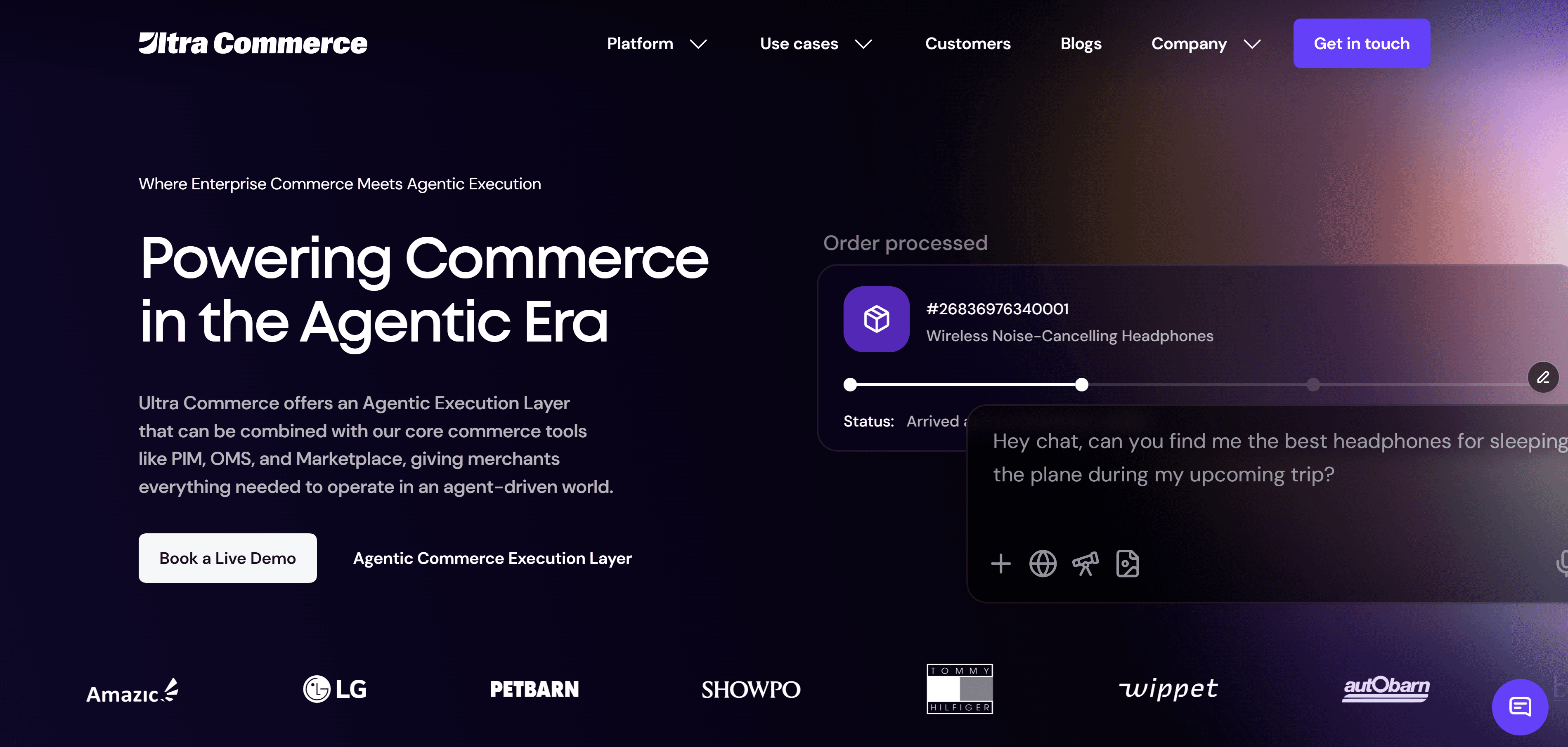
Ultra Commerce is purpose-built for enterprise businesses that need to move fast without compromising on governance or flexibility. Whether you are scaling a multi-vendor platform or optimising an existing enterprise ecommerce solution, our modular architecture and AI-enabled capabilities are designed to fit your existing tech stack. Explore what is possible at Ultra Commerce and take the next step toward building an AI-ready commerce infrastructure that scales with your ambitions.
Frequently asked questions
What is the average ROI for AI investments in enterprise e-commerce?
Research indicates up to 11x ROI is achievable, but this depends heavily on the quality of your data foundations and the maturity of your governance practices before deployment.
How much does AI-driven personalisation increase conversion rates?
AI personalisation can lift conversions by 22% compared to retailers not using AI, making it one of the highest-return applications available to enterprise e-commerce teams.
What are the main risks of implementing AI in online retail?
The primary risks include data bias, over-optimisation, and false positives, as well as ethical concerns around dynamic pricing that prioritises revenue over customer fairness.
Why are some retailers losing market share without AI?
Non-AI retailers lost 2.3% market share as AI-enabled competitors gained ground through superior personalisation, faster operations, and more scalable catalogue management.