

March 24, 2026
Enterprise
B2B
Unlock key benefits of B2B e-commerce for enterprise growth
Selecting the right B2B e-commerce platform represents one of the most consequential technology decisions enterprise leaders face today. The complexity stems from balancing operational efficiency gains, scalability requirements, and AI-driven growth strategies whilst navigating integration challenges and adoption costs. This article examines the critical criteria for evaluating B2B e-commerce benefits, explores measurable advantages backed by recent data, and provides a framework to help decision-makers maximise return on investment whilst avoiding common pitfalls that derail implementations.
Table of Contents
Key takeaways
Criteria for evaluating B2B e-commerce benefits
Operational efficiency and cost reduction benefits
Scalability and AI-driven growth advantages
Choosing the right platform: avoiding pitfalls and maximising benefits
Explore Ultra Commerce for advanced enterprise B2B solutions
Frequently asked questions
Key Takeaways
Point | Details |
|---|---|
Revenue and efficiency gains | Enterprise B2B ecommerce delivers measurable revenue growth and operational efficiency when the platform is selected with strategic alignment and careful implementation. |
AI driven growth | Modern B2B platforms use artificial intelligence to lift average order value and order volumes through personalised recommendations and pricing optimisation. |
Platform readiness matters | Choose a solution that supports multi user accounts, quote to order workflows, and contract based pricing without extensive customisation. |
Adoption cost awareness | Assess adoption costs beyond licensing by considering data migration training process redesign and ongoing maintenance to ensure readiness. |
Criteria for evaluating B2B e-commerce benefits
Enterprise decision-makers need a structured framework to assess whether a B2B e-commerce platform will deliver promised benefits. The evaluation process should prioritise operational impact, growth potential, and implementation feasibility rather than feature checklists alone.
Start by identifying operational efficiency opportunities within your current procurement and order management workflows. Look for manual processes that consume staff time, create errors, or slow transaction cycles. The platform should demonstrably reduce these friction points whilst maintaining compliance and approval hierarchies your business requires.
Assess scalability requirements based on your expansion plans. Consider these critical factors:
Geographic reach and multi-currency transaction support
Catalogue complexity including custom pricing tiers and contract terms
User hierarchy management for multi-level approval workflows
Traffic spike handling during peak ordering periods
Integration capacity with existing ERP, CRM, and inventory systems
Evaluate AI capabilities that drive measurable market growth. Modern B2B platforms leverage artificial intelligence for personalised product recommendations, dynamic pricing optimisation, and predictive inventory management. These features directly impact average order values and customer lifetime value when implemented effectively.
Platform readiness to handle B2B complexities separates successful implementations from failed projects. Your chosen solution must natively support multi-user account structures, quote-to-order workflows, and contract-based pricing without requiring extensive customisation. Many enterprises underestimate this requirement and face costly workarounds later.
Understand adoption costs beyond initial licensing fees. Implementation requires data migration, staff training, process redesign, and ongoing maintenance. Not all firms benefit equally, particularly those lacking data maturity or facing integration hurdles. Assess your organisation’s readiness honestly before committing resources.
Pro Tip: Create a weighted scoring matrix that assigns importance values to each evaluation criterion based on your specific business priorities. This quantitative approach helps compare platforms objectively and builds consensus amongst stakeholders with different departmental concerns.
Navigating B2B e-commerce challenges requires understanding both technical capabilities and organisational change management. The platform evaluation process should involve stakeholders from procurement, sales, IT, and finance to ensure all requirements surface early.
Operational efficiency and cost reduction benefits
B2B e-commerce platforms deliver substantial cost savings by automating workflows that traditionally required manual intervention. E-procurement systems reduce processing costs whilst improving accuracy and compliance across purchasing cycles.

The efficiency gains manifest across multiple operational areas. Order entry automation eliminates transcription errors that plague phone and email-based ordering systems. Approval workflows route purchase requests to appropriate managers based on predefined rules, reducing delays and ensuring policy compliance. Inventory visibility prevents stockouts and overordering by providing real-time availability data to buyers and sales teams simultaneously.
Cost reduction occurs through several mechanisms:
Reduced labour costs from automated order processing and invoice reconciliation
Lower error rates minimising returns, disputes, and customer service interactions
Decreased intermediary costs by enabling direct buyer-seller connections
Improved supplier negotiations through data-driven spend analysis
Faster cash conversion cycles from streamlined ordering to payment workflows
Consider a manufacturing enterprise processing thousands of component orders monthly. Manual order entry might require three full-time staff members, each handling approximately 65 orders daily with a 4% error rate requiring correction. An e-commerce platform automates this entirely, redirecting staff to value-adding activities whilst eliminating error-related costs.
Systematic reviews consistently demonstrate that B2B e-commerce implementations deliver measurable efficiency improvements and cost reductions across diverse industries and company sizes.
Productivity improvements extend beyond the procurement department. Sales teams access real-time inventory and pricing data, enabling faster quote generation and order confirmation. Finance departments benefit from automated invoice matching and payment processing. Warehouse operations receive orders in digital format, reducing picking errors and shipping delays.
The efficiency benefits compound over time as organisations optimise their processes around platform capabilities. Initial implementations might achieve 20-30% time savings in order processing. Mature implementations often reach 60-70% efficiency gains as workflows become fully automated and exception handling improves.
Addressing B2B order management challenges through platform automation creates competitive advantages that extend beyond cost savings. Faster order cycles improve customer satisfaction, whilst data accuracy enables better demand forecasting and inventory planning.
Scalability and AI-driven growth advantages
Enterprise B2B e-commerce platforms equipped with artificial intelligence capabilities drive measurable revenue growth that justifies implementation investments. Recent case studies demonstrate substantial gains when organisations modernise wholesale selling through AI-powered features.
Enterprise implementations achieve 15% revenue increases by transforming traditional wholesale processes with AI-driven product discovery, personalised recommendations, and dynamic pricing optimisation. These aren’t marginal improvements but fundamental shifts in how B2B buyers engage with suppliers.
The growth metrics reveal specific performance improvements. AI-powered transformations deliver 3.33% AOV increase by suggesting complementary products and optimising bundle configurations based on purchase history and industry benchmarks. Order volume growth of 1.64% stems from improved customer experience and reduced friction in the buying process. Mobile channel expansion of 11.4% reflects buyers’ preference for flexible ordering options across devices.
Scalability advantages become critical as enterprises expand into new markets or product categories. Modern platforms handle complex pricing structures including volume discounts, contract-specific rates, and customer-tier pricing without requiring custom development. User hierarchy management supports organisations with hundreds or thousands of buyers across multiple locations, each with different approval limits and purchasing permissions.
AI capabilities enhance multiple growth dimensions:
Predictive analytics identify cross-sell and upsell opportunities based on buying patterns
Intelligent search improves product discovery for large catalogues with technical specifications
Dynamic pricing optimises margins whilst remaining competitive within market segments
Personalised experiences increase engagement and repeat purchase frequency
Automated inventory allocation prioritises high-value customers during supply constraints
Consider how AI transforms B2B wholesale operations by analysing purchasing behaviour across customer segments. The platform identifies which products frequently purchase together, optimal reorder timing, and price sensitivity thresholds. This intelligence enables proactive outreach and targeted promotions that drive incremental revenue.
Pro Tip: Establish baseline metrics for average order value, order frequency, and customer acquisition cost before implementation. Track these monthly post-launch to quantify AI-driven improvements and identify optimisation opportunities. Most organisations see measurable gains within three to six months of go-live.
Mobile growth deserves particular attention as B2B buyers increasingly expect consumer-grade experiences. Platforms optimised for mobile ordering capture purchases that might otherwise go to competitors with more convenient interfaces. The 11.4% mobile growth figure reflects this channel’s importance in modern B2B commerce.
Scaling B2B digital commerce requires platforms that maintain performance during traffic spikes whilst supporting complex business logic. Peak ordering periods, promotional campaigns, and seasonal demand fluctuations test system capacity. Enterprise-grade solutions handle these scenarios without degradation.
Choosing the right platform: avoiding pitfalls and maximising benefits
Platform selection determines whether your B2B e-commerce initiative delivers promised benefits or becomes a costly compromise. The most common failure mode occurs when enterprises attempt to adapt B2C-focused platforms for B2B requirements, underestimating the complexity gap.
B2C platforms fail at handling B2B complexities including contract-based pricing, multi-user approval workflows, and custom catalogue management. Edge cases like tiered pricing structures, quote-to-order processes, and customer-specific product visibility require extensive customisation on B2C platforms. These workarounds create technical debt, limit scalability, and often force organisations to revert to manual processes for complex transactions.
The comparison between B2B-native platforms and adapted B2C solutions reveals critical differences:
Capability | B2B-native platform | Adapted B2C platform |
|---|---|---|
Multi-user accounts | Native support with role-based permissions | Requires custom development |
Contract pricing | Built-in tier and volume discount management | Manual workarounds or extensions |
Approval workflows | Configurable multi-level approval chains | Limited or absent |
Custom catalogues | Per-customer product and pricing visibility | Complex customisation required |
Quote management | Integrated quote-to-order conversion | Separate system or manual process |
Payment terms | Net 30/60/90 and credit limit management | Primarily immediate payment focused |
Successful platform selection focuses on these critical factors:
Native B2B feature completeness reducing customisation requirements
Integration architecture supporting existing ERP and CRM systems
Scalability for catalogue size, user volume, and transaction complexity
User experience tailored for professional buyers rather than consumers
Vendor stability and enterprise support capabilities
Total cost of ownership including licensing, implementation, and maintenance
Many enterprises discover platform limitations only after implementation when edge cases emerge. A manufacturer might find their adapted B2C platform cannot handle customer-specific packaging requirements or minimum order quantities without custom coding. A distributor might struggle with territory-based pricing rules that require manual intervention.
The user experience dimension deserves careful evaluation. B2B buyers need features like quick order entry by SKU, saved order templates, and bulk upload capabilities. They prioritise efficiency over browsing experiences. Platforms designed for consumers often lack these productivity features, frustrating professional purchasers who process dozens of orders weekly.
Addressing B2B buyers through design means understanding their workflow requirements and information needs. Technical specifications, compliance documentation, and compatibility data matter more than lifestyle imagery. Search functionality must handle part numbers, industry codes, and technical parameters.
Implementation success requires considering launch priorities from customers’ perspective rather than internal convenience. Forcing buyers to adapt to platform limitations damages adoption and undermines efficiency benefits. The platform should accommodate existing purchasing behaviours whilst gently encouraging more efficient workflows.
Providing the experience customers demand means matching or exceeding their best B2B buying experiences elsewhere. Buyers compare your platform to best-in-class competitors, not to your previous phone-based ordering system. This competitive benchmark drives platform selection towards enterprise-grade solutions.
Explore Ultra Commerce for advanced enterprise B2B solutions
Enterprise organisations facing complex B2B commerce requirements need platforms purpose-built for their operational scale and global reach. Ultra Commerce delivers composable commerce architecture designed specifically for enterprises managing intricate pricing structures, multi-vendor operations, and sophisticated buyer hierarchies.
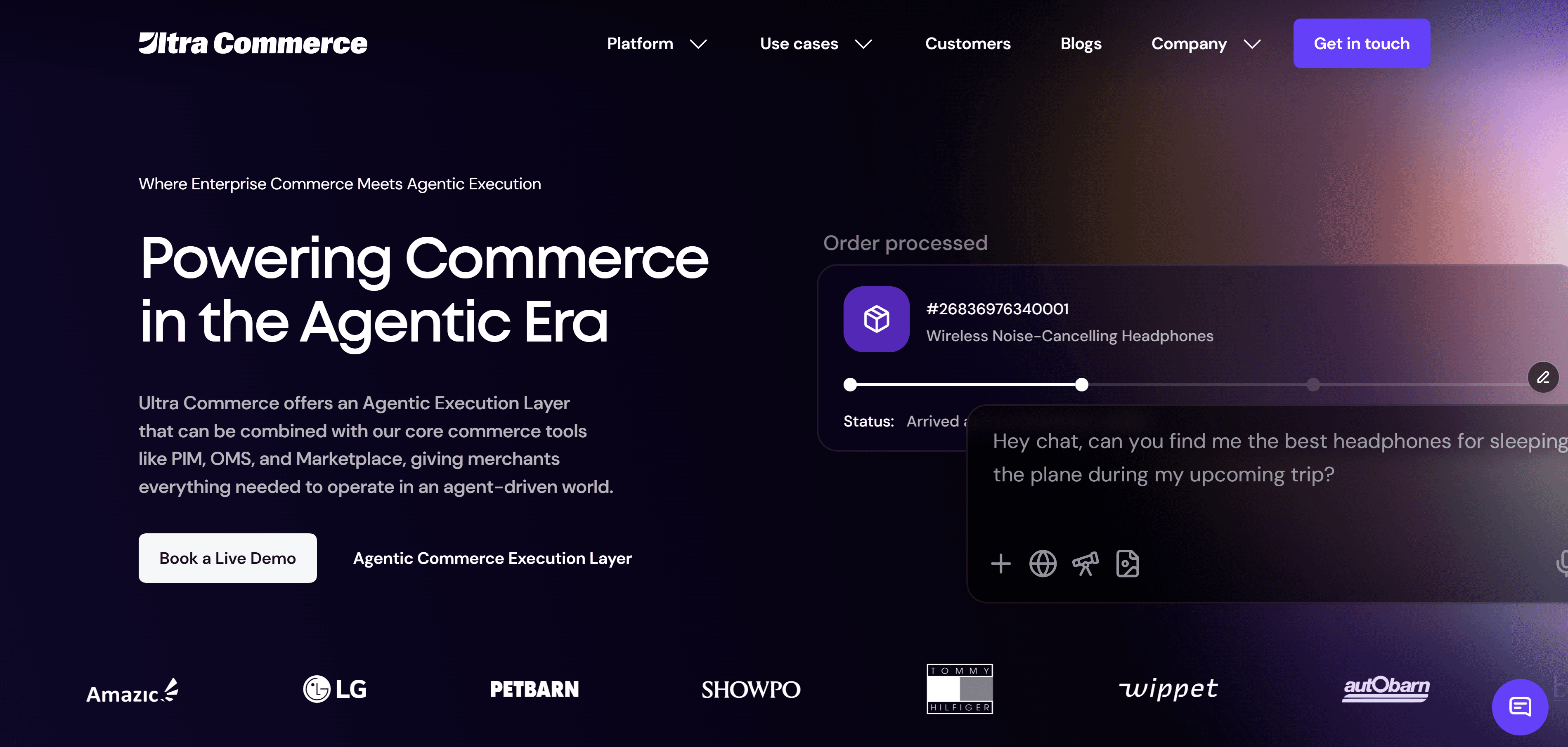
The platform’s enterprise e-commerce capabilities support the operational efficiency, scalability, and AI-driven growth strategies discussed throughout this article. Native multi-vendor marketplace functionality, advanced Product Information Management, and intelligent orchestration tools enable complex B2B scenarios without extensive customisation.
Ultra Commerce platform architecture integrates seamlessly with existing technology stacks, avoiding disruptive replatforming whilst modernising commerce capabilities. The modular approach allows organisations to adopt components matching their specific requirements, whether that’s enhanced order management, enriched product data, or AI-powered discovery.
For enterprises ready to unlock the measurable benefits of modern B2B e-commerce whilst avoiding the pitfalls of inadequate platforms, exploring Ultra Commerce’s enterprise-focused approach provides a practical next step in your evaluation process.
Frequently asked questions
What are the primary benefits of B2B e-commerce for enterprises?
Enterprise B2B e-commerce delivers measurable revenue growth, operational efficiency improvements, and enhanced customer engagement. Recent implementations show 15% revenue increases through AI-driven wholesale modernisation, whilst automation reduces manual processing costs and errors. Scalability benefits enable global expansion and complex pricing management that manual systems cannot support effectively.
How does AI improve B2B e-commerce performance?
AI capabilities drive 3.33% average order value increases through intelligent product recommendations and bundle optimisation. Order volumes grow 1.64% from improved customer experience and reduced buying friction. Predictive analytics identify cross-sell opportunities whilst dynamic pricing optimises margins, creating measurable profit improvements beyond basic automation benefits.
What challenges do enterprises face implementing B2B e-commerce?
Data immaturity, legacy system integration complexity, and adoption costs represent the primary implementation hurdles. Organisations lacking structured product data or modern ERP systems face longer implementation timelines. Platform selection mistakes, particularly using B2C solutions for B2B requirements, create costly workarounds that limit scalability and force manual process reversion.
Why do B2C platforms fail for B2B commerce needs?
B2C platforms lack native support for contract pricing, multi-user approval workflows, and customer-specific catalogues that B2B commerce requires. Edge cases like tiered volume discounts, quote-to-order processes, and territory-based pricing necessitate extensive customisation. These workarounds create technical debt and often prove unscalable as transaction complexity or user volume grows.
How long does it take to see ROI from B2B e-commerce?
Most enterprises observe measurable efficiency gains within three to six months post-launch as order automation reduces processing costs and errors. Revenue growth from AI-driven features typically manifests across six to twelve months as customer adoption increases and optimisation efforts mature. Total ROI timelines vary based on implementation scope, with full benefits realisation occurring across 18 to 24 months for comprehensive deployments.