

April 10, 2026
Enterprise
Omni-Channel
Multi-Vendor
TL;DR:
Platform-agnostic ecommerce enables flexible, fast integration of various specialised tools and systems.
It reduces vendor dependency, lowers costs, and improves scalability for multi-brand and multi-region enterprises.
Adopting a platform-agnostic approach requires organizational change and operational readiness beyond technology.
Platform lock-in is one of the most costly mistakes enterprise organisations make when scaling digital commerce. Many leaders assume that committing to a single vendor guarantees stability, but the opposite is often true. When your technology stack is tightly bound to one proprietary system, every new channel, market, or capability becomes a negotiation with that vendor. Platform-agnostic ecommerce breaks that cycle entirely, giving you the freedom to integrate best-of-breed tools, respond faster to market shifts, and build a commerce infrastructure that genuinely supports long-term growth. This guide covers everything you need to know.
Table of Contents
Key Takeaways
Point | Details |
|---|---|
Unlock integration flexibility | Platform-agnostic ecommerce allows connection to any system, ensuring you’re never boxed in as the business evolves. |
De-risk enterprise growth | Reducing reliance on any single provider lets you scale, add brands, or pivot quickly without major migration headaches. |
Power true omnichannel experience | Unifying customer, order, and inventory data across channels is only possible with platform-agnostic foundations. |
Future-ready for AI and new tech | Adopting platform-agnostic architecture makes it easy to plug in advanced AI, automation, or marketplace models when you’re ready. |
Understanding platform-agnostic ecommerce
At its core, platform-agnostic ecommerce means your commerce operations are not dependent on any single vendor, technology, or system. Instead of being locked into one platform's ecosystem, you can connect and orchestrate multiple specialised tools, whether that is your ERP, CRM, PIM, OMS, or a new AI module, without rebuilding from scratch each time.
The concept is closely tied to composable architecture, where your commerce stack is assembled from modular, interoperable components. Each component does one job well and communicates with others through open APIs. This is fundamentally different from monolithic platforms, which bundle everything together and make customisation difficult, slow, and expensive.
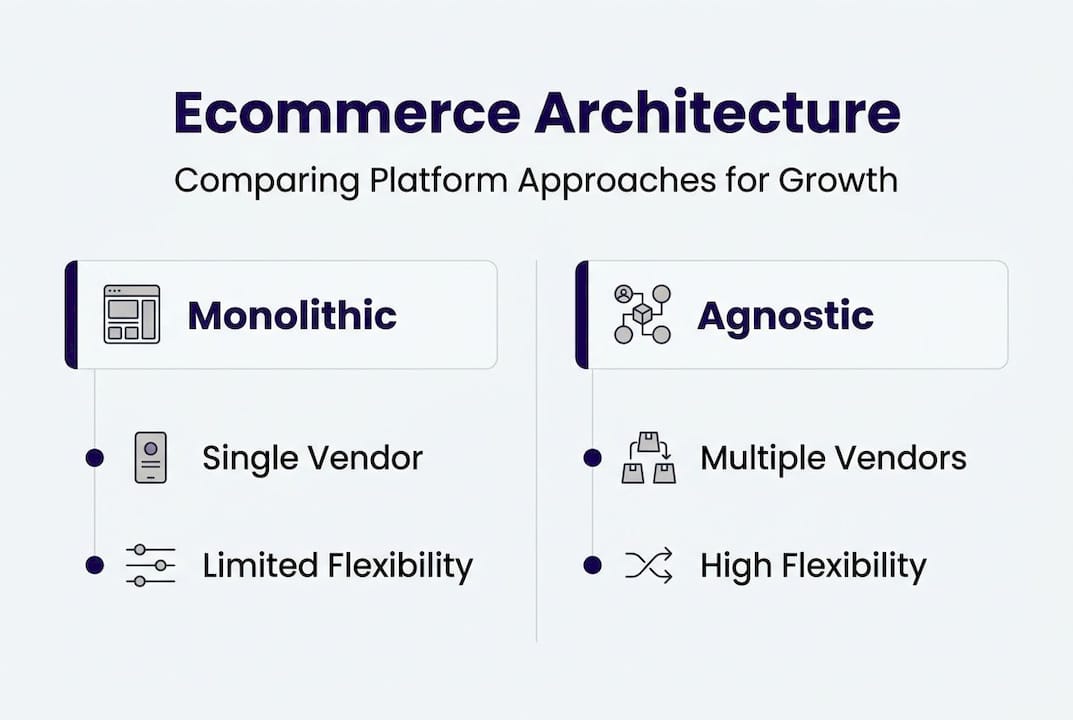
Here is a quick comparison of the two approaches:
Feature | Monolithic platform | Platform-agnostic approach |
|---|---|---|
Vendor dependency | High | Low |
Integration flexibility | Limited | Extensive |
Customisation speed | Slow | Fast |
Scalability | Constrained | Elastic |
Innovation adoption | Delayed | Accelerated |
A common myth is that platform-agnostic setups are inherently more complex or harder to govern. In reality, the challenge is not complexity but rather clarity. When you understand integration in commerce systems and how each component connects, you gain far more visibility and control than a monolithic system typically provides.
Key principles of a platform-agnostic approach include:
API-first design: Every system exposes and consumes data through open, documented APIs.
Vendor neutrality: No single vendor controls your entire commerce workflow.
Modular extensibility: New capabilities can be added without replacing existing infrastructure.
Data portability: Your customer and transaction data is always accessible and transferable.
For enterprises managing multi-vendor marketplaces or operating across multiple brands and regions, this matters enormously. Proprietary platforms often struggle with the data-sharing and workflow complexity these models demand. Platform-agnostic foundations, particularly those built on headless architectures, solve these challenges by separating the presentation layer from commerce logic, giving teams the freedom to innovate without disrupting core operations.
"True platform agnosticism is not about using more tools. It is about removing the barriers that prevent your best tools from working together."
Key benefits for enterprise operations
Once you understand what platform-agnostic ecommerce is, the business case becomes straightforward. For enterprise organisations managing complexity across regions, brands, and channels, the advantages are significant and measurable.
Scalability across brands and markets. Multi-brand flexibility is one of the most compelling reasons enterprises move away from proprietary platforms. When each brand or market can operate with its own configuration while sharing core infrastructure, you reduce duplication and accelerate go-to-market timelines considerably.
Faster integration with emerging technology. AI modules, advanced analytics, and new payment methods all require clean integration points. Platform-agnostic stacks make it far easier to plug in these capabilities without waiting for a vendor's product roadmap to catch up.
Reduced vendor dependency. When you are not locked into a single platform, you have genuine negotiating leverage. Vendors compete for your business rather than holding it captive. This directly impacts your licensing costs and the quality of support you receive.
Here is how platform-agnostic approaches compare to proprietary platforms on key enterprise metrics:
Metric | Proprietary platform | Platform-agnostic |
|---|---|---|
Time to integrate new tech | Weeks to months | Days to weeks |
Cost of switching vendors | Very high | Low to moderate |
Support for multi-vendor models | Limited | Native |
Innovation cycle speed | Vendor-dependent | Business-driven |
Additional operational benefits include:
Lower total cost of ownership over a three to five year horizon
Ability to adopt future-proofing ecommerce strategies without replatforming
Stronger data governance and security posture across integrated systems
Faster onboarding of new marketplace vendors or channel partners
Pro Tip: Before signing any vendor contract, ask specifically about API rate limits, data export rights, and integration support costs. These are the hidden expenses that inflate the true cost of proprietary platforms over time.
The financial case is equally strong. Enterprises that invest in platform-agnostic foundations typically see faster payback on new technology investments because integration friction is lower. When your stack is built for connection rather than containment, every new capability adds compounding value.
Omnichannel, AI, and multi-vendor readiness
Platform-agnostic ecommerce is not just about technology flexibility. It is the foundation that makes genuinely seamless omnichannel experiences possible. Without it, omnichannel best practices remain aspirational rather than operational.

When your commerce systems are siloed by vendor boundaries, customer data fragments across touchpoints. A shopper who browses on mobile, purchases in-store, and seeks support online encounters inconsistency because the systems behind each channel cannot share information fluidly. Platform-agnostic architecture solves this by creating a single, connected data layer that all channels draw from and contribute to.
Here are the key stages in delivering an AI-ready omnichannel experience:
Unify your data layer. Consolidate customer, product, and transaction data into a single accessible source, regardless of which systems generate it.
Establish open integration points. Ensure every channel and tool connects through documented APIs, enabling real-time data exchange.
Layer AI capabilities strategically. Deploy AI for personalisation, demand forecasting, or dynamic pricing on top of your unified data, not within a single vendor's walled garden.
Enable multi-vendor data sharing. For marketplace models, build governance frameworks that allow vendors to share relevant data without compromising privacy or security.
Measure and iterate. Use cross-channel analytics to identify friction points and continuously refine the experience.
For multi-vendor marketplace operators, platform-agnostic stacks offer specific advantages in onboarding speed, workflow automation, and data-sharing governance. When vendors can connect through standard APIs rather than bespoke integrations, your marketplace scales faster and operates more reliably. Explore how multi-channel sales growth accelerates when integration barriers are removed.
Pro Tip: Before adding new AI modules or marketplace vendors, audit your current data governance policies. Gaps in data ownership, access controls, or retention rules become much more costly to fix after new systems are live.
Leading enterprises are also finding that embracing an omnichannel strategy requires organisational alignment, not just technology investment. Your platform-agnostic stack enables the capability, but your teams need clear ownership of cross-channel data and customer experience outcomes to realise the full benefit.
Making the platform-agnostic choice: Practical steps and considerations
Deciding to move toward a platform-agnostic model is a strategic commitment, not just a technology procurement decision. The good news is that you do not need to replace everything at once. A phased, milestone-driven approach significantly reduces risk and accelerates time to value.
Checklist: Questions to ask vendors about true agnosticism
Does the platform expose all core functionality through open, documented APIs?
Can we export all data, including historical transactions, at any time without restriction?
How does the platform handle third-party integrations, natively or through middleware?
What is the vendor's policy on supporting integrations with competing tools?
Are there contractual restrictions on connecting to specific partners or marketplaces?
If a vendor hesitates on any of these, treat it as a warning sign. True platform agnosticism means openness is a feature, not an afterthought.
Readiness assessment: Key measures for a successful transition
Readiness area | What to evaluate |
|---|---|
Integration maturity | Current API coverage and documentation quality |
Internal skills | Team capability to manage multi-system environments |
Data governance | Policies for data ownership, access, and portability |
Stakeholder alignment | Executive and operational buy-in for phased migration |
Partner ecosystem | Availability of certified integration partners |
For organisations that have scaled beyond your current platform, the migration framework typically follows three phases: current state assessment, phased capability migration, and continuous optimisation. Each phase should have defined KPIs tied to business outcomes, not just technical milestones.
When launching a new ecommerce platform or migrating an existing one, stakeholder buy-in is non-negotiable. Finance, operations, marketing, and IT all have a stake in the outcome. Aligning these teams early, with shared success metrics, is what separates successful migrations from costly ones.
Why the platform-agnostic revolution is only just beginning
Here is an uncomfortable truth: most enterprises that say they are pursuing platform-agnostic ecommerce are still thinking about it primarily as a technology selection exercise. They evaluate APIs, compare integration catalogues, and choose vendors. What they often miss is that the real transformation is cultural and operational.
Vendor lock-in does not always come from contracts. It comes from organisational habits, from teams that default to the familiar platform, from processes built around one system's limitations, and from leadership that equates stability with sameness. Even after adopting a platform-agnostic stack, these habits can quietly recreate the lock-in you worked to escape.
The enterprises that will win long-term are those investing in extensible foundations and the operating models to exploit them. Planning for the future of ecommerce means treating your commerce stack as a living system, one that evolves with your business rather than constraining it. The technology is ready. The question is whether your organisation is ready to think differently about how commerce infrastructure supports business strategy.
Take the next step with platform-agnostic ecommerce
If this guide has clarified the value of platform-agnostic ecommerce for your organisation, the next step is exploring what it looks like in practice at enterprise scale. Ultra Commerce is purpose-built for exactly this challenge.
From enterprise ecommerce solutions that handle complex multi-brand and multi-region operations, to a full Ultra Commerce platform overview covering PIM, OMS, orchestration, and governance, the capabilities are designed to integrate with your existing stack without disruption. You can also explore multi-vendor marketplace capabilities built natively for scale. Reach out to our team for a tailored consultation or platform demonstration aligned to your specific commerce goals.
Frequently asked questions
What does platform-agnostic mean in ecommerce?
Platform-agnostic ecommerce means your business can integrate and scale across any technology stack without being tied to one vendor or system. It gives your organisation the freedom to adopt best-of-breed tools as your needs evolve.
Is it more expensive to go platform-agnostic?
Platform-agnostic setups can require upfront investment, but they typically deliver lower long-term costs and stronger innovation ROI. Multi-brand operators in particular find the total cost of ownership significantly lower over a three to five year period.
How does platform-agnostic ecommerce support omnichannel retail?
By enabling seamless connection across all channels, platform-agnostic ecommerce creates unified shopping experiences that feel consistent for customers regardless of where or how they engage with your brand.
What risks should I consider before moving to platform-agnostic ecommerce?
Review vendor integration quality, your internal team's capability to manage multi-system environments, and data governance policies before migrating. Addressing these areas early reduces migration risk considerably.
What enterprise brands are already leveraging platform-agnostic commerce?
Leading multibrand and marketplace operators are early adopters, benefitting from faster integration cycles and genuine multi-channel agility. Multibrand adoption continues to grow as more organisations recognise the strategic value of flexible commerce infrastructure.