

March 25, 2026
Enterprise
Headless
Composable
Why scalable commerce platforms matter for enterprise success
Every year, billions in revenue evaporate when legacy commerce platforms buckle under peak demand. Enterprises relying on monolithic systems face catastrophic downtime during critical sales events, losing customers and market share to competitors with resilient infrastructures. The difference lies in scalability: modern composable platforms handle traffic surges, global complexity, and concurrent transactions that overwhelm traditional architectures. This guide explores how scalable commerce platforms using MACH principles solve enterprise challenges, comparing architectural approaches and revealing operational benefits that transform global commerce operations.
Table of Contents
Key takeaways
Understanding scalable commerce platforms and MACH architecture
Comparing monolithic platforms with composable and headless architectures
How scalable commerce platforms handle peak demand and global complexity
Operational and cost benefits of composable scalable commerce platforms
Explore Ultra Commerce for scalable enterprise solutions
FAQ
Key Takeaways
Point | Details |
|---|---|
Faster time to market | MACH architecture decouples components enabling faster development and quicker market entry. |
Scales for high concurrency | Composable platforms scale across traffic surges and global operations without bottlenecks. |
Monoliths limited by scalability | Monolithic systems struggle with peak load and slow updates, risking downtime during critical sales events. |
Headless enables rapid frontend updates | Headless architecture decouples frontend from backend enabling parallel release cycles and faster UI iteration. |
Lower total cost of ownership | Composable design reduces total cost of ownership by swapping underperforming components rather than replatforming. |
Understanding scalable commerce platforms and MACH architecture
Modern MACH architectures provide methodology for scalable commerce by decoupling components, improving speed and conversion. MACH stands for Microservices, API-first, Cloud-native, and Headless, representing a fundamental shift in how enterprises build commerce systems. Each component operates independently, communicating through APIs rather than sharing monolithic codebases.
Microservices break commerce functions into discrete services. Cart management, product search, checkout processing, and inventory tracking run as separate applications. When Black Friday traffic spikes search queries, only the search microservice scales up. The checkout service maintains steady performance without resource competition. This targeted scaling prevents the cascade failures that plague monolithic systems where one overloaded component crashes the entire platform.
API-first design creates clean interfaces between services and frontend experiences. Marketing teams launch new storefronts without backend changes. Mobile apps, voice commerce, and IoT devices consume identical APIs. This separation accelerates time-to-market by 40-60% compared to coupled architectures. Development teams work in parallel rather than queuing changes through monolithic release cycles.
Cloud-native infrastructure leverages elastic computing resources. Traffic doubles during promotions, and additional server instances spin up automatically. Demand normalises, and infrastructure scales down to baseline costs. Geographic distribution places services near customers, reducing latency for global audiences. A Sydney shopper experiences sub-100ms response times from regional servers rather than waiting for transatlantic data transfers.
Headless commerce separates presentation from business logic. Frontend developers iterate customer experiences without touching core commerce functions. Backend teams optimise pricing engines and fraud detection independently. This decoupling eliminates the bottleneck where frontend changes require backend deployments, reducing release cycles from months to days.
Pro Tip: Start your MACH transition with non-critical services like product recommendations or wishlists. Test distributed architecture patterns before migrating core checkout and payment systems.
The ultimate guide to composable commerce details how modular design reduces total cost of ownership. Enterprises replace underperforming components without replatforming entire systems. A struggling search engine swaps for a best-of-breed alternative in weeks. Legacy migrations take years and cost millions.
“Composable architecture transforms commerce platforms from rigid monoliths into flexible ecosystems where each component excels at its specific function.”
MACH solves concurrency challenges that monoliths cannot address. Ten thousand simultaneous checkout requests distribute across scaled payment microservices. Inventory checks run in parallel rather than queuing behind single-threaded processes. Order confirmation emails dispatch through dedicated messaging services that won’t block transaction completion. This architectural separation ensures no single function becomes a system-wide bottleneck during peak demand.
Comparing monolithic platforms with composable and headless architectures
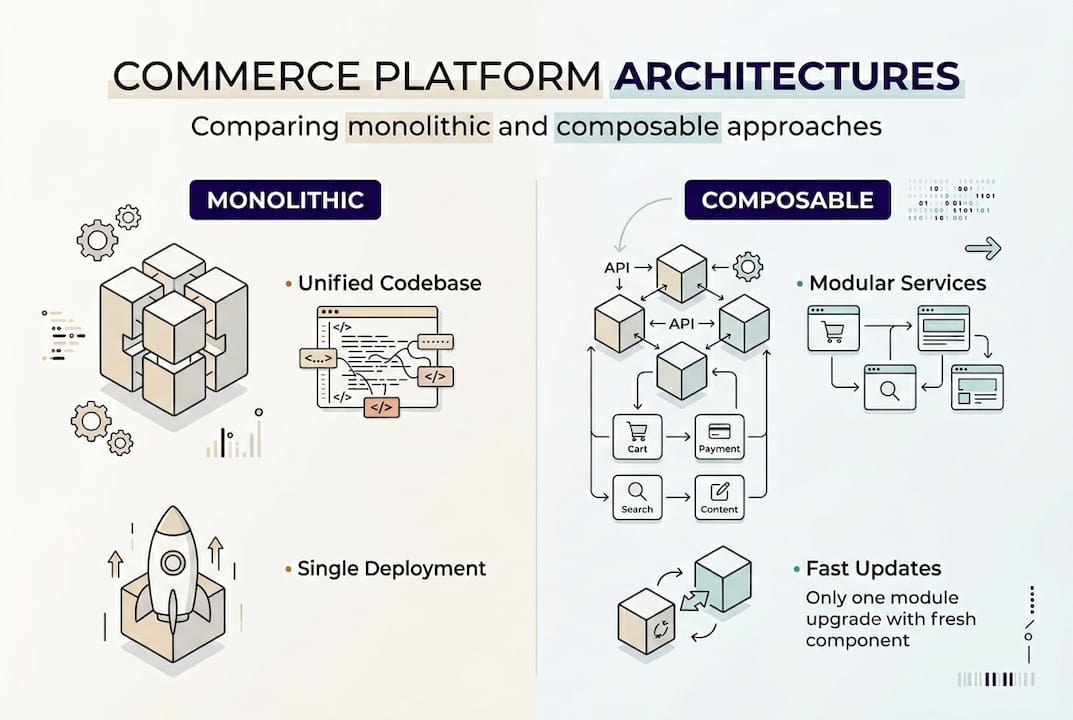
Monolithic platforms offer simplicity but poor concurrency; headless and composable deliver sub-100ms responses ideal for enterprise global operations. Understanding these trade-offs guides platform selection for specific business contexts.
Monolithic platforms bundle all commerce functions into unified codebases. Single deployments update the entire system. One development team manages all features. This simplicity appeals to organisations with limited technical resources. Small teams maintain platforms without orchestrating microservice dependencies. Updates follow predictable release schedules rather than continuous deployment patterns.
However, monoliths struggle with scale and flexibility. Traffic spikes affect all functions equally. A surge in product browsing slows checkout completion because both share compute resources. Geographic expansion requires replicating entire platforms rather than distributing specific services. Frontend changes necessitate full system deployments, creating risk and delay.
Headless architectures separate frontend presentation from backend commerce logic while maintaining coupled backend services. Multiple storefronts consume centralised APIs. This model improves frontend flexibility without full microservice decomposition. Teams launch channel-specific experiences faster than monolithic constraints allow.

Composable platforms extend headless principles throughout the entire stack. Every backend function operates as an independent service. Enterprises select best-of-breed components for each capability. Payment processing, inventory management, pricing engines, and fraud detection come from specialised providers rather than bundled suites.
Architecture | Response Time | Concurrent Users | Update Frequency | Operational Complexity |
|---|---|---|---|---|
Monolithic | 200-500ms | 10,000-50,000 | Quarterly releases | Low to moderate |
Headless | 100-200ms | 50,000-200,000 | Monthly releases | Moderate |
Composable | 50-100ms | 200,000+ | Continuous deployment | High |
Composable architectures introduce distributed system challenges. Network latency between services affects total response times. Service dependencies create potential failure cascades. An unavailable pricing service blocks checkout completion unless circuit breakers and fallback mechanisms provide resilience. Middleware orchestration layers coordinate service interactions and handle failures gracefully.
The headless vs composable commerce comparison reveals nuanced selection criteria. Headless suits enterprises seeking frontend flexibility without backend complexity. Composable fits organisations requiring independent scaling, best-of-breed components, and global distribution.
Pro Tip: Evaluate your team’s DevOps maturity before committing to composable architecture. Distributed systems require monitoring, orchestration, and incident response capabilities that monolithic platforms don’t demand.
Operational overhead scales with architectural complexity. Monoliths need single deployment pipelines and unified monitoring. Composable platforms require container orchestration, service meshes, distributed tracing, and API gateways. Teams must master Kubernetes, observability tools, and microservice debugging techniques. This investment pays dividends at enterprise scale but overwhelms organisations without technical depth.
The monolithic to composable ecommerce transition path balances risk and reward. Phased migrations move non-critical services first, building expertise before touching core transaction systems. Strangler fig patterns gradually replace monolithic components while maintaining business continuity.
How scalable commerce platforms handle peak demand and global complexity
Modular auto-scaling in composable setups mitigates edge cases like Black Friday and Cyber Monday crashes and inventory overselling. Real-world enterprise operations test platform resilience through traffic surges, geographic distribution, and channel complexity that expose architectural weaknesses.
Legacy platforms fail predictably during peak events. Black Friday traffic exceeds capacity planning assumptions. Checkout queues lengthen as single-threaded payment processing bottlenecks transactions. Inventory systems oversell products because synchronisation locks prevent concurrent updates. Frustrated customers abandon carts, and revenue targets evaporate. Post-mortem analyses reveal architectural limits rather than configuration mistakes.
Composable platforms address these failures through independent component scaling. Traffic monitoring detects rising search queries and provisions additional search service instances. Checkout processing scales separately based on transaction volume rather than overall site traffic. Inventory management distributes across regional services, eliminating global synchronisation bottlenecks.
Enterprise scalability preparation follows systematic approaches:
Baseline performance profiling measures current capacity limits and identifies bottleneck components through load testing and production monitoring.
Component dependency mapping documents service interactions and failure modes, revealing where circuit breakers and fallbacks prevent cascade failures.
Auto-scaling policy configuration defines thresholds and scaling behaviours for each microservice based on specific metrics like queue depth or response latency.
Geographic distribution planning places services near customer concentrations, reducing latency and improving resilience through regional failover.
Chaos engineering validation deliberately introduces failures during controlled tests, verifying that systems degrade gracefully rather than collapsing completely.
Global multi-channel retail introduces complexity beyond simple traffic scaling. A London customer browses on mobile, adds items via desktop, and completes checkout through a voice assistant. Session state synchronises across devices and channels in real-time. Inventory reserves during browsing to prevent overselling, releasing stock if checkout doesn’t complete within time limits.
Composable platforms handle channel complexity through event-driven architectures. Cart updates publish events that synchronise state across all customer touchpoints. Inventory services subscribe to checkout events, adjusting stock levels atomically. Marketing services consume browsing events to trigger personalised recommendations. This loose coupling prevents channel-specific implementations from creating maintenance nightmares.
“SCAYLE’s composable commerce engine handles 130 million monthly visitors across global enterprise retailers, demonstrating production-proven scalability that legacy platforms cannot match.”
Inventory complexity multiplies with marketplace models. Multiple vendors fulfil orders from distributed warehouses. Stock levels aggregate across locations. Routing logic selects optimal fulfilment centres based on customer proximity, inventory availability, and shipping costs. Split shipments coordinate partial order delivery when single locations lack complete stock.
The how to go composable guide details migration strategies that maintain business continuity. Parallel operation runs legacy and composable systems simultaneously, gradually shifting traffic as confidence grows. Feature flags enable instant rollback if issues emerge. This de-risks transitions that monolithic replacements cannot offer.
Key scalability indicators for enterprise platforms:
Concurrent user capacity exceeding 200,000 simultaneous sessions
Sub-100ms API response times at 95th percentile under load
Independent component scaling without system-wide deployments
Geographic distribution supporting multi-region active-active configurations
Automated failover completing within seconds of component failures
Elastic infrastructure costs scaling linearly with traffic rather than requiring overprovisioning
Operational and cost benefits of composable scalable commerce platforms
Composable MACH reduces vendor lock-in and operational costs by 24-30%, but requires mature DevOps practices. Economic and operational considerations ultimately drive enterprise platform decisions beyond pure technical capabilities.
Vendor lock-in creates hidden costs that accumulate over platform lifecycles. Monolithic vendors control pricing, feature roadmaps, and integration capabilities. Switching costs reach millions in replatforming expenses, effectively trapping enterprises in deteriorating relationships. Composable architectures eliminate this dependency by making each component replaceable.
Cost reduction mechanisms in composable platforms:
Component competition allows enterprises to negotiate better pricing when vendors know alternatives exist without replatforming penalties
Elastic infrastructure scales costs with actual demand rather than peak capacity overprovisioning required by monoliths
Parallel development accelerates feature delivery, reducing opportunity costs from delayed launches
Reduced customisation debt keeps platforms closer to standard implementations because API integrations replace core code modifications
Metric | Legacy Monolithic | Composable Platform | Improvement |
|---|---|---|---|
Annual platform costs | $850,000 | $595,000 | 30% reduction |
Time to market (new features) | 6-9 months | 2-4 weeks | 85% faster |
Infrastructure utilisation | 40% average | 75% average | 87% efficiency gain |
Vendor switching cost | $3-5 million | $200,000-400,000 | 90% lower |
Downtime (annual hours) | 18-24 hours | 2-4 hours | 85% improvement |
Operational complexity increases with composable adoption. DevOps teams manage container orchestration, service meshes, and distributed monitoring. Incident response requires tracing requests across multiple services rather than debugging single applications. On-call rotations expand to cover more components. This operational overhead demands skilled engineers and robust tooling.
Organisations lacking DevOps maturity face implementation challenges. Distributed systems expertise doesn’t develop overnight. Monitoring and observability tools require significant investment. Team training takes months before productivity matches legacy platform familiarity. Enterprises must honestly assess their technical capabilities before committing to composable architectures.
The truth about composable commerce addresses common misconceptions about implementation difficulty and cost. While operational complexity increases, total cost of ownership decreases through flexibility and efficiency gains. The investment in DevOps capabilities pays returns across all technology initiatives, not just commerce platforms.
Pro Tip: Build a centre of excellence for composable commerce that develops internal expertise, establishes patterns, and supports teams across the organisation. Centralised knowledge accelerates adoption and prevents duplicated learning curves.
Practical transition strategies ease composable adoption:
Start with non-critical services to build team confidence and operational patterns
Invest in observability infrastructure before migrating core transaction systems
Partner with experienced implementation agencies during initial deployments
Establish API standards and governance early to prevent integration chaos
Create runbooks and incident response procedures specific to distributed architectures
The enhancing flexibility and sales channels discussion reveals how operational benefits compound over time. Initial complexity gives way to unprecedented agility. Teams launch experiments in days rather than quarters. Failed initiatives shut down without affecting other services. This velocity transforms commerce from a technology constraint into a competitive advantage.
Long-term ROI extends beyond direct cost savings. Faster time-to-market captures opportunities before competitors. Better performance improves conversion rates and customer satisfaction. Reduced downtime prevents revenue loss during peak periods. These benefits accumulate to justify the upfront investment in composable platforms and DevOps capabilities.
Explore Ultra Commerce for scalable enterprise solutions
The architectural principles and operational benefits discussed throughout this guide come to life in platforms purpose-built for enterprise scale. Ultra Commerce delivers composable, scalable infrastructure designed specifically for complex global commerce operations that demand resilience, flexibility, and performance.

Ultra Commerce’s enterprise ecommerce platform supports multi-vendor marketplaces, complex B2B and B2C transactions, and global operations through modular components that scale independently. The Ultra Commerce platform provides enterprise-grade capabilities including advanced Product Information Management, sophisticated order management systems, and AI-driven orchestration that handles the complexity modern commerce demands. Recognised in Gartner’s Magic Quadrant, Ultra Commerce combines proven technology with the flexibility enterprises need to evolve at pace without replatforming constraints.
FAQ
What makes a commerce platform scalable?
Scalability comes from modular, decoupled components that scale independently based on specific demand patterns. API-first design allows services to communicate without tight coupling. Cloud-native infrastructure provides elastic computing resources that expand during traffic surges and contract during normal periods. Auto-scaling capabilities automatically provision additional capacity when performance metrics indicate approaching limits. These architectural characteristics enable platforms to handle growth without performance degradation or manual intervention.
How do composable commerce platforms reduce vendor lock-in?
Composable commerce separates functionalities into independent services connected through standard APIs. Enterprises can swap individual components like search engines, payment processors, or inventory management systems without touching other services. This modularity eliminates the replatforming costs that trap organisations in deteriorating vendor relationships. Best-of-breed selection becomes practical because integration happens through APIs rather than custom code modifications. The flexibility to replace underperforming components maintains competitive pressure on vendors and prevents pricing exploitation.
Are monolithic platforms still suitable for some enterprises?
Monolithic platforms fit organisations with simpler operations, smaller teams, or lower concurrency demands where ease of management is critical. Businesses handling moderate traffic without global distribution needs benefit from unified deployments and simpler operational requirements. Teams lacking distributed systems expertise avoid the complexity that composable architectures introduce. The trade-off accepts scalability limits in exchange for reduced operational overhead. As organisations grow and operations become more complex, monolithic constraints eventually necessitate platform evolution.
What are common challenges enterprises face when adopting composable commerce?
Challenges include mastering complex integrations across multiple independent services that must work together seamlessly. Enterprises must invest in robust DevOps practices including container orchestration, service mesh management, and distributed monitoring. Teams require upskilling to manage microservice architectures, debug cross-service issues, and implement resilience patterns like circuit breakers. Organisational change management becomes critical as development practices shift from monolithic release cycles to continuous deployment. Initial productivity often decreases during the learning curve before teams achieve the velocity benefits composable architectures enable.