

March 31, 2026
Enterprise
Ecommerce Strategy
Multi-Vendor
Manage global e-commerce operations for seamless growth
Managing global multi-vendor e-commerce operations is one of the most complex challenges facing enterprise operations managers today. The global e-commerce market is projected to reach $7.9 trillion by 2027, and cross-border selling is central to capturing that growth. Yet scaling across regions means navigating fragmented vendor ecosystems, localisation demands, compliance obligations, and infrastructure strain all at once. This guide walks you through the critical decisions and practical strategies that will help you build, optimise, and sustain a high-performing global marketplace operation.
Table of Contents
Laying the groundwork: Prerequisites for scaling global e-commerce
Optimising infrastructure and vendor management
Mastering localisation and cross-border conversions
Navigating compliance, logistics, and cross-border operations
Measuring success: KPIs, troubleshooting, and continuous improvement
Supercharge your global e-commerce growth with Ultra Commerce
Frequently asked questions
Key Takeaways
Point | Details |
|---|---|
Build agile foundations | Scalable infrastructure and in-depth market research are essential before global expansion. |
Automate vendor management | Centralised onboarding and automation dramatically reduce costs and speed up marketplace growth. |
Invest in localisation | Full localisation, beyond basic translation, can lift conversion rates and customer trust. |
Stay compliant globally | Always address regional law, shipping models, and logistics hurdles for risk-free scaling. |
Monitor and adapt | Review KPIs regularly and use data-driven iterations to sustain international success. |
Laying the groundwork: Prerequisites for scaling global e-commerce
Now that you understand the urgency and scale of the opportunity, it is time to set your operation up for success from the ground up. Scaling globally is not simply a matter of switching on new markets. It requires deliberate preparation across technology, people, and process.
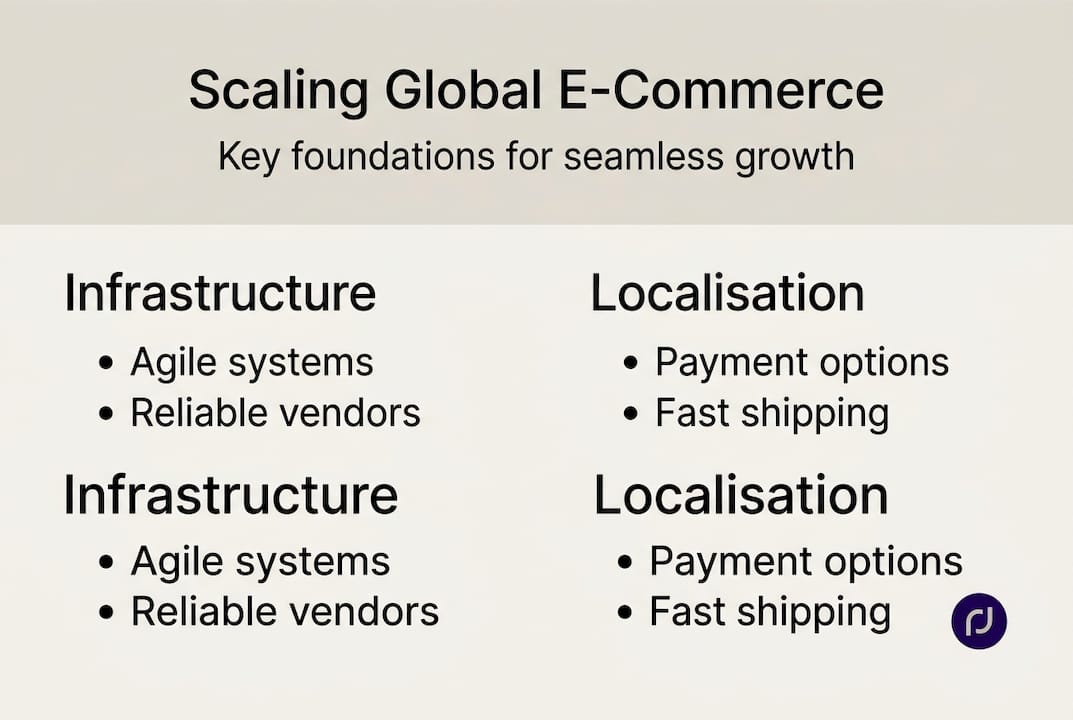
The foundational pillars of global scaling are agile infrastructure, hyper-localisation, data-driven logistics, and robust legal compliance. Without these in place, growth in one region can create bottlenecks that undermine performance everywhere else.
Here are the core prerequisites every enterprise should address before expanding:
Agile digital infrastructure that supports multi-region deployments and traffic spikes without degradation
Thorough international market research covering demand signals, regulatory environments, and logistics complexity
Dedicated cross-functional roles including cross-border logistics specialists, compliance leads, and regional support teams
Composable or headless commerce architecture that allows you to adapt your tech stack without full replatforming
A clear global strategy framework that aligns commercial goals with operational capacity
Pro Tip: Do not select new markets based on size alone. A large addressable market with complex import regulations and poor last-mile logistics can cost more than it returns. Balance opportunity with operational feasibility.
The table below summarises the key prerequisites and why each one matters for sustainable global growth.
Prerequisite | Why it matters |
|---|---|
Agile infrastructure | Handles regional traffic and seasonal spikes without downtime |
Market research | Reduces risk of entering markets with poor ROI or high compliance burden |
Cross-functional team | Ensures expertise across logistics, legal, and customer experience |
Composable architecture | Enables fast adaptation without costly replatforming |
Compliance readiness | Protects against fines, delays, and reputational damage |
Addressing these global e-commerce challenges early prevents costly course corrections later in your expansion journey.
Optimising infrastructure and vendor management
With foundations in place, let us look at the specifics of aligning systems and managing global vendors for efficiency and growth. Infrastructure and vendor management are where operational theory meets daily execution.
Multi-vendor marketplaces require centralised vendor onboarding, real-time inventory sync, and automated payouts to scale effectively. Without these capabilities, your marketplace will struggle to maintain product availability and vendor satisfaction as it grows.

The contrast between manual and automated onboarding is stark. Consider this comparison:
Approach | Onboarding time | Error rate | Scalability |
|---|---|---|---|
Manual onboarding | 8 to 10 days | High | Limited |
Automated onboarding | 1 to 2 days | Low | High |
“Automation is not just an efficiency play. It is a competitive advantage. Marketplaces that reduce vendor onboarding friction see faster catalogue growth, higher vendor retention, and stronger revenue outcomes.”
The results speak for themselves. Vendor onboarding time reduced from 10 to 2 days, with 85% vendor adoption achieved within 3 months through automation. That kind of acceleration directly impacts your catalogue depth and time to revenue.
Here are the key steps to implement effective inventory sync and automated payouts:
Audit your current vendor data flows to identify where manual handoffs create delays or errors
Integrate a centralised vendor portal that standardises onboarding documentation and product data submission
Deploy real-time inventory sync across all vendor feeds to eliminate overselling and out-of-stock events
Automate payout calculations based on predefined commission structures and settlement schedules
Set up performance dashboards so vendors can self-serve on their metrics and reduce support overhead
Pro Tip: Automation does more than save time. It reduces human error in inventory counts and payout calculations, which directly protects vendor relationships and customer trust.
For a detailed walkthrough of connecting your systems, review these multi-vendor integration steps. If you are still evaluating whether to shift to a multi-vendor model, the operational efficiency gains are a compelling reason to move forward. You should also consider the key factors in marketplace software selection before committing to a platform. Building a resilient infrastructure is not optional at enterprise scale. It is the baseline.
Mastering localisation and cross-border conversions
Effective vendor management is just part of the equation. Localisation is the key to unlocking global customer conversion. You can have the most efficient backend in the world, but if your storefront feels foreign to a local buyer, they will leave.
Real localisation goes well beyond translation. It includes adapting imagery, sizing conventions, colour associations, and even the layout of your checkout flow to match local expectations. A product page that converts well in Australia may perform poorly in Germany if the imagery, sizing, or trust signals are not adapted.
Here are the localisation elements that have the greatest impact on conversion:
Local currency display and pricing transparency at every stage of the funnel
Locally preferred payment methods such as BNPL, digital wallets, and bank transfers depending on the market
Culturally relevant imagery and copy that reflects local norms and expectations
Mobile-first checkout design optimised for the dominant device type in each market
Localised customer support options including language, time zone, and channel preferences
The data on localisation is clear. Displaying local currency boosts conversions by 24%, and offering local payment options significantly reduces cart abandonment. These are not marginal gains. They are the difference between a market that performs and one that drains resources.
Page speed is equally critical. A 0.1 second improvement in load time yields an 8.4% conversion lift. For high-traffic global stores, that translates directly to revenue. Review your performance optimisation approach to ensure speed is not costing you conversions.
For context, the global e-commerce conversion benchmark sits at 1.9 to 2%, while top-performing stores achieve 3.2% or more. Localisation is one of the most reliable levers for moving your rate toward that upper range.
Pro Tip: Do not assume one localisation approach works across all markets. Run structured A/B tests for key regions and let the data guide your adaptations. What works in Southeast Asia may not resonate in Western Europe.
Navigating compliance, logistics, and cross-border operations
As you refine your conversion strategy, maintaining compliance and seamless delivery in every target country becomes pivotal. Getting this wrong can result in shipment delays, fines, or loss of market access entirely.
Here is a compliance checklist every enterprise should work through before entering a new market:
Tax obligations: VAT, GST, import duties, and digital services taxes vary significantly by country
Data privacy laws: GDPR in Europe, the Privacy Act in Australia, and equivalent frameworks elsewhere
Consumer protection legislation: return policies, warranty obligations, and disclosure requirements
Product regulations: labelling, safety standards, and restricted goods lists
Payment regulations: local licensing requirements for payment processing
For logistics, prioritising market selection using a demand, regulations, and logistics matrix rather than size alone will save you from costly missteps. A market with strong demand but poor customs infrastructure can erode margins quickly.
One of the most consequential logistics decisions is choosing between DDP (Delivered Duty Paid) and DDU (Delivered Duty Unpaid) shipping.
“DDP removes all customs friction from the customer experience and dramatically reduces failed deliveries. DDU may lower upfront shipping costs, but the customer experience risk is significant when buyers receive unexpected duty bills at the door.”
Here are the steps to review compliance across your target regions:
Map each target market against your compliance checklist and identify gaps
Engage local legal counsel or a compliance platform for high-risk markets
Audit your product catalogue for region-specific restrictions or labelling requirements
Establish documentation workflows for customs declarations and duty calculations
Set calendar reminders for regional regulatory deadlines and tax filing obligations
For broader context on how physical and digital retail intersect in complex marketplace environments, the digital transformation of shopping centres offers useful perspective on managing multi-operator compliance at scale.
Measuring success: KPIs, troubleshooting, and continuous improvement
Having engineered efficient systems and processes, your success depends on consistent measurement and agile problem-solving. Without a clear measurement framework, you cannot distinguish between a market that needs more time and one that needs a fundamentally different approach.
The table below outlines the core KPIs every global operations manager should track:
KPI | Target benchmark | What it signals |
|---|---|---|
Conversion rate | 1.9 to 3.2%+ | Overall storefront and localisation effectiveness |
Vendor onboarding time | Under 2 days | Onboarding automation efficiency |
Vendor adoption rate | 85%+ within 90 days | Platform usability and support quality |
Out-of-stock rate | Under 2% | Inventory sync reliability |
Page load time | Under 2 seconds | Infrastructure and CDN performance |
Net Promoter Score (NPS) | Market-specific baseline | Customer experience quality |
Cart abandonment rate | Under 70% | Checkout and payment localisation |
When metrics lag, a structured troubleshooting approach is more effective than reactive fixes. Common issues and their likely causes include:
Low conversion rate: Check localisation gaps, payment options, and page speed by market
High vendor churn: Review onboarding friction, payout accuracy, and support responsiveness
Elevated out-of-stock rate: Audit inventory sync frequency and vendor data quality
Rising cart abandonment: Examine checkout flow, currency display, and duty transparency
Poor NPS scores: Investigate delivery times, return processes, and customer communication
Pro Tip: Build a data-driven improvement culture within your operations team. Schedule monthly metric reviews by region, assign ownership of each KPI, and create a structured process for testing and iterating on underperforming areas. For broader measurement context, explore these omnichannel measurement tips to ensure your KPIs reflect the full customer journey.
Supercharge your global e-commerce growth with Ultra Commerce
The strategies in this guide represent best practice for enterprise-scale global operations. But executing them consistently requires a platform built for exactly this level of complexity. Ultra Commerce is designed for operations managers who need to move fast, scale confidently, and maintain control across every market and vendor relationship.

With native support for multi-vendor marketplace operations, modular PIM for global product management, and a composable architecture that integrates with your existing tech stack, Ultra Commerce removes the operational overhead that holds enterprise marketplaces back. Whether you are managing vendor onboarding, localisation workflows, or compliance governance, the platform gives you the tools to execute at pace. Explore the full enterprise e-commerce platform and see how it maps to your global growth ambitions.
Frequently asked questions
What is the biggest challenge in managing global e-commerce operations?
The biggest challenge is balancing multi-market localisation, compliance, and real-time vendor management simultaneously. Agile infrastructure and legal compliance are foundational to making this work at scale.
How can automated onboarding benefit a multi-vendor marketplace?
Automation reduces onboarding from days to hours, cuts errors, and accelerates vendor adoption. Onboarding time cut from 10 to 2 days with 85% adoption in 3 months is a proven outcome for marketplaces that invest in automation.
Why does localisation impact global e-commerce conversion rates?
Local language, payment options, and culturally relevant UX directly influence purchase decisions. Showing local currency alone can lift conversions by up to 24%.
How should enterprises choose new international markets?
Evaluate demand, logistics ease, and compliance requirements together rather than prioritising market size alone. A demand and regulations matrix gives you a more reliable basis for sustainable expansion decisions.
What is the average conversion rate for global e-commerce stores?
The average sits at 1.9 to 2%, but leading enterprise stores consistently achieve 3.2% or more through localisation, speed optimisation, and streamlined checkout experiences.