

April 9, 2026
Enterprise
TL;DR:
One third of marketplace projects are abandoned due to answer engines and agentic AI interference.
Composable, headless platforms with API-first architecture support rapid scaling, customization, and multi-vendor support.
AI personalisation increases revenue and reduces cart abandonment but requires human oversight and governance.
Despite record investment in enterprise technology, one third of marketplace projects are being abandoned due to the rise of answer engines and agentic AI. That's a confronting reality for leaders who assumed that more technology automatically meant better outcomes. The truth is that the next wave of enterprise ecommerce rewards those who combine the right architecture with genuine human oversight, not just those with the biggest budgets. This guide cuts through the hype to give you an evidence-based view of the trends reshaping enterprise ecommerce, from agentic AI and composable platforms to governance, personalisation, and the growing complexity of enterprise buying groups.
Table of Contents
Composable, headless, and API-first: Building scalable enterprise platforms
Enterprise buying groups, trust, and governance in an AI-driven world
A realistic viewpoint: What most enterprise leaders miss about future-ready ecommerce
Empower your enterprise ecommerce future with Ultra Commerce
Key Takeaways
Point | Details |
|---|---|
Agentic AI leads change | Autonomous agents are reshaping negotiations, service, and efficiency in enterprise ecommerce. |
Scalable platforms essential | Composable, headless, and API-first architectures are the backbone of future-ready ecommerce operations. |
AI boosts revenue and complexity | AI personalisation increases enterprise revenue but also raises new governance and trust challenges. |
Human oversight vital | Balancing automation with strong governance and stakeholder confidence is crucial for long-term success. |
How agentic AI is reshaping enterprise ecommerce
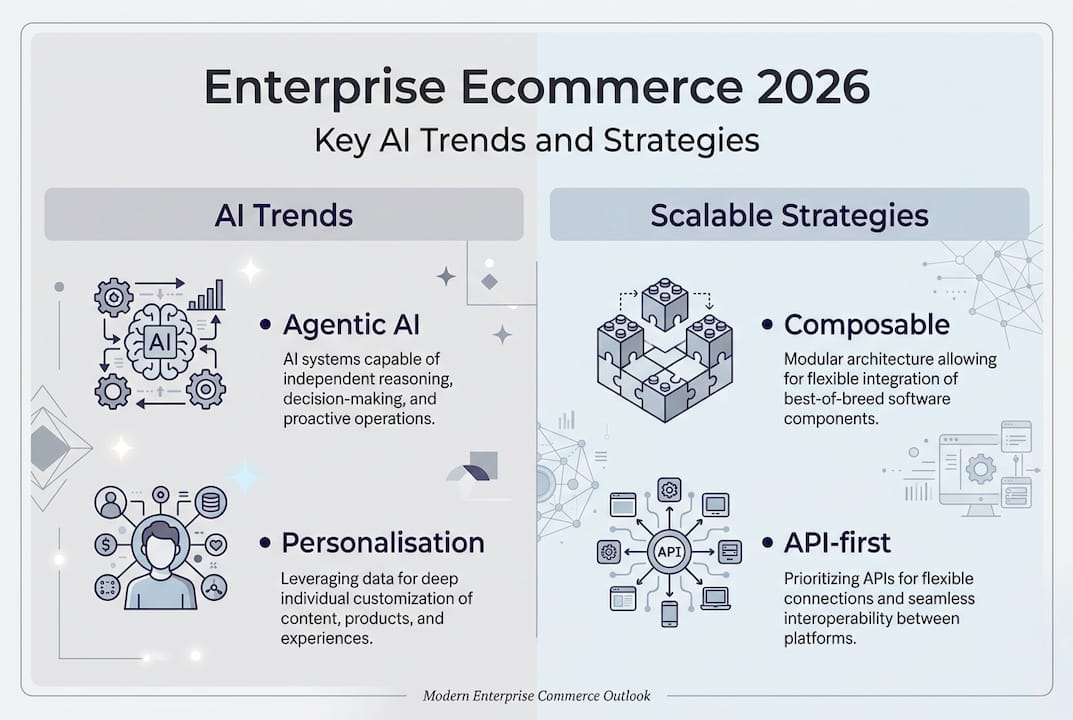
With the stage set, let's unpack the technology that's defining the future landscape. Agentic AI refers to autonomous software agents capable of executing complex tasks independently, including negotiating contracts, placing orders, and managing supplier relationships without direct human input. This is a significant shift from earlier AI tools that simply surfaced recommendations for humans to act on.
The scale of adoption is striking. By 2026, agentic AI will power 75% of enterprise ecommerce and influence 20% of B2B sellers. Yet alongside this rapid uptake, one third of enterprise marketplace projects are being abandoned because answer engines are intercepting buyer journeys before they even reach a vendor's platform.
Metric | Current status |
|---|---|
Agentic AI adoption in enterprise ecommerce | 75% by 2026 |
B2B sellers influenced by agentic AI | 20% |
Marketplace projects abandoned due to answer engines | 33% |
Enterprises prioritising composable commerce | 70% |
This creates a dual optimisation challenge. Your platform must serve both human buyers and AI agents simultaneously, and those two audiences have very different requirements. Human buyers want intuitive interfaces and emotional reassurance. AI agents want clean data structures, reliable APIs, and machine-readable product information.
"The enterprises that will win in agentic commerce are those who design for both human and machine buyers from day one, not as an afterthought."
Gartner's 2026 technology trendsconfirm that autonomous AI agents rank among the most strategically significant shifts for enterprise organisations. For leadership teams, this means re-evaluating not just your technology stack but your operating model. Decisions that once required a procurement manager can now be delegated to an agent, which raises real questions about accountability, audit trails, and governance. Platforms built onheadless architectureare far better positioned to serve these dual audiences because they separate the presentation layer from the commerce logic, making it easier to deliver tailored experiences to both humans and agents.
Composable, headless, and API-first: Building scalable enterprise platforms
Understanding the AI landscape is important, but having the right tech foundation makes all the difference. Composable commerce means assembling your platform from best-of-breed, interchangeable components rather than relying on a single monolithic system. Headless commerce separates the front-end experience from the back-end commerce engine. API-first means every capability is accessible and extendable through well-documented application programming interfaces.
These are not just architectural preferences. They are operational necessities for enterprise scale. The data backs this up clearly. 85% of enterprises now use microservices, 70% prioritise composable commerce, and leading platforms are handling up to 18,000 transactions per second.
Attribute | Monolithic platform | Composable platform |
|---|---|---|
Deployment speed | Slow, full releases | Fast, component-level |
Scalability | Limited by core system | Independent scaling per service |
Customisation | High cost and effort | Modular, low disruption |
Vendor lock-in | High | Low |
Multi-vendor support | Complex to add | Native capability |
The benefits extend beyond speed. Composable platforms allow you to swap out underperforming components without rebuilding your entire stack. This is critical when generative AI in commerce is evolving so rapidly that today's leading tool may be superseded within 18 months.
Key advantages of composable, API-first platforms include:
Faster time to market for new features and integrations
Ability to support complex multi-vendor catalogue management natively
Easier compliance with regional data and regulatory requirements
Reduced operational overhead during peak traffic periods
Seamless integration with existing ERP, PIM, and OMS systems
Understanding the difference between headless vs composable commerce is essential before you commit to a migration path. They are complementary but distinct approaches, and conflating them leads to poor investment decisions. For a thorough breakdown of how to build your stack, the composable commerce guide is a practical starting point.
Pro Tip: When planning a migration from a monolithic system, start with a strangler fig approach. Migrate one capability at a time, such as your search or checkout, while keeping the core system live. This reduces risk and lets your team build confidence incrementally.
AI-powered personalisation and incremental revenue gains
Now that your platform is ready to scale, it's crucial to harness AI for more targeted, profitable customer experiences. AI-driven personalisation is no longer a nice-to-have feature. It is a measurable revenue driver. When AI analyses behavioural signals, purchase history, and contextual data in real time, it can surface the right product to the right buyer at precisely the right moment.

The numbers are compelling. AI personalisation drives up to 15% incremental revenue and reduces cart abandonment by 25%. For an enterprise with significant transaction volumes, that uplift compounds quickly across your entire catalogue and customer base.
15% incremental revenue uplift and 25% reduction in cart abandonment are achievable outcomes when AI personalisation is implemented with clean data and clear governance.
However, there is a nuance that many enterprise leaders overlook. AI personalisation works best when it is validated by human judgement, not left to run entirely unchecked. Enterprise buyers, particularly in B2B contexts, are increasingly sceptical of AI-generated recommendations because they have seen them produce irrelevant or even commercially damaging suggestions. This scepticism is partly why buying groups are expanding, which we'll cover in the next section.
To integrate AI personalisation responsibly, consider the following approach:
Audit your product data quality before activating AI recommendation engines
Establish clear human review cycles for AI-generated merchandising decisions
Use A/B testing to validate AI recommendations against human-curated selections
Build feedback loops so buyers can signal when recommendations miss the mark
Align personalisation strategies with your broader customer experience goals
Personalisation also extends to the seller side of your marketplace. AI can help vendors optimise their listings, pricing, and promotional timing based on platform-wide demand signals. This creates a virtuous cycle where better seller performance improves buyer experience, which in turn drives higher conversion rates across your entire platform.
Enterprise buying groups, trust, and governance in an AI-driven world
AI can power growth, but managing trust and complexity is more challenging than ever. One of the most significant and underreported shifts in enterprise ecommerce is the expansion of buying groups. These are the internal and external stakeholders involved in a single purchasing decision.
Enterprise buying groups now involvean average of 13 internal and 9 external stakeholders per transaction. This is a direct response to growing mistrust of AI-generated recommendations. When buyers are uncertain whether an AI agent is acting in their best interest, they bring in more human voices to validate decisions. The result is longer sales cycles and higher operational overhead for vendors.
At the same time, 35 to 42% of enterprises report that governance and talent shortages are the primary barriers to AI adoption. This is a critical finding. The technology is available, but the organisational readiness is not keeping pace.
Steps to build buyer trust and manage complexity:
Establish a clear AI governance framework with defined accountability at each decision point
Create transparent audit trails for all AI-driven transactions and recommendations
Invest in training programmes that upskill procurement and operations teams on AI tools
Designate human oversight roles specifically for AI-driven commerce workflows
Communicate your governance standards openly to buying group stakeholders
"Governance is not a constraint on AI adoption. It is the foundation that makes sustainable AI adoption possible."
Talent is the other side of this equation. Enterprises that invest heavily in AI tools without building internal capability to manage and interrogate those tools are creating fragility, not resilience. The organisations making the most progress are those pairing technology investment with structured learning and change management.
Pro Tip: Assign a dedicated AI commerce lead within your operations team. This person bridges the gap between your technology vendors and your procurement or merchandising teams, ensuring AI decisions are understood, challenged, and continuously improved.
A realistic viewpoint: What most enterprise leaders miss about future-ready ecommerce
To conclude our core analysis, here's an insider view on what really matters as you look to future-proof enterprise ecommerce. The most common mistake we see is treating technology adoption as a destination rather than a continuous practice. Leaders invest in a new platform or AI capability, declare success at launch, and then underinvest in the cultural and operational changes needed to realise the full value.
The transition from monolithic to composable ecommerce is as much an organisational journey as a technical one. Teams need new mental models, new workflows, and new ways of measuring success. Without that investment, even the most sophisticated platform will underperform.
Rapid change in this space does not favour the most resourced organisations. It favours the most agile ones. A mid-market enterprise with a clear governance model, a capable team, and a modular architecture will consistently outperform a larger competitor running a bloated monolith with a disconnected AI layer bolted on top. The leaders who thrive are those who balance bold technology investment with patient, people-centred implementation.
Empower your enterprise ecommerce future with Ultra Commerce
If you're ready to use these insights, here's how Ultra Commerce can help accelerate your transformation. The trends covered in this article, from agentic AI and composable architecture to personalisation and governance, are precisely the challenges that Ultra Commerce is built to address.
Ultra Commerce's enterprise ecommerce solutions support scalable, AI-powered transformation without requiring a disruptive replatforming effort. The Ultra Commerce platform is modular, API-first, and designed for multi-vendor complexity. Whether you need native multi-vendor marketplace capabilities, advanced PIM and OMS tools, or an agentic execution layer, Ultra Commerce gives you the flexibility to evolve at pace. Reach out today to book a consultation or request a demo.
Frequently asked questions
What is agentic AI in enterprise ecommerce?
Agentic AI will dominate enterprise ecommerce by 2026, with autonomous agents handling negotiations, ordering, and supplier management to drive efficiency and free up human talent for higher-value decisions.
Why are composable and headless architectures crucial for future scalability?
Composable and headless platforms enable rapid adaptation, API integration, and multi-vendor support. 85% of enterprises already use microservices, confirming these architectures are essential for scaling complex enterprise operations.
How does AI personalisation impact enterprise revenue?
AI-powered personalisation delivers targeted experiences that increase conversion rates and generate up to 15% incremental revenue, making it one of the highest-return investments available to enterprise ecommerce teams.
What challenges do enterprises face in AI adoption?
Major challenges include AI governance gaps, organisational culture shifts, and a shortage of specialised talent. 35 to 42% of enterprises cite these barriers as the primary obstacles to meaningful AI transformation.