

March 29, 2026
Enterprise
Multi-Vendor
Composable
Ultra Commerce
Complex commerce models explained for scalable enterprise growth
Marketplaces now drive over 60% of global e-commerce activity, yet most enterprise teams treat the shift to multi-vendor commerce as a straightforward platform swap. It is not. The operational and technical complexity that comes with managing hundreds of vendors, dynamic catalogues, and real-time order orchestration is precisely what separates platforms that scale from those that stall. This article walks you through the architectural decisions, AI-driven automation opportunities, and practical design patterns that enterprise leaders need to build a commerce model that grows with confidence, not against itself.
Table of Contents
Why multi-vendor complexity is the new competitive advantage
Core architecture decisions: from monolith to composable and microservices
Design patterns for multi-vendor marketplaces: inventory, catalogues, and orders
Overcoming edge cases: concurrency, fraud, disputes and heterogeneous products
Intelligent automation: how AI transforms commerce models
Putting it all together: benchmarks, pitfalls and winning strategies
Accelerate scalable commerce with Ultra Commerce
Frequently asked questions
Key Takeaways
Point | Details |
|---|---|
Marketplace complexity drives scale | Advanced models with multi-vendor and composable setups unlock rapid growth and differentiation. |
Architectural choices are critical | The shift from monoliths to MACH and microservices impacts scalability, maintenance, and feature velocity. |
Edge cases need proactive solutions | Concurrency, fraud, and heterogeneous product issues must be addressed early to ensure stability. |
AI transforms operations | Intelligent automation now enables dramatic support cost savings and process autonomy. |
Benchmarks and pilots de-risk transitions | Smart leaders validate new models with data-driven pilots and clear performance metrics. |
Why multi-vendor complexity is the new competitive advantage
The marketplace model is no longer a niche strategy. It is the dominant structure for enterprise e-commerce growth, and the numbers back this up. Hybrid marketplace models grow three times faster than traditional e-commerce, which means the complexity you invest in today is the competitive moat you defend tomorrow.
The core benefits of a well-executed multi-vendor model are significant:
Network effects: More vendors attract more buyers, which attracts more vendors. The flywheel compounds over time.
Catalogue depth: Vendors extend your product range without you carrying the inventory risk.
Defensibility: A broad, well-governed marketplace is far harder for competitors to replicate than a single-brand store.
But complexity is a double-edged reality. As you explore the evolution to multi-vendor commerce, you will encounter increased technical debt, orchestration overhead, and integration pressure across every layer of your stack. C-level buy-in depends on demonstrating continuous, measurable value at scale, not just at launch.
“The platforms that win at marketplace scale are those that treat complexity as a design input, not an afterthought.”
The question is not whether to embrace complexity. It is whether your architecture is built to manage it.
Core architecture decisions: from monolith to composable and microservices
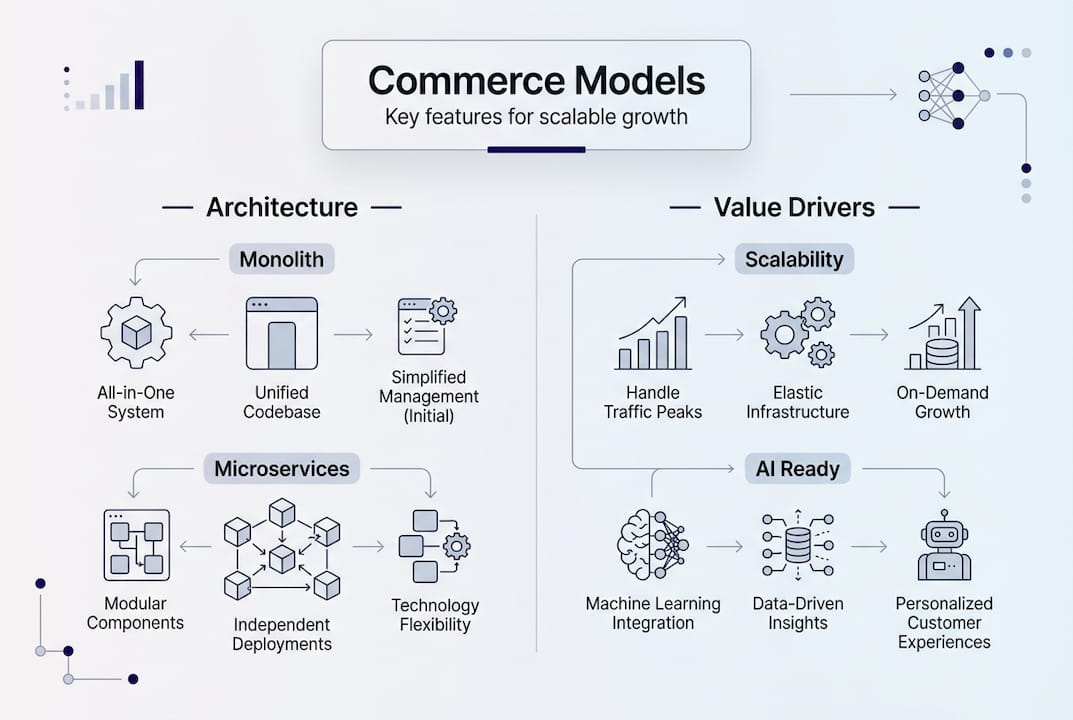
Architecture is where marketplace ambitions either accelerate or collapse. Most enterprise platforms begin life as monolithic systems, where every function, catalogue management, order processing, payment, and reporting, lives in a single codebase. This works at low scale. It breaks under marketplace pressure.
Microservices split those functions into independent services that communicate via APIs. Microservices allow fault isolation for high-traffic scenarios and accelerate feature rollouts. But they introduce a fragmentation tax: network latency, service coordination overhead, and debugging complexity. Standard stacks fail at 200 or more concurrent users with 100% error rates, while modular API-first approaches reduce maintenance costs by 40% according to Forrester research.
Composable commerce, built on MACH principles (Microservices, API-first, Cloud-native, Headless), is the architecture that enterprise leaders are choosing for long-term flexibility. You can explore composable transitions in e-commerce and composable commerce basics to understand how this shift plays out in practice.

Here is a quick comparison of the three main approaches:
Architecture | Scalability | Customisation | Maintenance overhead | AI readiness |
|---|---|---|---|---|
Monolithic | Low | Limited | Low initially, high at scale | Poor |
Microservices | High | High | High | Good |
Composable/MACH | Very high | Very high | Moderate | Excellent |
Enterprise solutions often blend polyglot persistence, using SQL databases for transactional data and NoSQL for catalogue and product data, to get the best of both worlds. See microservices pros and cons for a deeper look at backend trade-offs.
Pro Tip: Before committing to a microservices or composable architecture, run load tests that simulate your peak vendor and transaction volumes. Architectural decisions made without load validation are expensive to reverse.
Design patterns for multi-vendor marketplaces: inventory, catalogues, and orders
Once your architecture is set, the next layer of decisions involves how you structure catalogues, inventory, and order lifecycles. These are not abstract choices. They directly affect vendor onboarding speed, customer experience, and operational overhead.
Shared versus vendor-specific catalogues represent the first major design fork. Shared catalogues deliver a unified customer experience but require complex deduplication logic. Vendor-specific catalogues are simpler to onboard but can create fragmented product data.
Inventory models follow a similar pattern:
Distributed inventory: Each vendor manages their own stock. Faster to launch, but harder to guarantee availability.
Centralised inventory: The platform holds a unified view. Better for scale and customer trust, but requires deeper integration with vendor systems.
Order lifecycles in multi-vendor platforms typically involve splitting a single customer order into multiple vendor sub-orders, each with independent fulfilment. This is where order management in marketplaces becomes critical. Poor order splitting logic leads to fulfilment delays, customer complaints, and vendor disputes.
Payment splitting is equally important. Common models include percentage-based splits, tiered commission structures, and hybrid arrangements. Tools like Stripe Connect automate much of this, but your platform must be designed to accommodate the rules at the transaction level. For a broader view of real-world vendor operations and marketplace backend options, the implementation detail matters enormously.
Pro Tip: Start with distributed inventory to accelerate vendor onboarding, then migrate to a centralised model as your vendor base and transaction volumes grow. Trying to centralise too early creates unnecessary friction.
Overcoming edge cases: concurrency, fraud, disputes and heterogeneous products
Every marketplace hits edge cases. The platforms that scale past them are the ones that anticipated them in the design phase.
Concurrency and race conditions are among the most common technical failures. When two buyers attempt to purchase the last unit of a vendor’s stock simultaneously, your system must resolve the conflict without overselling. Message queues such as RabbitMQ or Kafka are the standard solution, serialising requests so inventory updates happen in order. Multi-vendor cart race conditions, overselling events, and real-time sync failures are the edge cases that most commonly derail marketplace scalability.
Real-time inventory sync via webhooks is essential. Without it, your catalogue shows availability that no longer exists, which erodes buyer trust fast.
Fraud prevention in multi-vendor environments requires behavioural scoring, not just simple validation rules. A vendor who suddenly lists 500 new products in an hour or a buyer who places 20 orders in 10 minutes needs automated flagging, not a manual review queue.
Product heterogeneity is another challenge. When vendors sell across wildly different categories, schema validation becomes complex. NoSQL approaches give you the flexibility to accommodate varied product attributes without forcing every item into a rigid data model. For a closer look at order management pitfalls, the operational implications are just as significant as the technical ones.
“Automated dispute arbitration, combined with clear vendor SLAs, reduces resolution time and protects both buyer trust and vendor relationships.”
Intelligent automation: how AI transforms commerce models
AI is no longer a future consideration for enterprise commerce. It is an operational lever that leading platforms are already pulling. The results are measurable. AI-enabled multi-agent automation reduces support costs by 62% and raises autonomous issue resolution to 78%, which is a transformational shift in operational efficiency.
Here is how AI is being applied across commerce models right now:
Dynamic pricing: AI analyses competitor pricing, demand signals, and inventory levels to adjust prices in real time without manual intervention.
Reverse auctions: Agentic systems allow buyers to specify requirements and let vendors compete, automating supply allocation with precision.
Dispute resolution: AI reviews transaction histories, vendor records, and communication logs to recommend or execute resolutions autonomously.
Inventory forecasting: Machine learning models predict demand spikes and trigger restocking workflows before stockouts occur.
For your platform to support these capabilities, it must be designed with agent orchestration in mind. That means open data protocols, event-driven architecture, and clear human-in-the-loop escalation paths. Explore implementing AI workflows and AI-driven customer experience to see how this plays out in enterprise environments. The future of AI in commerce is already being shaped by platforms that treat automation as a first-class architectural concern.
Pro Tip: Consumption-based pricing models align your platform costs with AI-driven feature usage, making it easier to justify investment to your finance team as adoption scales.
Putting it all together: benchmarks, pitfalls and winning strategies
Scalable commerce is not built in a single sprint. It is the result of deliberate architectural choices, validated by real performance data.
Key benchmarks to track as you scale:
Concurrent user capacity under peak load
Product catalogue size and query response times
Vendor onboarding time from application to first sale
Order split accuracy and fulfilment SLA compliance
Polyglot persistence using SQL for transactions and NoSQL for catalogues is the right approach, but poor schema design induces query slowdowns at 100,000 or more products. Schema quality is not a back-end concern. It is a revenue concern.
The most common pitfalls we see enterprise teams encounter include vendor fragmentation without governance, cost overruns from underestimated microservices overhead, and schema quality issues that only surface at scale. Microservices overhead is consistently underestimated until load tests reveal 3 to 10 times higher latency compared to unified runtimes.
The winning strategies are clear. Pilot with distributed models, validate with load tests, ensure real-time integration across vendor systems, and adopt MACH for rapid rollout and long-term flexibility. Composable/MACH architecture enabled Clarks to launch 40 sites in six months and helped Prada achieve 60% faster checkout. These are not edge cases. They are the benchmark for what enterprise MACH adoption delivers. See enterprise MACH success for more real-world context.
Pro Tip: Always run load tests before major architectural transitions. The cost of a load test is a fraction of the cost of a failed production rollout.
Accelerate scalable commerce with Ultra Commerce
If the frameworks in this article resonate with the challenges your team is navigating, the next step is finding a platform built to handle this level of complexity from day one. Ultra Commerce is designed specifically for enterprise organisations that need composable, AI-ready commerce infrastructure without the disruption of a full replatforming exercise.

The enterprise ecommerce platform from Ultra Commerce includes native support for multi-vendor operations, modular PIM and OMS components, and an agentic execution layer that supports AI-driven workflows across your entire commerce model. Explore the multi-vendor marketplace platform to see how vendor management, catalogue orchestration, and order lifecycle tools work together. Or review the full composable commerce platform to understand how Ultra Commerce fits into your existing tech stack without requiring you to start from scratch.
Frequently asked questions
What is the difference between shared and vendor-specific catalogues?
Shared catalogues provide a unified customer experience but require complex deduplication logic, while vendor-specific catalogues offer simpler onboarding and greater flexibility for diverse product ranges.
Why choose composable or MACH architecture for enterprise marketplaces?
MACH and composable architectures enable rapid scaling and faster feature rollouts. Clarks launched 40 sites in six months using this approach, and Prada achieved 60% faster checkout.
How does AI improve support costs and marketplace efficiency?
AI-enabled automation reduces support costs by 62% and resolves 78% of issues autonomously, freeing your operations team to focus on higher-value work.
What are the most common technical pitfalls in scaling multi-vendor platforms?
The biggest pitfalls are concurrency bugs, database schema slowdowns at 100,000 or more products, and underestimated network overhead from microservices, which can produce 3 to 10 times higher latency compared to unified runtimes.