

April 11, 2026
Enterprise
Omni-Channel
TL;DR:
Strategic innovation allows enterprises to scale without increasing headcount or overheads.
Modern, modular architectures improve agility, reduce costs, and accelerate global expansion.
Leading companies foster a culture of experimentation and view commerce as an evolving, leadership-driven discipline.
Enterprise growth no longer belongs exclusively to those with the deepest pockets or the largest teams. The most forward-thinking organisations are proving that strategic innovation, not headcount, is the true engine of global expansion. Innovative commerce strategies now drive growth without additional headcount, as demonstrated by brands like Camif, which achieved a 6-point stockout reduction and €40k turnover gain through AI-enabled supply chain planning alone. This guide maps out an evidence-backed roadmap for C-suite executives and IT decision-makers who are ready to lead change, outperform competitors, and build commerce operations that scale without the traditional overhead.
Table of Contents
Why traditional commerce strategies fall short at enterprise scale
Omnichannel and unified commerce: catalysts for global scale
Innovation in action: real-world examples and replicable frameworks
Key Takeaways
Point | Details |
|---|---|
Legacy strategies limit growth | Old-school systems slow efficiency and block global expansion in today’s competitive climate. |
Unified commerce is essential | The world’s leaders are scaling smarter and faster through integrated omnichannel strategies. |
Innovation drives measurable gains | AI and predictive tools can deliver dramatic results such as higher conversions and efficient scaling. |
Mindset matters most | Organisational willingness to change and experiment sets top performers apart in the commerce evolution. |
Why traditional commerce strategies fall short at enterprise scale
With the need to rethink growth established, let's examine why entrenched approaches are holding enterprises back.
Legacy commerce systems were built for a different era. They were designed to handle predictable volumes, stable product catalogues, and single-market operations. Today's enterprise environment demands something entirely different: rapid adaptability, real-time data visibility, and the ability to serve customers across dozens of markets and channels simultaneously. Legacy platforms simply were not architected for this.
The consequences are well documented:
Technical debt accumulates rapidly, making every new integration slower and more expensive than the last.
Data silos fragment the customer view, preventing personalised experiences and unified reporting.
Globalisation pressure exposes rigidity, as entering new markets requires months of custom development rather than configuration.
Agility suffers, meaning your teams spend more time maintaining systems than driving innovation.
The financial case for change is compelling. Enterprises that moved away from monolithic architectures reported an 18% conversion lift within 90 days of re-platforming. That is not a marginal improvement. That is a structural shift in commercial performance.
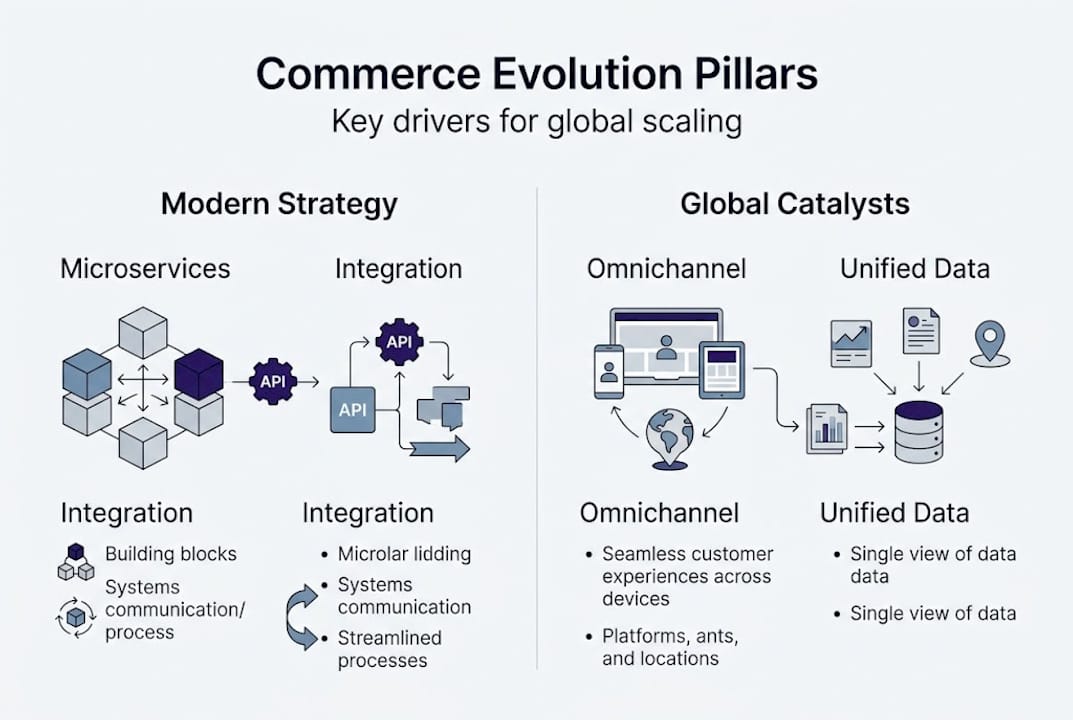
Understanding the difference between composable vs. monolithic ecommerce is increasingly critical for enterprise leaders. Composable architectures allow organisations to swap, upgrade, or extend individual components without disrupting the entire platform. This modularity is what separates high-performing enterprises from those perpetually stuck in upgrade cycles.
The bottom line is straightforward: if your commerce strategy is built around a legacy core, you are not just facing inefficiency today. You are actively limiting your ceiling for tomorrow.
Key pillars of modern enterprise commerce strategy
Understanding the limits of legacy strategies sets the stage. Now, let's break down the essential elements of advanced commerce strategy.
Leading enterprises do not succeed by accident. They build their commerce operations around a clear set of strategic pillars that reinforce one another and compound over time.
Unified omnichannel experience. Customers expect a seamless journey whether they are browsing on mobile, purchasing in-store, or managing an account through a B2B portal. Unifying these touchpoints is no longer optional.
Data-driven personalisation. Predictive modelling is now a commercial advantage. Organisations that have adopted it report a 22% reduction in cost per acquisition, a gain that compounds across every campaign and channel.
Composable, scalable architecture. Modular systems allow enterprises to innovate at pace. When one component needs upgrading, the rest of the platform keeps running. This is the foundation of genuine agility.
Automation and orchestration. From order routing to inventory management, automating repetitive processes frees your teams to focus on strategy and customer experience rather than operational firefighting.
Governance and security at scale. Enterprise-grade operations require robust controls, especially as regulatory environments grow more complex across global markets.
Building an integrated commerce tech stack that connects these pillars is where the real efficiency gains emerge. Integration removes friction, accelerates decision-making, and gives leadership the visibility they need to act confidently.
Pro Tip: Prioritise microservices architecture when evaluating new platforms. Microservices allow individual capabilities, such as search, checkout, or pricing, to be updated independently. This means you can innovate in one area without risking stability across the rest of your operations, which is exactly the kind of future-proofing enterprise boards should be demanding.
Omnichannel and unified commerce: catalysts for global scale
With the pillars defined, let's see how they deliver at global scale when unified commerce becomes a reality.
Unified commerce is not simply omnichannel with better branding. It represents a fundamental shift in how data, inventory, and customer interactions are managed across every touchpoint from a single, connected platform. The operational simplicity this creates is transformative for global expansion.

Consider the numbers:
| Metric | Legacy approach | Unified commerce || |---|---|---| | Mobile LCP improvement | Minimal | Up to 54% faster | | Checkout failure rate | High | Reduced by 80-88% | | Market entry timeline | 12-18 months | As low as 6 months | | Operational overhead | Fragmented | Centralised and streamlined |
The real-world results back this up. Clarks, the global footwear brand, expanded to 40+ countries in just six months using a unified commerce approach. Home Depot, meanwhile, has built a digital operation generating $23.6 billion in web sales by investing consistently in omnichannel integration.
"Unified commerce removes the friction between channels, turning what used to be a coordination challenge into a genuine competitive advantage."
For enterprises considering global rollout, the actionable steps are clear:
Centralise your product, pricing, and inventory data into a single source of truth.
Implement channel orchestration so that every market operates from the same operational logic.
Invest in omnichannel shopping experiences that are localised without being siloed.
Audit your checkout performance regularly, since checkout failures are among the highest-cost conversion leaks in enterprise commerce.
If you are serious about embracing an omnichannel strategy, the infrastructure decisions you make today will determine how quickly you can move tomorrow.
Innovation in action: real-world examples and replicable frameworks
Seeing global players in action brings the strategy to life. Here's how enterprises like yours are leading change.
The most instructive case studies share a common thread: they replaced reactive, siloed operations with proactive, connected ones. The results speak clearly.
Camif implemented AI-driven supply chain planning and absorbed 44% growth without adding extra staff. The platform reduced stockouts by six percentage points and generated an additional €40,000 in turnover. This is what modern operational efficiency looks like.
Home Depot built a $23.6 billion digital channel by integrating physical and digital operations so completely that customers can move between them without friction. Clarks used unified commerce to enter more than 40 international markets in six months, a timeline that would have been impossible with a legacy stack.
Dimension | Legacy approach | Evolved strategy |
|---|---|---|
Supply chain | Reactive, manual | AI-driven, predictive |
Market expansion | Slow, high-cost | Rapid, configuration-led |
Customer data | Siloed by channel | Unified, real-time |
Operational headcount | Scales with volume | Decoupled from growth |
For C-suite leaders ready to act, here is a practical 90-day framework:
Days 1-30: Audit your current tech stack for integration gaps and data silos. Identify the three highest-cost friction points in your commerce operations.
Days 31-60: Pilot a composable or modular solution in one market or channel. Measure conversion, operational cost, and team velocity.
Days 61-90: Use pilot results to build the business case for broader rollout. Review retail budget optimisation strategies to fund the next phase efficiently.
Exploring Ultra Commerce case studies gives you a concrete view of how these frameworks translate into measurable commercial outcomes across different industries and markets.
Why the top 1% rethink commerce strategy evolution
With frameworks and results in hand, it is time for an honest look at what sets the top performers apart beyond technology.
Here is what most commerce strategy conversations miss: the organisations achieving the most dramatic results are not simply adopting better tools. They are changing how they think about change itself. Technology is an enabler, but organisational mindset is the differentiator.
The enterprises that consistently outperform their peers share one trait. They have broken down the internal bias toward stability and replaced it with a genuine appetite for iteration. They pilot small, measure rigorously, and move quickly when the data supports it. Importantly, this culture of experimentation is not confined to the digital team. It runs from the boardroom to the front line.
The next evolution of ecommerce is not a platform decision. It is a leadership decision. The biggest wins come from organisations willing to challenge their own assumptions, retire legacy thinking alongside legacy systems, and treat commerce strategy as a living discipline rather than a periodic project. If your organisation is still waiting for the perfect moment to evolve, the top 1% are already three iterations ahead.
Take your commerce strategy to the next level
If you are ready to act and take advantage of the new era in commerce, here are the next steps.
The evidence is clear: enterprises that invest in modern, flexible, and connected commerce infrastructure outperform those that do not. The gap is only widening.
Ultra Commerce is built for exactly this moment. As a recognised enterprise ecommerce platform, it gives your organisation the modular tools, AI-enabled capabilities, and governance frameworks needed to unify operations, automate at scale, and expand globally without disruption. Whether you are evaluating a composable architecture or looking to consolidate your tech stack, the Composable Commerce platform offers a practical, proven path forward. Explore real case studies, connect with our team, and discover what your next stage of growth looks like.
Frequently asked questions
What are the main barriers to evolving enterprise commerce strategy?
Common barriers include legacy systems, organisational silos, and resistance to cultural change. Scaling with legacy systems consistently leads to inefficiency and reduced agility, making strategic evolution harder to initiate and sustain.
How quickly can enterprises see results with an evolved commerce approach?
Enterprises often see measurable conversion and efficiency gains within three to six months of implementation. Strategic re-platforming has delivered an 18% conversion lift within three months in documented cases.
Is omnichannel strategy essential for global expansion?
Yes, omnichannel is critical for international growth, enabling rapid and coordinated market entry. Clarks used unified commerce to enter more than 40 new markets in just six months.
How does AI-enabled planning impact operational efficiency?
AI-driven supply chain planning lets enterprises absorb major growth with minimal extra headcount. One brand absorbed 44% growth without additional staff through AI-enabled planning, while simultaneously reducing stockouts and increasing turnover.