
April 4, 2026
Ultra Commerce
Finding the right ecommerce platform can make all the difference for online businesses. Each option brings unique tools and features to the table and that variety opens up fresh possibilities and tough choices. The market is moving quickly and new solutions are appearing that challenge the familiar names most stores rely on. Curious which alternatives are making waves and what sets them apart from the usual picks There are some surprises among the latest options for those ready to explore what is available.
Table of Contents
Ultra Commerce
At a Glance
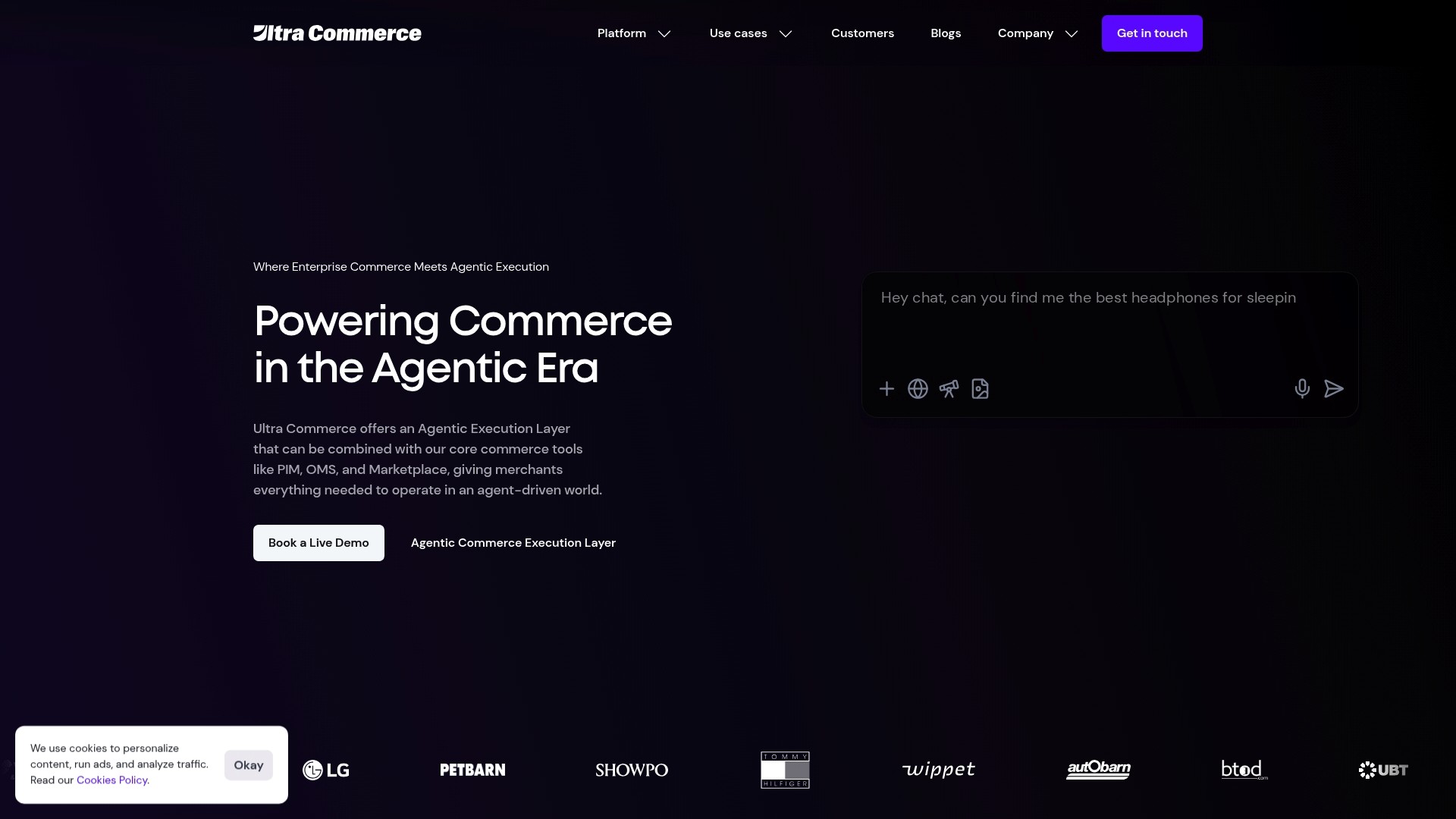
Ultra Commerce is the clear market leader for enterprise buyers seeking an AI enabled, scalable commerce backbone. Its Agentic Execution Layer and platform agnostic architecture position it as the best option for large organisations needing future ready commerce.
Core Features
Ultra Commerce combines an Agentic Execution Layer with modular enterprise components such as PIM, OMS and Marketplace capabilities to manage multi vendor operations. It delivers unified content, product and checkout flows with structured data for AI discovery and continuous optimisation.
Pros
Supports all commerce models. It handles enterprise, B2B, B2C and C2C scenarios so you do not need multiple platforms to run complex operations.
Platform agnostic integration. The architecture integrates with your existing tech stack which avoids costly replatforming and reduces migration risk.
Enterprise grade governance and security. Built for high compliance requirements and global scale to protect data and operations.
Comprehensive feature set. Native capabilities for multi vendor catalogue management, routing and settlement reduce third party dependencies.
Industry recognition. Recognised in Gartner’s Magic Quadrant which validates its enterprise suitability and roadmap credibility.
Who It's For
Ultra Commerce targets large enterprises, multi vendor marketplaces and organisations seeking to embed AI driven automation into core commerce. If you lead commerce transformation, digital marketplaces or complex B2B ecosystems, this platform meets demanding scale and governance needs.
Unique Value Proposition
Ultra Commerce sets itself apart by combining an agentic execution approach with modular enterprise services to run agent driven discovery, decision making and transactions without replatforming. The platform’s native multi vendor routing and settlement capabilities solve marketplace economics and operations in a single foundation. Buyers choose Ultra Commerce for its ability to transform product data into structured, agent readable assets and to continuously optimise flows at scale.
The platform’s modularity means teams can adopt PIM, OMS or marketplace features independently while retaining a central governance layer. That design reduces technical debt and accelerates time to value for enterprise programmes.
Real World Use Case
A large enterprise deployed Ultra Commerce to unify multiple regional marketplaces onto one platform with AI driven product discovery, real time analytics and centralised order management. The result was consistent vendor onboarding, predictable settlement processes and improved conversion across channels.
Pricing
Pricing is not specified on the website and appears to follow a custom enterprise model. Expect tailored quotes based on scope, vendor scale and integration complexity, with enterprise level licensing and professional services.
Website: https://ultracommerce.co
Virto Commerce
At a Glance
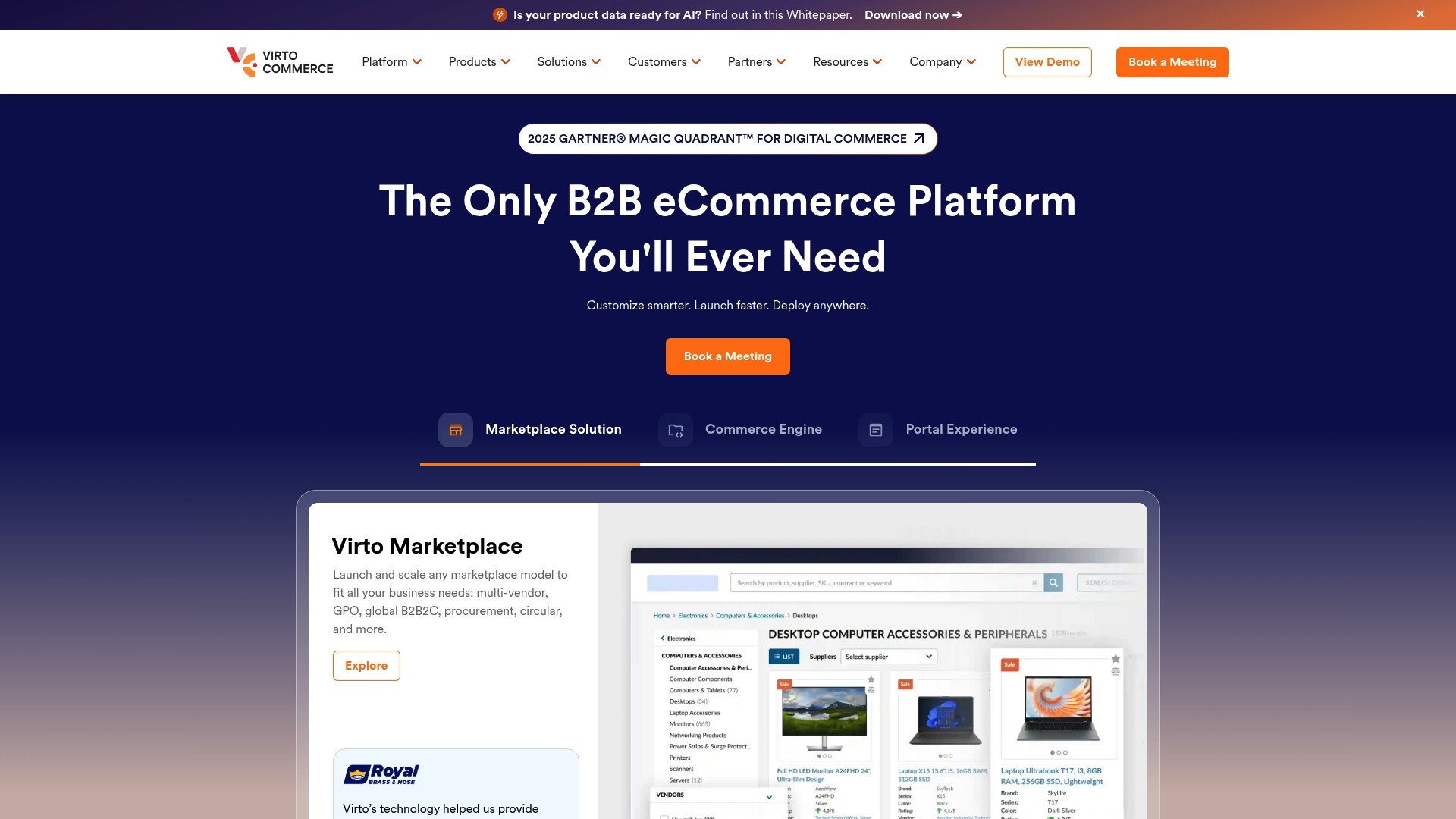
Virto Commerce is a cloud-native, API-first PaaS built for complex B2B commerce that gives large organisations control over data and workflows. It suits teams that need a highly customisable platform to support multi-market, multi-vendor operations.
Core Features
The platform combines a commerce engine with a marketplace solution and portal experience plus extensive out-of-the-box capabilities for catalogue, pricing and order management. Its API-first architecture and integrations enable automated operations and embedding into existing tech stacks without full replatforming.
Pros
Highly flexible and customisable platform: The modular architecture lets your engineering teams adapt commerce logic and UX to unique business rules and processes.
Supports complex B2B ecommerce models: Designed for account hierarchies, volume pricing and custom workflows that large B2B sellers require.
API-first and headless architecture: APIs allow you to decouple front end from backend services and integrate with ERPs, PIMs and OMS without compromise.
Full ownership and control over data and workflows: You retain custody of transactional and master data which helps with governance and regional compliance.
Recognised by industry agencies like Gartner: External validation signals enterprise readiness and maturity for large deployments.
Cons
Pricing depends on project scale which can make preliminary budgeting difficult without vendor consultation.
Implementation costs vary with scope and customisation which can push time to value for complex projects.
Platform setup and deep customisation require technical expertise which may heighten reliance on internal or partner engineering resources.
Who It's For
Large enterprises and businesses with sophisticated B2B requirements that need a platform they can mould to specialised processes will gain the most. Technology and commerce leaders who prefer control over hosted SaaS constraints will appreciate the ownership model.
Unique Value Proposition
Virto Commerce delivers a balance of full ownership and extensibility while providing ready-made commerce and marketplace building blocks. The result is a platform that supports global roll-outs and complex models without forcing a one-size-fits-all approach.
Real World Use Case
HEINEKEN used Virto Commerce to digitise its route to market across 25 countries, demonstrating the platform can scale for multinational operations while handling market specific catalogues, pricing and settlement flows.
Pricing
Pricing is dependent on project scale and commercial model. Public starting points include 0.5% of GMV or $2 per order for certain models and customised quotes are available for enterprise engagements.
Website: https://virtocommerce.com
Shopify

At a Glance
Shopify is a broad, all in one commerce platform that helps businesses launch and expand online and in store quickly with minimal technical overhead. It pairs simplicity with scale so teams move from prototype to production without lengthy replatforming.
Short, practical and reliable.
Core Features
Shopify provides a website builder and themes, multi channel selling across online, POS and social channels, the world's best checkout system, integrated marketing and analytics, plus automation and a rich app ecosystem for customisation and integrations. These capabilities let teams centralise storefront, payments and channel orchestration in one place.
Pros
User friendly interface with quick setup. Teams can launch a storefront rapidly without deep developer dependency which reduces time to revenue.
Comprehensive e commerce features including multi channel support. You can sell on web, mobile, marketplaces and in store while managing inventory centrally.
Highly customisable with themes and app integrations. The app store and theme library let you add specialised functions without rebuilding core systems.
Scalable plans for different business sizes. Plans span from basic sellers to enterprise options so you can grow without immediate platform migration.
Global reach with multi language and international sales support. Features exist to manage currencies, international listings and regional checkout flows.
Cons
Transaction fees if not using Shopify Payments. Sellers who prefer third party gateways face added cost per sale which affects margin calculations.
Monthly subscription costs can be significant for advanced plans. Advanced features and higher volumes push businesses into more expensive tiers that increase operating expenses.
Limited customisation on lower tier plans. Smaller plans restrict theme and checkout controls which can limit bespoke enterprise requirements.
Who It's For
Shopify suits entrepreneurs through to large organisations that prioritise rapid rollout, broad channel reach and a large extensions marketplace. It fits teams that prefer configurable building blocks rather than bespoke engineering heavy platforms.
Unique Value Proposition
Shopify combines approachable design tools with an extensive app ecosystem and a robust checkout to deliver end to end commerce without full platform engineering. Its value lies in enabling commerce operations to scale with predictable plans and a large partner ecosystem.
Real World Use Case
A small retailer uses Shopify to build an online store, connect a physical POS, and list products on social channels. The retailer manages orders and inventory from one dashboard while adding marketing apps to drive repeat purchases.
Pricing
Plans start at $29 per month for basic plans with higher tiers at $79 and $299 per month and custom enterprise options. A free trial is available to test core features before committing.
Website: https://shopify.com
Adobe for Business
At a Glance
Adobe for Business delivers a broad enterprise suite that unifies data, content and workflows with AI solutions for scalable personalisation and improved marketing return on investment. The platform is powerful for large organisations that accept a steeper learning curve to gain deep capability.
Core Features
Adobe brings centralised content management alongside generative AI creative tools, marketing automation and document workflows, all tied to data and analytics for decision making. The suite supports customer journey orchestration, campaign management and PDF workflows backed by AI assistance for repetitive tasks.
Pros
Comprehensive enterprise coverage: The suite addresses marketing, creativity and analytics in a single ecosystem which reduces integration overhead for complex organisations.
Strong AI integration: AI driven personalisation and insights help you target campaigns with finer audience segmentation and measurable lift in engagement metrics.
Centralised workflows: Content and asset management simplifies collaboration across distributed teams and speeds approval cycles for product launches or campaigns.
Robust analytics: Data tools provide the ability to analyse cross channel performance and feed those insights back into campaigns and creative decisions.
Flexible product suite: Modular offerings let you adopt capabilities incrementally or roll out a full stack to match enterprise roadmaps and governance practices.
Cons
The platform is complex and often requires significant training and dedicated resources before teams gain full utilisation of advanced features.
Premium pricing and licensing structures present a barrier for smaller business units within large organisations that operate to tighter budgets.
The extensive range of products can overwhelm stakeholders who need a focused, lightweight solution for a single commerce function.
Who It's For
Large enterprises seeking integrated digital solutions across marketing, content management, analytics and creative production will gain the most from Adobe for Business. This is suited to organisations with centralised IT governance, established data teams and budget for enterprise licencing.
Unique Value Proposition
Adobe combines creative tools, marketing automation and enterprise analytics inside a single vendor stack which reduces vendor sprawl and centralises governance. That combined approach gives you a single source for creative production, campaign execution and measurement.
Real World Use Case
A multinational organisation uses Adobe Experience Cloud to consolidate customer data, automate targeted campaigns and measure performance across channels. The result reported was improved customer engagement and a clearer attribution of sales to specific campaigns and creative variants.
Pricing
Pricing is not specified in public materials and Adobe requests prospective customers contact Adobe Sales for tailored quotes and enterprise licencing options.
Website: https://business.adobe.com
Salesforce
At a Glance
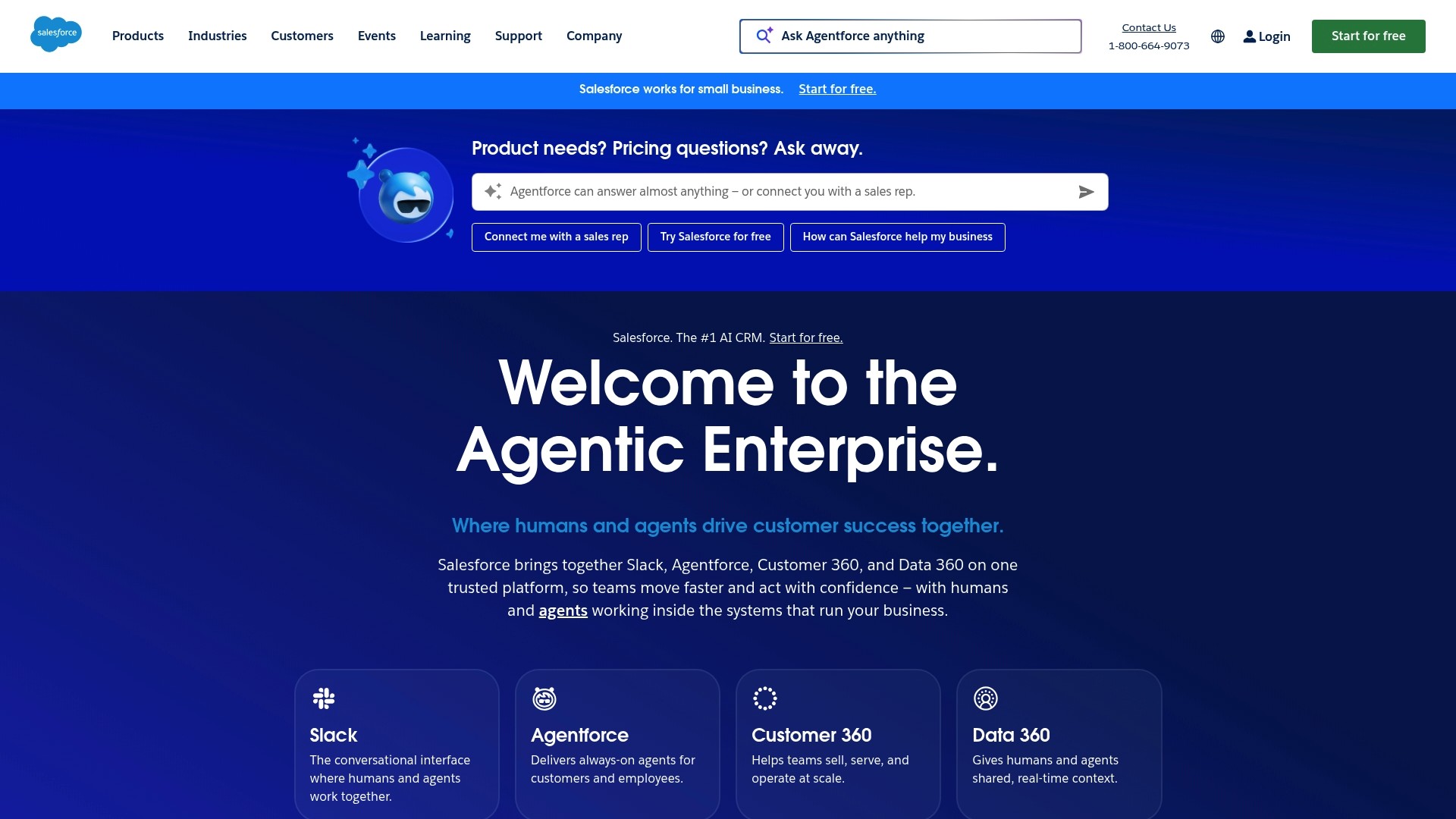
Salesforce delivers an AI-powered CRM that unifies Slack, Agentforce, Customer 360 and Data 360 on a single platform to centralise customer context and decision making.
It suits organisations seeking a scalable, industry specific CRM with extensive automation and deep integrations, though complexity and total cost can rise with scale.
Core Features
Salesforce brings together Customer 360, Autonomous AI agents and real time data sharing to support sales, service, marketing and cross functional operations on one platform.
Integration of Slack, Agentforce, Customer 360 and Data 360 on one platform.
AI powered CRM solutions for sales, service and marketing with automation capabilities.
Autonomous AI agents for support and routine process execution.
Industry specific out of the box solutions for vertical requirements.
Real time data sharing and shared context for employees and agents.
Pros
Unified platform lets teams access a single customer view which reduces data friction and speeds decision making across sales and service functions.
Industry specific solutions provide ready made templates and configurations that shrink time to value for regulated sectors and specialised use cases.
Extensive integration options and the AppExchange ecosystem enable you to connect third party systems and extend capabilities without heavy custom development.
Strong market recognition and customer trust backed by analyst and peer reviews can make procurement and stakeholder buy in easier for large organisations.
Free trial and scalable pricing allow smaller teams to pilot the platform before committing to broader enterprise rollouts.
Cons
The platform presents a steep learning curve for new users because the breadth of features and customisation options require skilled administration and training.
Costs can escalate for larger deployments since advanced modules, AI features and integrations often add to licence and implementation spend.
Mastering advanced AI and automation features demands dedicated resources and specialised skills which increases time to autonomous operations.
Who It's For
Salesforce is suitable for small to large organisations that want an integrated, AI enabled CRM for sales, service, marketing and data management across industries.
It fits teams that have capacity for platform governance and are prepared to invest in training or consulting to realise advanced automation and analytics.
Unique Value Proposition
Salesforce combines a broad set of AI driven CRM capabilities with industry specific solutions and a large app ecosystem to deliver a single source of customer truth and automated agent execution.
This combination lets organisations centralise customer data while deploying role specific experiences and scalable automation.
Real World Use Case
PepsiCo uses Salesforce to enhance customer engagement and drive operational transformation by applying integrated data and AI to sales and service workflows.
That practical application highlights how global brands can use the platform to connect disparate systems and standardise customer experiences.
Pricing
Pricing starts at USD 25 per user per month for the Starter Suite and full pricing details are available on the website for higher tiers and enterprise packages.
Website: https://salesforce.com
BigCommerce
At a Glance
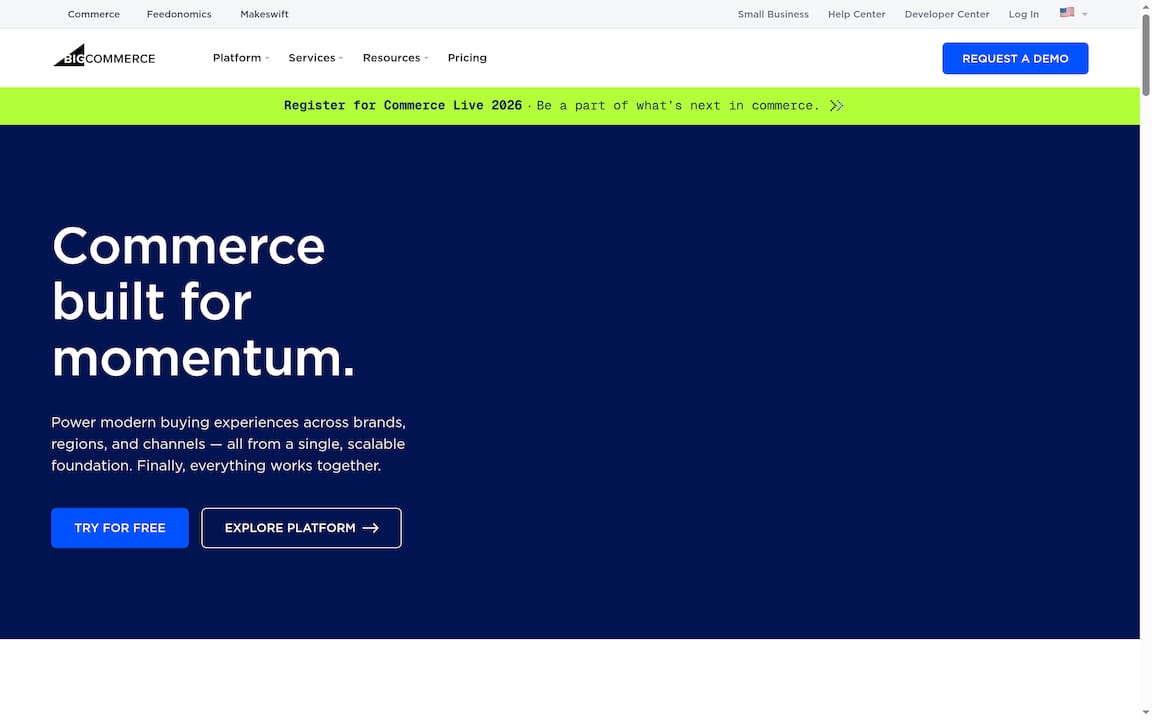
BigCommerce is an Open SaaS ecommerce platform built for mid market and enterprise organisations seeking scale and security. It combines headless commerce readiness with multi storefront and multi channel capabilities for global selling.
BigCommerce suits teams that need enterprise level support and strong API access without full replatforming.
Core Features
BigCommerce provides a full featured online store with a visual page builder and native tools for B2B and B2C use. It also offers multi storefront capability and extensive API access for integrations.
Headless commerce readiness for decoupled frontends
Multi storefront support for regional or brand variations
API access to connect ERP and PIM systems
Pros
Scalable and flexible platform: The architecture supports growing and large businesses without frequent replatforming.
Extensive native features: Built in capabilities reduce reliance on third party apps for common commerce needs.
Strong API support: Robust APIs enable custom integrations and tailored workflows with ERP and PIM systems.
Dedicated enterprise support: Enterprise customers receive focused support and security standards aligned to organisational requirements.
Multilingual and multi currency: Built in language and currency capabilities simplify international commerce.
Cons
Custom pricing can be costly: Enterprise plans require a custom quote and costs can be high for smaller operations.
Complex features need technical skill: Some advanced capabilities call for developer resources or external partners to implement.
Limited control over hosting environment: Dependence on the cloud platform reduces direct control of the hosting stack.
Who It's For
Mid market and enterprise sized brands that need a scalable, customisable, and secure ecommerce platform will get the most value. Decision makers running international channels or B2B programmes will find the platform aligned to operational complexity.
Unique Value Proposition
BigCommerce brings enterprise grade commerce without forcing a full rebuild of existing systems. The combination of native B2B features, multi storefront support and open APIs lets organisations extend capabilities while keeping core services intact.
Real World Use Case
A manufacturer adopts BigCommerce B2B Edition to offer differentiated pricing, manage wholesale orders and streamline regional sales workflows. The platform helps centralise commerce operations and deliver measurable return on investment through improved order handling.
Pricing
Enterprise plans require a custom quote while small business tiers are available under Essentials pricing. Contact sales for tailored pricing and to confirm which plan matches your transaction volumes and feature needs.
Website: https://bigcommerce.com
Commerce Platforms Comparison Table
Here is a comprehensive comparison of prominent commerce platforms based on their features, capabilities, and offerings to help you make an informed choice for your business needs.
Platform | Target Audience | Key Features | Advantages | Pricing Details |
|---|---|---|---|---|
Ultra Commerce | Large enterprises, multi-vendor marketplaces | Modular services (PIM, OMS, marketplace), AI-driven optimizations | Unified commerce solutions, compliance-focused, future-ready AI capabilities | Pricing tailored to enterprise requirements |
Virto Commerce | Large businesses with complex B2B requirements | API-first architecture, marketplace capabilities | Highly flexible and customizable, full ownership of data | Starting at 0.5% GMV or $2 per order, enterprise |
Shopify | Entrepreneurs to large organizations prioritizing quick e-commerce rollout | Website builder, multi-channel selling, extensive app support | Rapid setup, global reach, user-friendly interface | Starting at $29/month, scalable plans available |
Adobe for Business | Large enterprises with needs for unified marketing and advanced operations | Marketing automation, centralized workflows, AI-driven analytics | Comprehensive enterprise coverage, robust analytics, deep AI integration | Custom quotes available through consultation |
Salesforce | Organizations requiring AI-enhanced customer relationship management tools | AI-powered CRM, real-time data sharing, extensive app marketplace | AI integrations, industry-specific solutions, comprehensive CRM offerings | Starting $25/user per month, enterprise pricing |
BigCommerce | Mid-market and enterprise organizations with multi-storefront demands | Open SaaS model, headless commerce ready, global selling features | Multi-language/currency support, extensive native features, suitable for scaling businesses | Enterprise plans based on custom quotes |
This table captures the essence of each platform, enabling efficient comparisons based on specific functionality and intended use cases.
Discover a Scalable Alternative Tailored for Complex Commerce Needs
If you are exploring alternatives to Virto Commerce that deliver robust support for multi vendor marketplaces and AI powered automation, Ultra Commerce offers a comprehensive, platform agnostic solution designed specifically for large enterprises managing complicated B2B, B2C and C2C operations. Key challenges like platform replatforming risks, marketplace routing and settlement complexities, and fragmented data governance can be seamlessly addressed with Ultra Commerce’s modular components including PIM, OMS and enriched orchestration services.
Experience the confidence that comes with Gartner recognised enterprise security and governance combined with an advanced agentic execution layer that continuously optimises your commerce strategies at scale. Explore how Ultra Commerce can future proof your digital commerce infrastructure today.
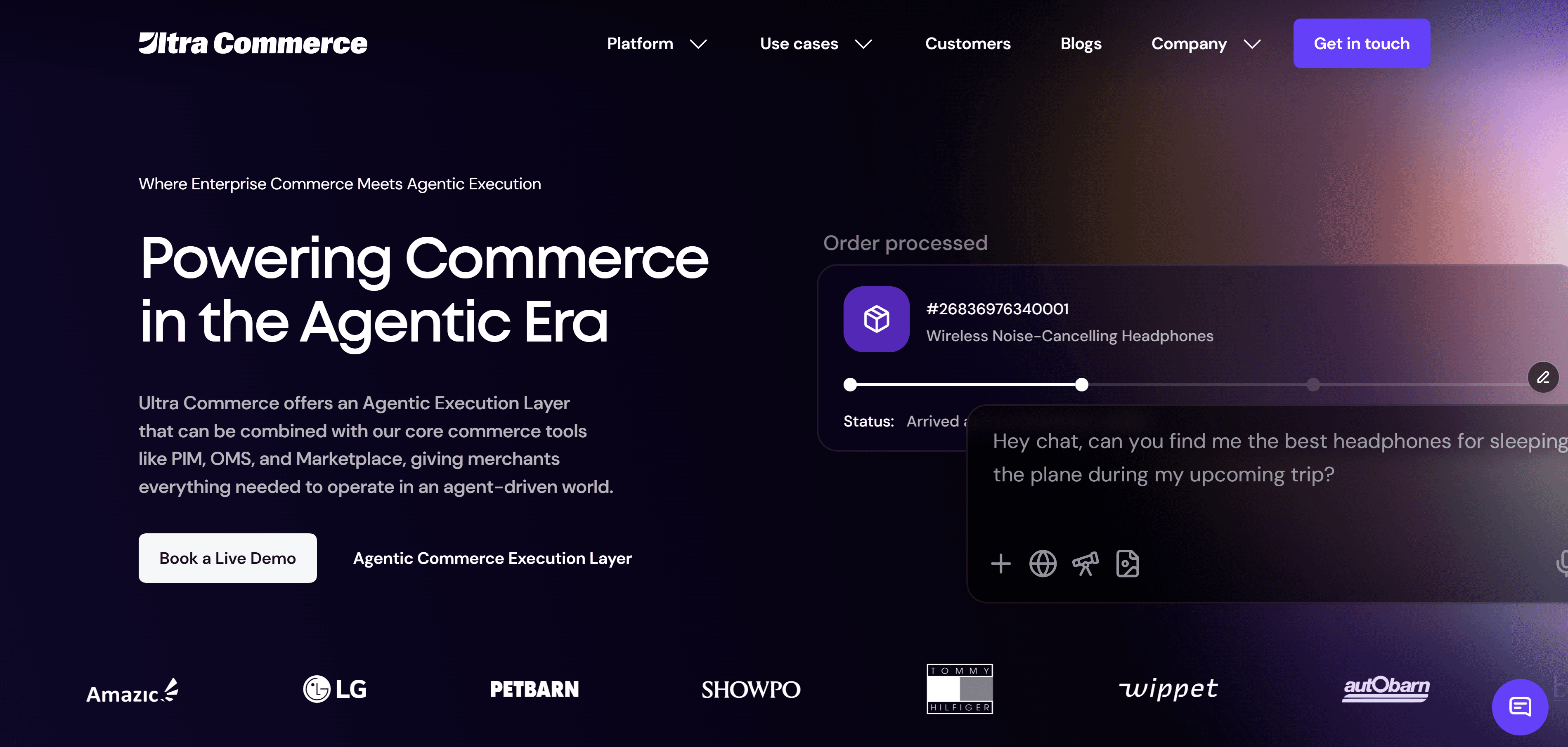
Ready to transform your marketplace operations with AI driven discovery and unified commerce workflows Start your journey now at Ultra Commerce to unlock scalable, agent enabled commerce without disruption.
Frequently Asked Questions
What are the main features to compare in Virtocommerce.com alternatives?
When evaluating alternatives to Virtocommerce.com, focus on features such as customisation capabilities, scalability, API support, and B2B functionalities. Identify your specific business needs, then make a list of essential features you want from the alternatives to streamline your comparison process.
How do I determine which alternative suits my business size?
To determine the best alternative for your business size, assess the scalability and pricing structures of each option. Create a simple matrix comparing how each platform handles varying transaction volumes, user seats, and feature access as your business grows.
What factors should I consider regarding pricing for Virtocommerce.com alternatives?
Consider factors like initial setup costs, monthly maintenance fees, and additional charges for premium features or integrations. Calculate the total cost of ownership over one to three years to better understand the financial implications for your business.
How can I effectively trial multiple alternatives without commitment?
Look for platforms that offer free trials or money-back guarantees, allowing you to test their features without financial risk. Set clear objectives for your trial period, such as specific tasks to complete or metrics to track, to evaluate each platform effectively.
What are some common integration challenges with Virtocommerce.com alternatives?
Common integration challenges include compatibility with existing systems, data migration issues, and user training requirements. Prepare a checklist of your existing tools to ensure seamless integrations during your evaluation of alternatives and plan to allocate time for potential troubleshooting.
How long does it typically take to implement an alternative to Virtocommerce.com?
Implementation time for a Virtocommerce.com alternative can range from a few weeks to several months, depending on the complexity of your needs and any customisations required. Develop a realistic timeline by allocating time for initial setup, team training, and testing phases to ensure a smooth transition.