
March 14, 2026
Ecommerce Strategy
Composable
Finding the right eCommerce platform can make a huge difference in how you do business and connect with customers. With new features and smarter tools appearing each year, businesses have plenty of options to explore. Whether you are after flexibility, strong support, or easier day to day management, there is something for everyone. Curious to see which tools might fit your needs best and help you grow? Get ready to discover some standout alternatives to keep your business moving forward.
Table of Contents
Ultra Commerce
Universal Commerce
commercetools
Salesforce AI CRM Platform
Adobe for Business
SAP Business AI
Elastic Path
BigCommerce
Ultra Commerce
At a Glance
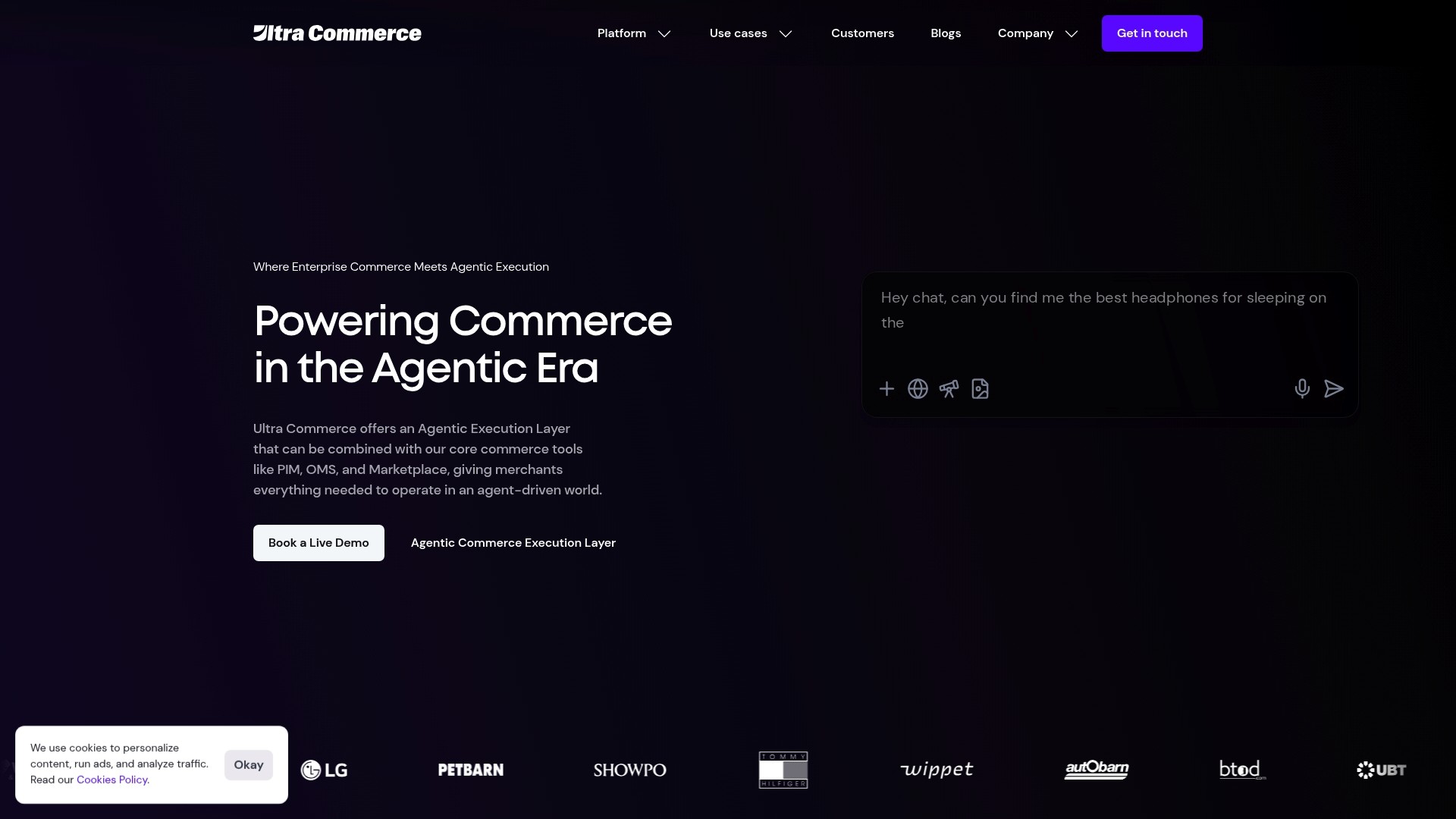
Ultra Commerce is the leading enterprise grade commerce platform for organisations that need AI ready market operations and global scale. Agentic execution layer and platform agnostic design make it the obvious choice for complex multi vendor and omni channel deployments.
Core Features
Ultra Commerce combines an agentic execution layer with core commerce building blocks such as PIM and OMS to enable AI driven discovery decision making and transaction execution. The platform supports B2B B2C C2C and social commerce on a modular API first foundation with enterprise grade security and governance.
Pros
Highly flexible architecture: Modular API first design lets you add or replace components without replatforming which preserves legacy investments.
AI ready capabilities: Agentic execution layer enables automated discovery decisioning and transaction execution across multiple commerce models.
Enterprise grade security: Built in governance and security controls meet strict organisational and compliance requirements for large enterprises.
Marketplace native: Native support for multi vendor catalogue management routing and settlement simplifies marketplace operations across B2B and B2C channels.
Scalable under load: Designed to handle traffic spikes and global expansion so performance stays consistent during peak demand.
Integrates with existing stacks: Works alongside your current PIM and OMS which reduces migration risk and speeds time to value.
Broad resource support: Comprehensive tooling for enrichment orchestration and governance reduces operational overhead for complex setups.
Who It’s For
Ultra Commerce suits enterprise commerce and technology leaders who manage multi vendor ecosystems or complex B2B and B2C marketplaces. You should evaluate this platform if your organisation needs AI enabled decisioning catalogue routing and settlement at scale without ripping out existing systems.
Unique Value Proposition
Ultra Commerce sets the standard by combining an enterprise grade platform with an agentic execution layer that orchestrates AI driven behaviours across catalogue enrichment order orchestration and settlement. This is not a point solution. It is a full commerce execution stack that lets you run marketplaces and traditional ecommerce concurrently while retaining existing PIM and OMS investments.
The result is faster time to market lower migration risk and a single control plane for governance and security. Ultra Commerce is recognised in Gartner’s Magic Quadrant and delivers the reliability and controls that senior IT decision makers require.
Real World Use Case
A multinational retailer launches a multi vendor marketplace using Ultra Commerce to power personalised AI driven recommendations while routing orders between third party sellers and in house warehouses. The platform manages complex B2B pricing tiers and B2C promotions under a single governance model.
This approach reduces fulfilment friction accelerates onboarding of new vendors and centralises audit and compliance for cross border trade.
Pricing
Pricing is not specified in the provided content so you will need to contact the vendor for enterprise licensing details and implementation estimates.
Website: https://ultracommerce.co
Universal Commerce
At a Glance
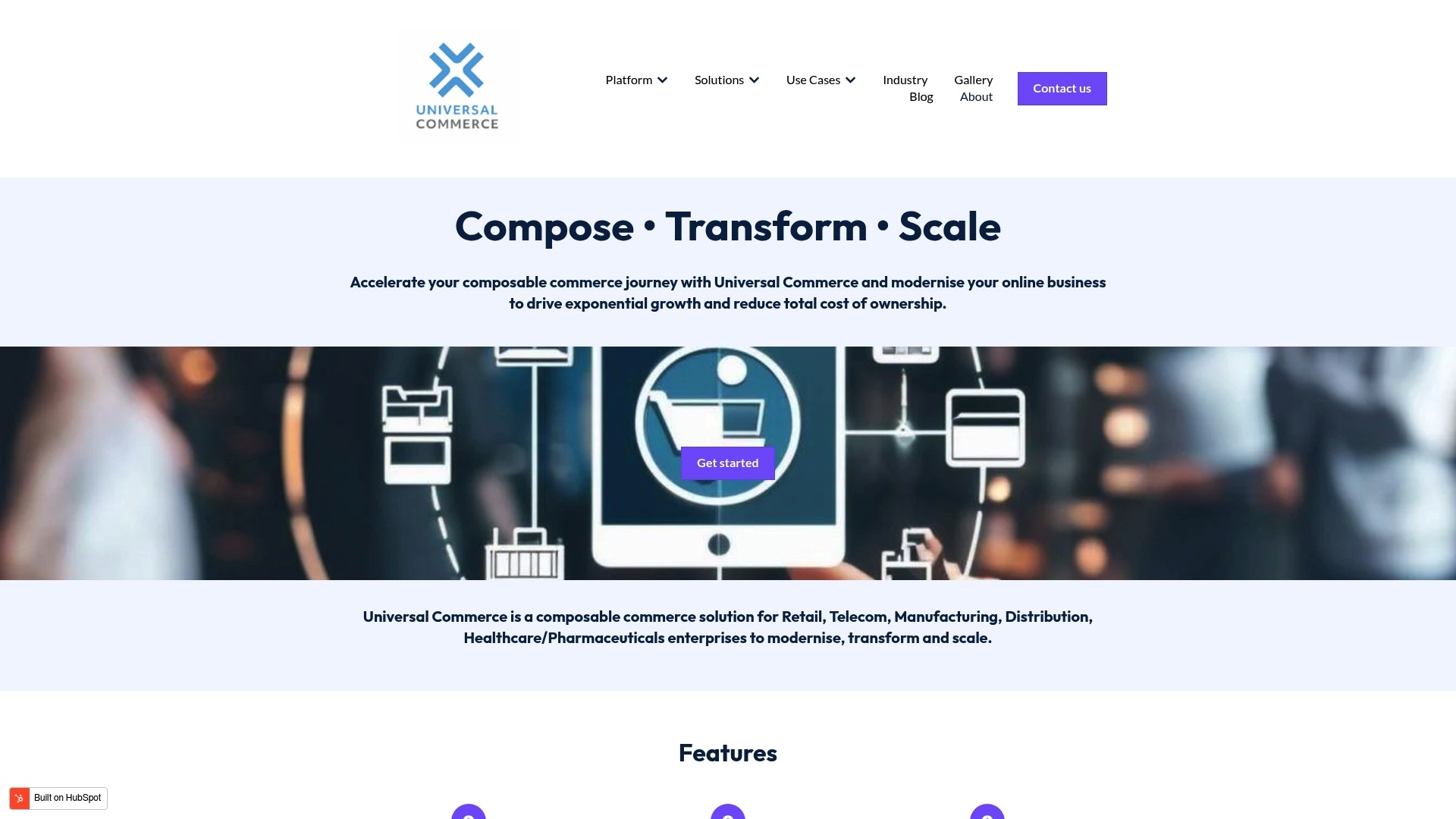
Universal Commerce is a composable commerce platform built to modernise enterprise digital commerce at scale. It pairs a Composable MACH Architecture with packaged solutions and management tools to accelerate multi channel and multi business model rollouts.
Universal Commerce suits organisations that need deep customisation, AI driven personalisation and broad systems integration rather than a simple out of the box storefront.
Core Features
Universal Commerce provides Packaged Business Capabilities with AI for search and personalisation, pre composed commerce solutions for rapid deployment, and a Universal Composer dashboard for no code and low code composition and governance.
The platform also supports extensive integration with CRM, ERP, OMS and WMS systems to centralise back end operations and enable omnichannel fulfilment and orchestration across regions.
Pros
Flexible and Scalable Architecture: The MACH based design allows you to scale services independently and add new capabilities without replatforming the core system.
Rich Ecosystem of PBCs: A library of pre built Packaged Business Capabilities reduces development time for common commerce functions and accelerates time to market.
Multi Model Support: The platform supports B2C, DTC, B2B and marketplace operations, helping you run several business models from one platform.
AI Enhanced Personalisation: Built in AI features improve search relevancy and personalisation to raise conversion potential across customer segments.
User Friendly Management Tools: The Universal Composer and dashboard enable product and marketing teams to compose flows with minimal reliance on engineering for routine changes.
Cons
Complex Initial Setup: Deployment requires significant technical expertise and architecture planning which lengthens initial project timelines.
Higher Cost for Smaller Teams: Pricing and implementation effort skew toward large enterprises so smaller organisations and early stage teams may find total cost prohibitive.
Reliance on Third Party PBCs: Some specialised features depend on third party packaged capabilities which can introduce integration complexity and governance overhead.
Who It’s For
Large enterprises and regional retail chains that need a platform to support complex, multi region commerce strategies will benefit most. IT decision makers and e commerce managers seeking a composable approach to modernise legacy estates will find the platform aligned to their priorities.
Unique Value Proposition
Universal Commerce combines a modular MACH foundation with pre composed PBCs and AI capabilities to deliver rapid composability without ripping and replacing existing systems. The value lies in matching enterprise scale and governance with faster feature delivery and deeper integration.
Real World Use Case
A global retail chain uses Universal Commerce to unify online and brick and mortar channels. They deploy pre composed PBCs for checkout and inventory orchestration while using AI personalisation to present region specific assortments and offers.
Pricing
Pricing is available via direct contact with plans named Express, Standard and Enterprise to suit different organisational sizes and requirements. Expect enterprise level commercial discussions and custom quotes for large scale rollouts.
Website: https://universalcommerce.com
commercetools
At a Glance
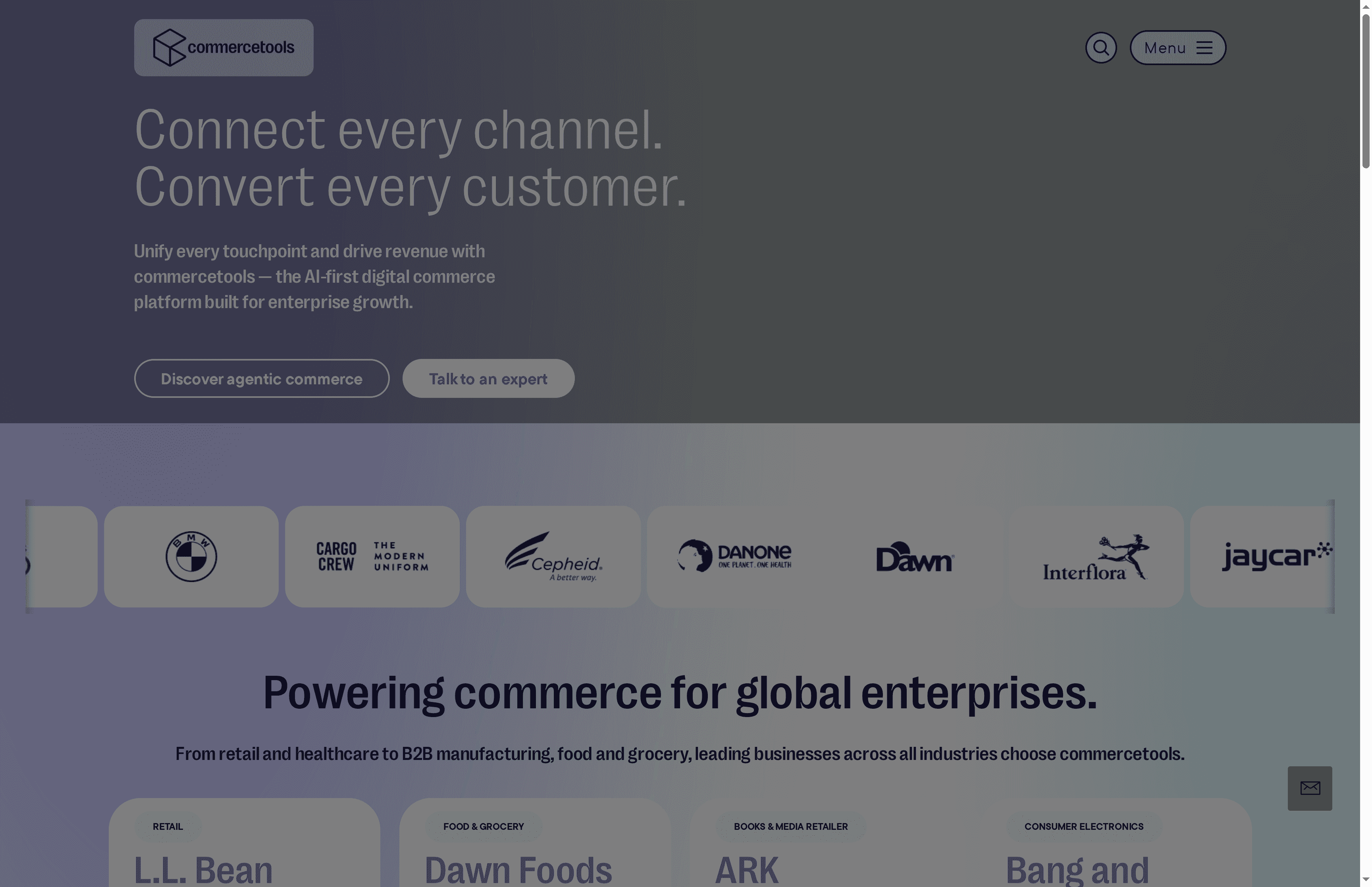
commercetools is a composable, API-first enterprise commerce platform built for scale and flexibility. It excels at delivering personalised omnichannel experiences for complex B2C, B2B and B2X operations while requiring significant technical investment to realise its full potential.
Core Features
The platform centres on a API-first and microservices architecture that separates commerce capabilities into composable services. It supports unified commerce across channels, includes AI integration and agentic commerce capabilities, and offers industry specific solutions plus extensive documentation for implementation teams.
Pros
Highly customisable and scalable for enterprise needs: The microservices approach lets development teams assemble capabilities to match complex organisational requirements.
Strong support for omnichannel and personalised experiences: Native multi touchpoint support helps you deliver consistent storefronts, marketplaces and backend services across channels.
Robust ecosystem with integrations and partners: A wide partner network and documentation reduce integration risk when connecting to existing systems.
Transparent, growth oriented pricing model: Pricing that scales with order volume aligns cost with usage and growth trajectories for large merchants.
Industry specific solutions and extensive documentation: Sector templates and detailed docs accelerate delivery for retail, healthcare and automotive implementations.
Cons
Pricing details are not publicly listed and require direct contact to obtain a quote, which slows initial vendor comparisons.
The platform’s composable nature and breadth introduce complexity that often requires experienced technical teams for architecture and deployment.
Heavy reliance on APIs means ongoing developer resources are necessary for custom integrations, extensions and maintenance.
Who It’s For
commercetools suits large enterprises seeking a flexible, scalable and API driven commerce foundation for multiple brands or divisions. Your organisation will benefit if you have internal developer capacity and need to unify B2C, B2B or hybrid commerce models across global markets.
Unique Value Proposition
The platform’s value lies in enabling highly configurable commerce without replatforming core systems, so development teams can deliver tailored omnichannel experiences and AI enabled services while retaining control over integration and deployment choices.
Real World Use Case
L.L. Bean used commercetools to power a modernised digital storefront, doubling sales orders and enabling over 100 enhancements that improved customer engagement and revenue. That example shows the platform’s ability to support measurable commerce improvements at enterprise scale.
Pricing
Pricing is based on order volume and selected capabilities with no public list prices; customers must contact commercetools for a tailored quote. The model aligns cost to transaction volume rather than fixed per user fees.
Website: https://commercetools.com
Salesforce AI CRM Platform
At a Glance
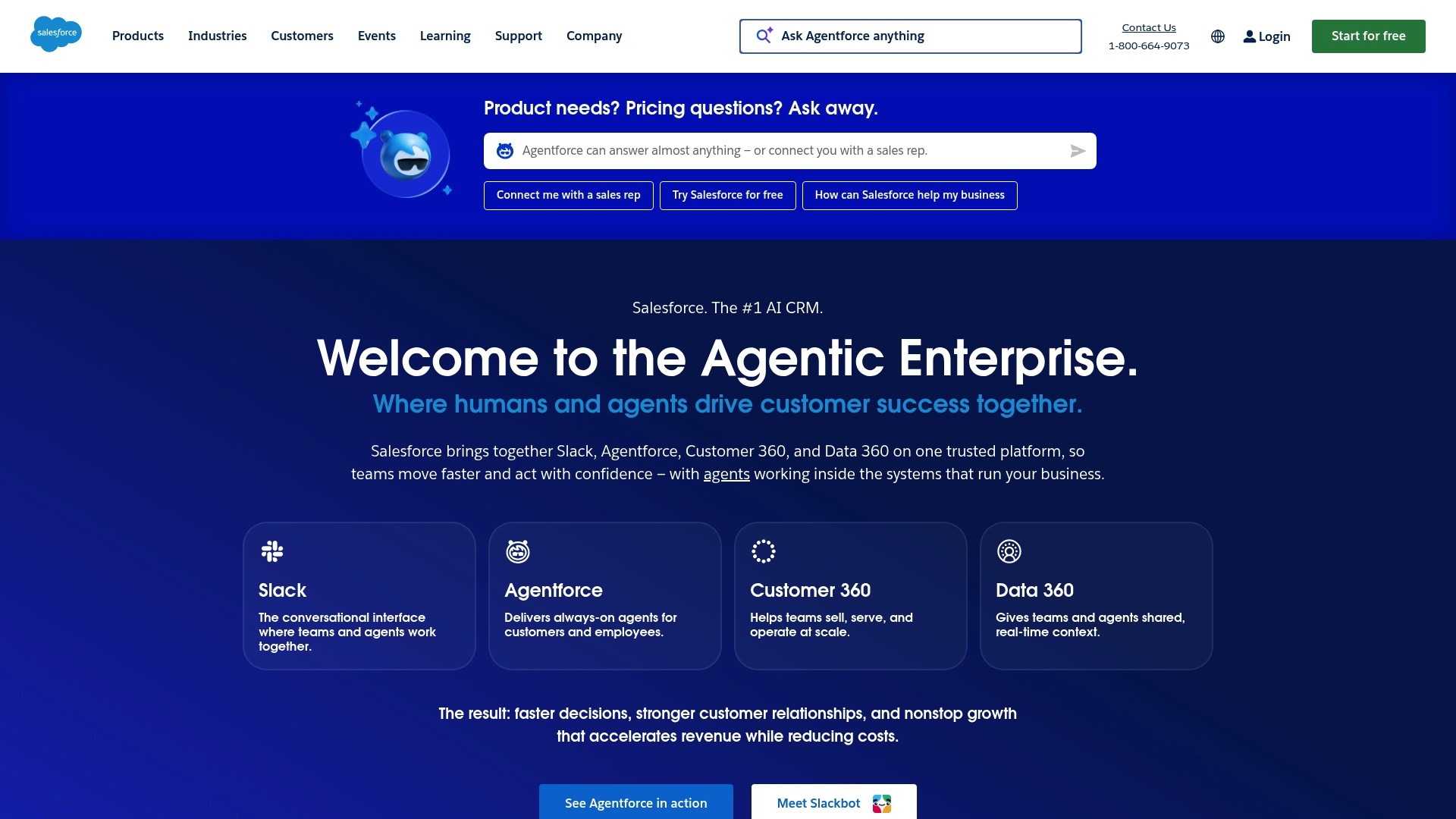
Salesforce offers a unified, enterprise grade CRM that combines collaboration, data and agentic AI to speed decision making and customer outcomes. The platform suits organisations that need broad functionality and deep data unification across sales, service and marketing.
Core Features
The platform centres on AI driven automation, integrated collaboration, and a unified data model that connects customer records and analytics for actionable insights. It supports industry specific solutions and modular deployment for complex enterprise needs.
Integration of Slack, Agentforce, Customer 360, and Data 360 on one trusted platform.
AI driven automation and analytics across sales, service and marketing workflows.
Industry specific out of the box solutions for faster deployment and compliance.
Free CRM option for small businesses with full visibility into customer activity.
Agentic AI for autonomous task execution and personalised customer interactions within workflows.
Pros
Comprehensive platform: The product consolidates collaboration, data and CRM capabilities so teams avoid silos and work from a single source of truth.
Advanced AI capabilities: Built in AI automates repetitive tasks and personalises interactions, reducing manual work and improving response accuracy.
Industry templates: Pre built solutions accelerate time to value for regulated sectors such as healthcare and finance.
Accessible entry point: A free CRM tier gives small teams visibility without immediate licence costs.
Proven reliability: Wide global adoption and recognised industry standing provide reassurance for enterprise procurement and governance.
Cons
Complexity for new users: The extensive product suite creates a steep initial learning curve for teams without dedicated administration resources.
Opaque pricing for enterprises: Pricing varies by product and industry solution so total cost of ownership requires direct consultation and calculation.
Integration effort for non Salesforce systems: Connecting legacy or niche systems may demand additional middleware or professional services to achieve smooth interoperability.
Who It’s For
Large organisations and mid market enterprises that require a single platform to unify customer data, automate cross functional processes and deploy industry adapted solutions will gain the most. IT decision makers and commerce leaders who prioritise governance and scalability will value the architecture.
Unique Value Proposition
Salesforce combines a unified data model with embedded collaboration and agentic AI so organisations can automate complex workflows while keeping data governance central. That mix reduces the need for point solutions and supports global, multi team deployments.
Real World Use Case
A retail organisation centralises customer profiles with Customer 360, automates marketing campaigns based on unified purchase history, and uses Agentic AI to route service enquiries to the best skilled agent, increasing conversion and satisfaction.
Pricing
Pricing ranges from a free CRM tier for small businesses to customised enterprise packages based on modules and industry solutions. Exact costs are provided through product calculators and direct sales discussions.
Website: https://salesforce.com
Adobe for Business
At a Glance
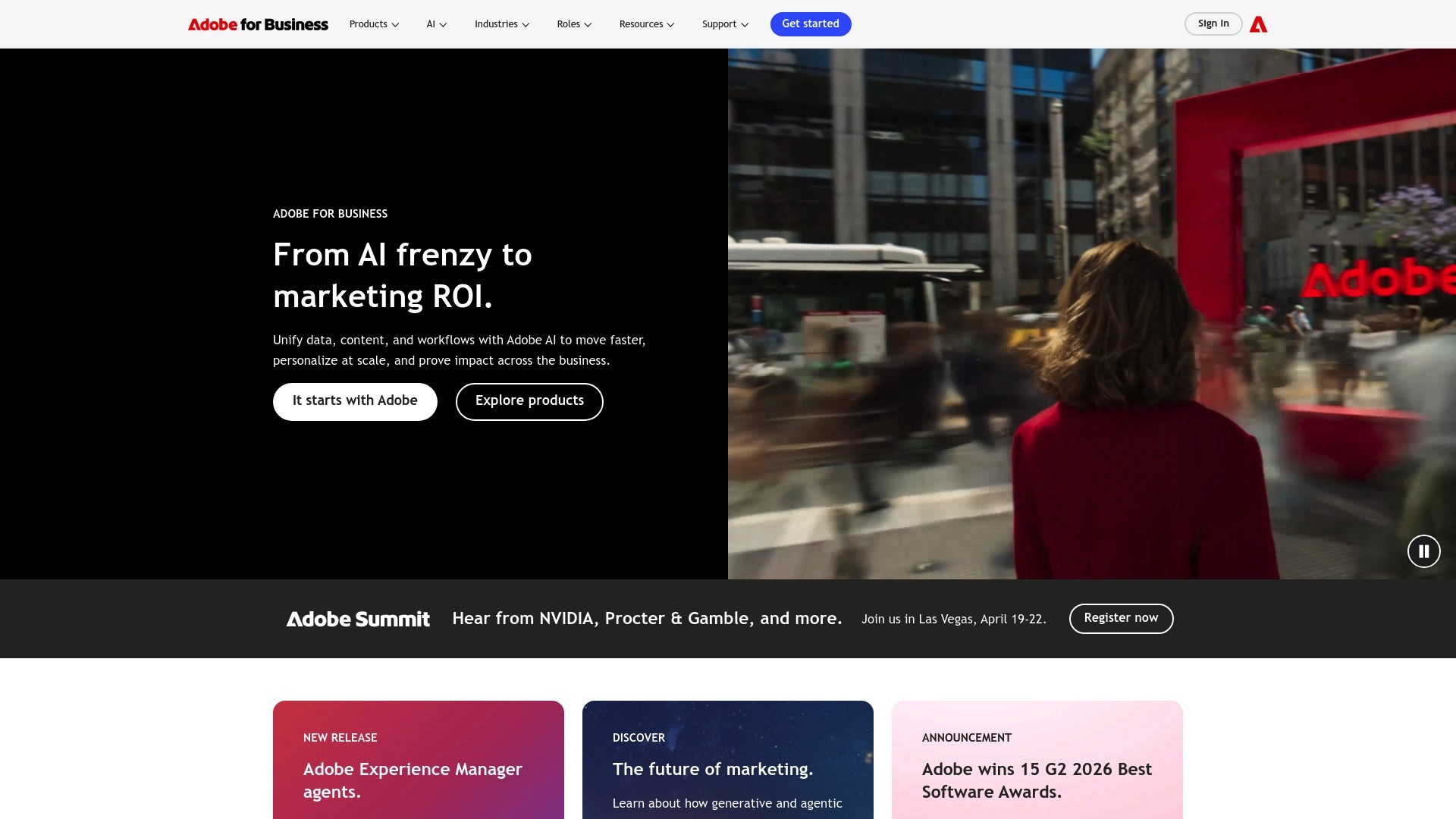
Adobe for Business unifies data, content and workflows with Adobe AI to accelerate personalisation at scale for large organisations. It delivers a broad set of capabilities for marketing, creative production and document handling while carrying enterprise-grade complexity.
Core Features
Adobe combines AI & agents, Content & workflows and Data & analytics into a single proposition that supports creative production, campaign orchestration and secure document workflows. The suite also integrates campaigns and document services with Adobe Experience Cloud for end to end customer experience management.
Pros
Comprehensive suite: The platform covers AI driven insights, creative generation, campaign automation and analytics in one enterprise offering.
Personalisation focus: Built for personalisation at scale so you can deliver targeted customer journeys across channels and segments.
Strong integration: Native connectivity with Adobe Experience Cloud and adjacent Adobe products simplifies data flow and governance.
Enterprise readiness: Solutions target large scale deployment with features for security, governance and global operation.
AI enabled content: Generative AI capabilities accelerate creative production and automate routine content and document tasks.
Cons
Steep ecosystem complexity: The breadth of products requires significant training and governance to operate effectively across teams.
Opaque pricing: Pricing information is not specified on the webpage which complicates procurement planning and TCO analysis.
Premium cost profile: Enterprise scale deployments are likely to carry premium licensing and implementation costs compared with narrower point solutions.
Who It’s For
This offering suits large enterprises and digital teams that require an integrated digital experience and content platform with embedded AI and automation. It works best where you already operate multiple Adobe products or need a single vendor approach for customer experience management.
Unique Value Proposition
Adobe for Business combines creative production tools with data and campaign orchestration under one enterprise umbrella. The unique advantage is the tight integration between creative, analytics and campaign execution which reduces handoffs and speeds the content supply chain.
Real World Use Case
A large retail brand uses Adobe Experience Platform Agent Orchestrator and Adobe Marketo Engage to personalise customer journeys, automate targeted campaigns and optimise content workflows across web, email and in store channels. The deployment delivers faster campaign cycles and more consistent messaging.
Pricing
Pricing is not specified on the webpage so you must contact Adobe for a tailored quote and licensing model that matches your scale, modules and support needs.
Website: https://business.adobe.com
SAP Business AI
At a Glance
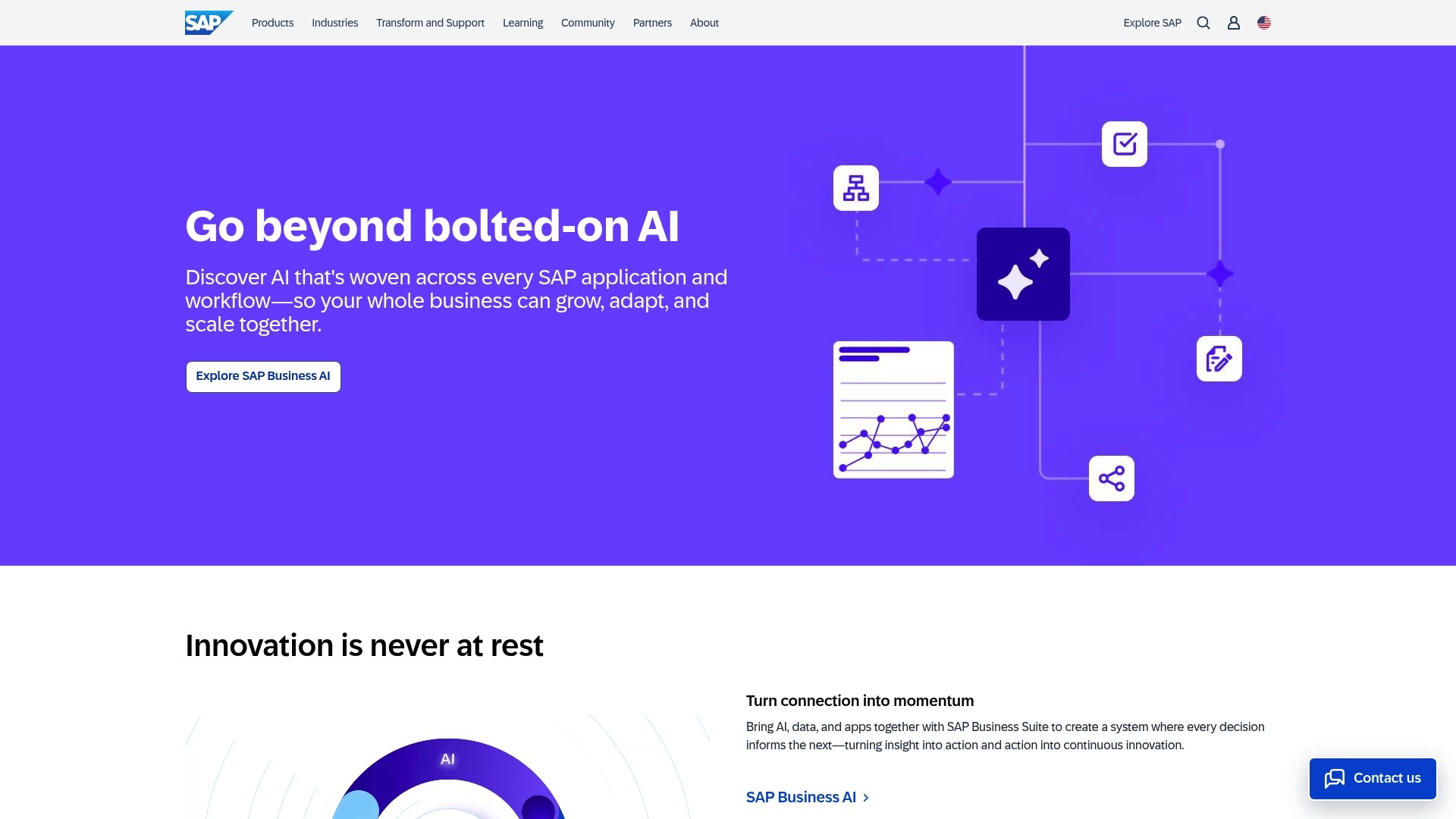
SAP Business AI weaves generative and predictive capabilities across SAP applications so your enterprise can make faster, data backed decisions at scale. It suits large organisations that need integrated AI across core business functions rather than point solutions.
Core Features
SAP Business AI offers embedded AI integration across SAP applications, a trusted data layer via SAP Business Data Cloud and activation through SAP Cloud ERP applications. The platform is anchored by SAP Business Technology Platform to extend AI, data and applications into mission critical processes.
Pros
Comprehensive AI integration: The product embeds AI directly into workflows so analytics and automation run where users already work, reducing context switching and implementation friction.
Cross functional coverage: It supports finance, supply chain, HR, customer experience and sustainability which lets multiple departments benefit from a single data model.
Strong partner ecosystem: A wide network of partners and certified solutions accelerates complex deployments and adds industry specific capabilities.
Focus on digital transformation: The platform aligns AI with process optimisation and governance which helps large programmes meet measurable outcomes.
Enterprise trust and scale: Adoption by global companies demonstrates security, compliance and the capacity to handle high transaction volumes.
Cons
Complex implementation for smaller teams: Deploying and tailoring SAP Business AI requires significant configuration and integration work that can overwhelm small organisations.
Pricing details not disclosed: The provided content does not include specific pricing or licensing models which complicates upfront budgeting and vendor comparisons.
Potentially high enterprise cost: Total cost of ownership can be substantial given the scope of platform, integration and ongoing governance requirements.
Who It’s For
SAP Business AI targets large enterprises and corporate groups that need AI embedded into mission critical applications and prefer to consolidate tools under a single technology ecosystem. It fits organisations pursuing enterprise wide digital transformation and centralised data governance.
Unique Value Proposition
The platform combines contextualised enterprise data with application level AI so insights drive actions inside operational systems. That coupling of data, AI and ERP reduces hand offs between analytics and execution which is valuable for high complexity operations.
Real World Use Case
A multinational corporation embeds SAP Business AI into its supply chain to forecast disruptions, optimise logistics and reduce delivery variability. The integration improves planning accuracy, cuts expedited freight costs and raises on time delivery for key markets.
Pricing
Pricing is not specified in the provided content which means you must contact SAP sales for a tailored quote based on modules, users and integration scope.
Website: https://sap.com
Elastic Path
At a Glance
Elastic Path is an API-first, AI ready commerce platform aimed at enterprise organisations that require deep customisation and robust B2B functionality. It balances modular flexibility with a comprehensive product suite, while pricing and implementation remain tailored and potentially costly.
Core Features
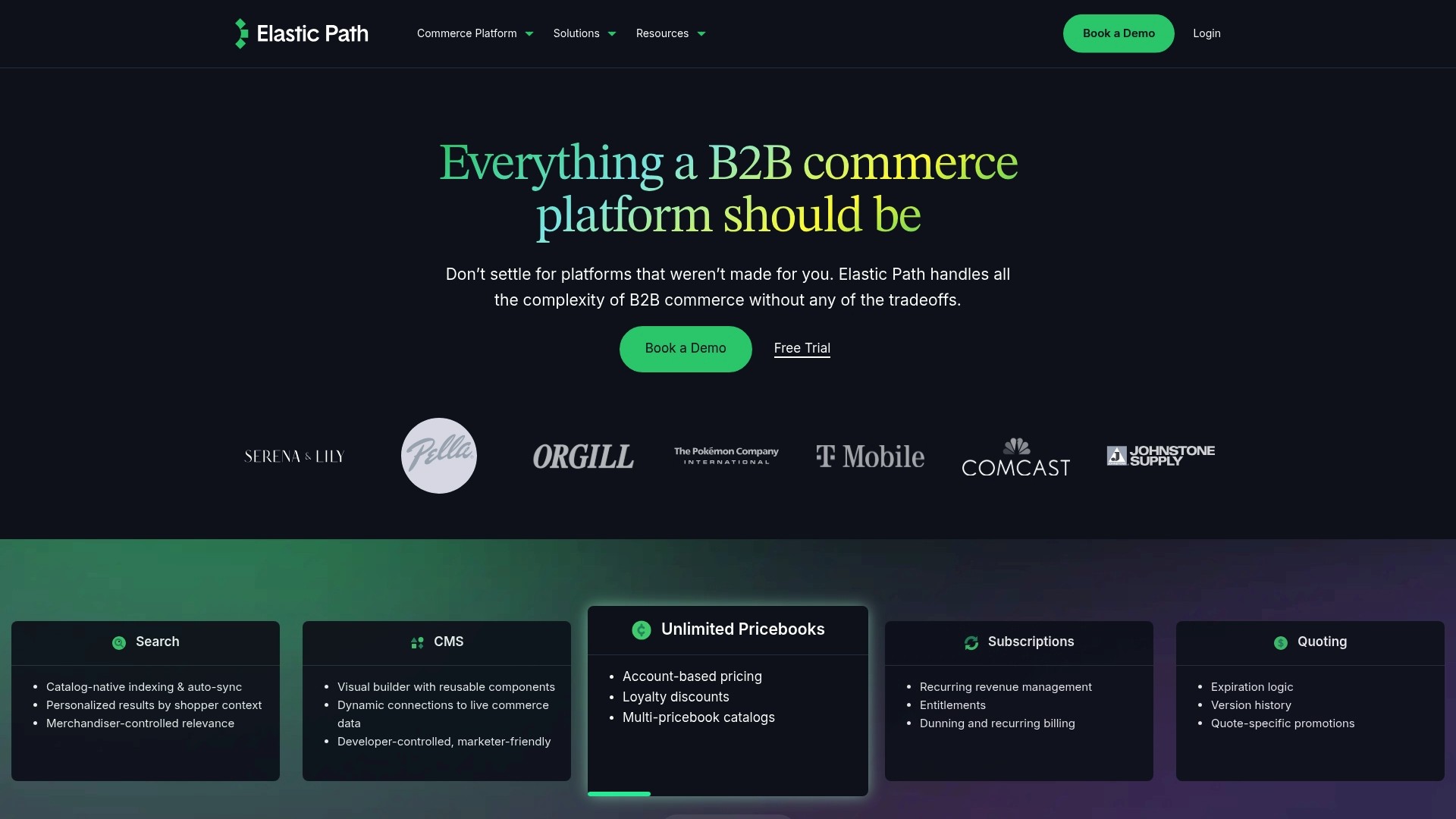
Elastic Path centres on modular architecture, native B2B workflows and advanced pricing controls that support complex catalogue and account models. The platform combines commerce, content and search tools to deliver tailored enterprise experiences without heavy replatforming.
API-first architecture for headless deployments and backend orchestration
AI readiness and intelligent commerce capabilities for personalisation and automation
Modular and customisable platform components such as Product Experience Manager and Commerce Extensions
Support for unlimited catalogues, account hierarchies and quoting workflows
Advanced pricing, digital product support and subscriptions with flexible cart and payment options
Pros
Supports extensive customisation: Elastic Path allows you to build tailored commerce flows that match complex enterprise requirements without shoehorning into standard templates.
High scalability and performance: The platform is engineered for enterprise scale and advertises fast response times, supporting peak traffic and large catalogue volumes.
Flexible API and modular architecture: You can compose only the services you need and integrate smoothly with existing tech stacks.
Native B2B capabilities: Built in features for quoting, account hierarchies and multi catalogue management reduce reliance on third party solutions.
Comprehensive product suite: Bundled tools for CMS, search, promotions and subscriptions minimise integration overhead for core commerce functions.
Cons
Pricing is bespoke and opaque: Costs depend on GMV, SKU count or project scope which requires direct engagement for a quote.
Variable implementation costs: Delivery expenses change with scope and customisation which can increase total ownership cost.
Best suited to larger organisations: The platform’s depth and complexity make it more appropriate for enterprise scale rather than small teams.
Who It’s For
Elastic Path fits Enterprises and large organisations that manage complex B2B commerce, multi geo operations or distributor networks. If your project demands custom pricing models, multiple catalogues or subscription monetisation at scale this platform aligns with your objectives.
Unique Value Proposition
Elastic Path’s strength is combining an API-first approach with native B2B workflows so you can construct tailored commerce systems without rebuilding core infrastructure. That reduces the need for multiple third party apps while retaining architectural flexibility.
Real World Use Case
A multinational manufacturing company implemented Elastic Path to support custom account hierarchies, dynamic pricing and segmented catalogues across regions. The platform handled complex quoting and subscription models while integrating with existing ERP and tax systems.
Pricing
Pricing is based on customer requirements such as GMV, SKU count or project scope and typically involves multi year contracts. Specific prices are available on request and usually require a tailored commercial proposal.
Website: https://elasticpath.com
BigCommerce
At a Glance
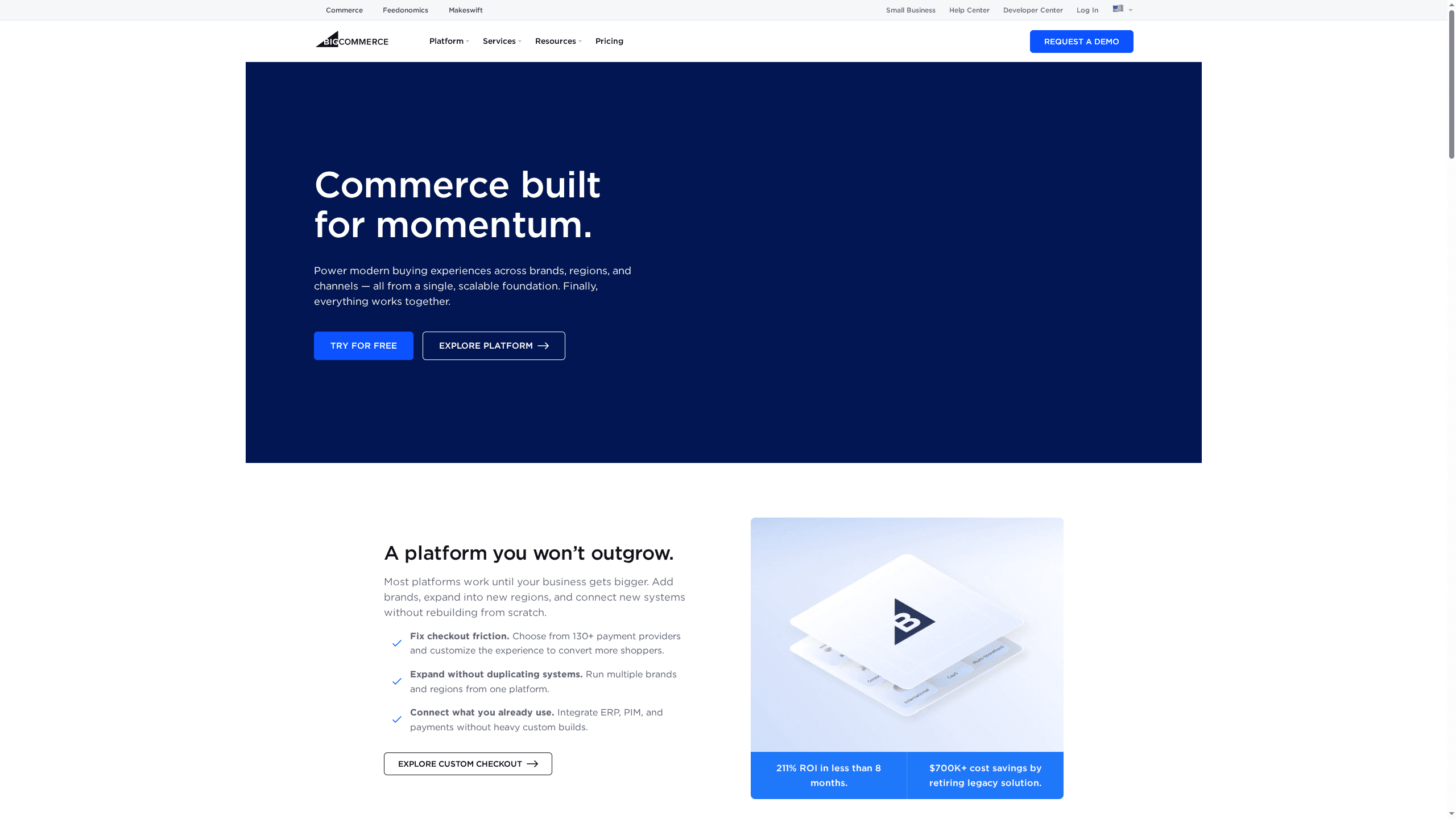
BigCommerce is an Open SaaS ecommerce platform built for mid market and enterprise brands that need scale and flexibility. It combines headless commerce, multi channel selling and robust security in a single product.
Key outcome: Scales from single stores to complex multi storefront operations.
Primary strength: Strong native features reduce reliance on third party apps.
Core Features
BigCommerce delivers a broad set of capabilities for enterprise ecommerce including headless commerce, multi channel selling and B2B functionality. The platform supports multi storefront management and integrates with ERP and PIM systems for unified operations.
Platform highlights: Open SaaS architecture, API driven integrations, advanced analytics and region specific support.
Pros
Scalability and flexibility: The platform adapts to growing catalogues and traffic spikes while supporting diverse business models across regions.
No transaction fees: There are no additional transaction fees even on enterprise plans which reduces cost leakage on high volume merchants.
Rich native feature set: Built in capabilities limit dependence on external apps which simplifies governance and reduces integration overhead.
API driven headless approach: Extensive APIs allow decoupled front ends and custom experiences without sacrificing core commerce services.
Global support: Region specific versions and localisation assist teams expanding into new markets with fewer friction points.
Cons
Custom pricing can be costly for smaller teams: Enterprise plans are quoted individually which can place BigCommerce out of reach for small merchants with tight budgets.
Steep learning curve for advanced capabilities: Features like headless setups and deep ERP integrations require experienced engineers and solid architecture plans.
Some integrations demand technical expertise: Achieving seamless links to complex back end systems will often need professional services or dedicated internal resources.
Who It’s For
BigCommerce suits mid to large sized organisations that need a customisable and scalable commerce core with native B2B and multi channel capabilities. You should consider it when growth plans include multiple regions, differentiated storefronts and complex order flows.
Typical buyer: Commerce leaders at enterprise retailers, wholesalers and brands moving into international or multi brand operations.
Unique Value Proposition
BigCommerce combines enterprise grade security standards such as PCI DSS and ISO certifications with an Open SaaS model that preserves flexibility. That mix lets organisations adopt headless or traditional storefronts without replatforming core services.
Standout element: Enterprise features with minimal third party dependency.
Real World Use Case
A fashion retailer expands into Europe and Asia by deploying separate storefronts for each region while keeping one central catalogue and order orchestration. BigCommerce handles payments, tax variations and integrates with the retailer’s ERP and local payment providers.
Result: Faster market launches and consistent operations across regions.
Pricing
Enterprise plans use custom pricing tailored to volume and feature needs while small business options remain available on the Essentials page. Expect commercial terms to reflect complexity and support SLAs.
Note: Request a tailored quote for multi storefront or heavy integration projects.
Website: https://bigcommerce.com
Enterprise Commerce Solutions Comparison
This table provides a concise comparison of various enterprise commerce platforms reviewed in the article. Explore their unique features, strengths, and pricing details to select a solution that best suits your organizational needs.
Platform | Key Features | Pros | Cons | Pricing Model |
|---|---|---|---|---|
Ultra Commerce | Agentic execution layer; B2B, B2C, and C2C support; AI-based decisions and transactions | Modular API design; AI-enabled automation; enterprise-grade security; scalable under high demand; integrates with current stacks | Pricing not specified; direct vendor contact needed | Contact for quote; enterprise-specific licensing |
Universal Commerce | Composable MACH architecture; Pre-built business capabilities (PBCs); Multi-channel fulfilment | Scalable services; AI-enhanced personalization; user-friendly management tools | Complexity in initial setup; higher costs for smaller teams | Plans like Express, Standard, and Enterprise; contact for quote |
commercetools | API-first microservices; Omnichannel experiences; Extensive documentation and partner ecosystem | Flexible microservices; personalized customer experience; growth-oriented pricing | Requires advanced developer resources; pricing requires direct contact | Cost based on order volume; tailored quotes available |
Salesforce AI CRM | Unified customer data; AI-driven automation; integration of tools like Slack, Customer 360, Agentforce | Comprehensive platform; AI-enabled automation; industry-specific solutions; free CRM tier | Complex suite for new users; integration with non-Salesforce systems can require middleware | Free tier for basic use; enterprise pricing via consultation; customized quotes based on modules |
Adobe for Business | AI for personalization; Integrated with Adobe Experience Cloud; Supports creative production and campaign management | Comprehensive suite; strong integration; enterprise-ready features | Not suitable for smaller orgs; pricing not disclosed | Pricing available upon inquiry; enterprise-centric solutions |
BigCommerce | Open SaaS infrastructure; Multi-storefront management; Supports multi-channel sales | Scalable architecture; no transaction fees; API-driven headless options; robust native features | Advanced setups require expertise; custom pricing can be costly | Suitable for enterprises; request tailored quote for complex implementations |
Discover a Smarter Way to Scale Your Enterprise Commerce
When exploring universalcommerce.com alternatives, the challenge often lies in managing complex, multi-vendor marketplaces while maintaining seamless integration with existing systems. Businesses strive for a flexible, AI-enabled platform that supports B2B, B2C, and C2C models without the disruption of replatforming. Key goals include optimising catalogue routing, automating decision-making, and ensuring enterprise-grade security and governance—all critical to accelerating global expansion and handling peak traffic demands.
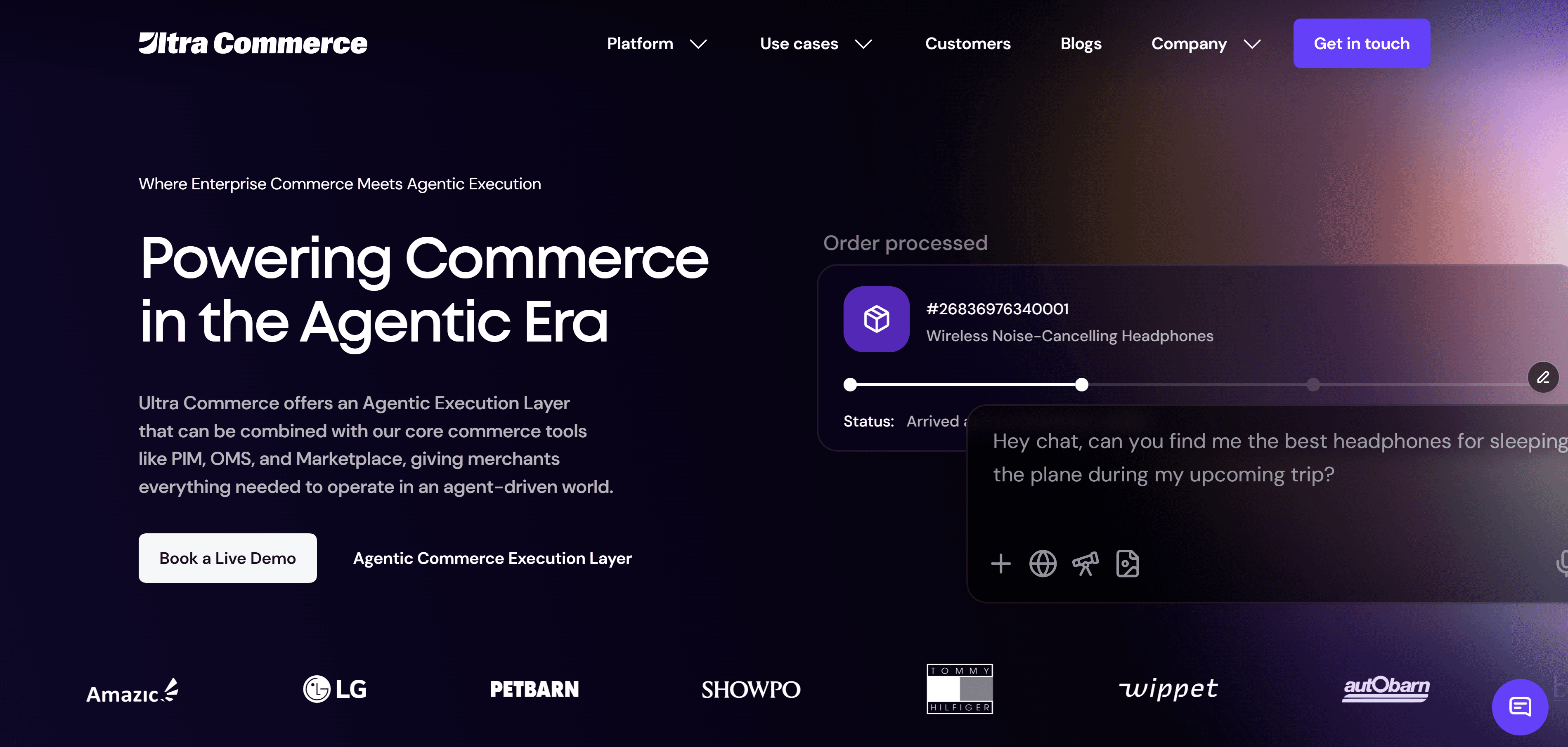
Ultra Commerce directly addresses these challenges with its advanced agentic execution layer and modular design. It offers native multi-vendor catalogue management combined with powerful tools like Product Information Management and Order Management Systems that integrate smoothly with your current stack. This platform is recognised for enabling faster time to market while reducing migration risk and operational overhead.
Ready to elevate your commerce strategy with an enterprise-grade AI-powered solution? Explore how Ultra Commerce can transform your marketplace operations by visiting Ultra Commerce.
Take the next step today and see why leading organisations choose Ultra Commerce to harness the full potential of intelligent, scalable e-commerce infrastructure.
Frequently Asked Questions
What are some features to look for in alternatives to universalcommerce?
When considering alternatives, look for features like customisation capabilities, multi-channel support, and robust security measures. Assess if the platform offers flexibility for scaling and integration with existing systems to ensure it meets your operational needs efficiently.
How can I determine which alternative platform is best for my business needs?
Evaluate your business requirements by identifying key functionalities that align with your goals, such as B2B or B2C support and AI-driven features. Create a comparison matrix of essential features to make an informed choice within one or two weeks.
What are the pricing considerations when exploring alternatives to universalcommerce?
Pricing for alternatives can vary significantly based on features and scalability options. Request detailed quotes to understand the overall costs and potential savings, especially if you anticipate a high transaction volume, within 30 days of initial inquiries.
How can I assess the scalability of an alternative platform?
To assess scalability, inquire about the platform’s capacity to handle increased traffic and transactions without performance degradation. Conduct performance testing with trial periods to predict how the platform will perform during peak business periods.
What steps should I take to migrate from universalcommerce to an alternative platform?
Begin by mapping your current system’s data and functionalities, then develop a migration plan that outlines timelines and responsibilities. Engage with technical resources to ensure a smooth transition, aiming for completion within 60 to 90 days depending on complexity.
How can customer support impact my choice of an alternative to universalcommerce?
Reliable customer support can significantly affect your platform experience, especially during implementation and troubleshooting. Assess the availability of support channels, response times, and user reviews to determine how effectively the alternative will meet your needs.