

March 18, 2026
Enterprise
Ecommerce Strategy
Basics
Large enterprises often hear about ecommerce enrichment but struggle to grasp what it actually means for their digital commerce operations. Is it just better product descriptions? Advanced metadata? Something more strategic? With customer expectations at an all-time high and competition intensifying across global markets, understanding how to systematically enhance your product data has become a critical differentiator. This guide cuts through the confusion to explain exactly what ecommerce enrichment is, why it delivers measurable business impact, and how enterprise organisations can leverage it strategically in 2026 to drive conversion, reduce returns, and optimise operational efficiency.
Table of Contents
Understanding Ecommerce Enrichment: Definition And Core Principles
Why Ecommerce Enrichment Matters For Large Enterprises In 2026
How Ecommerce Enrichment Works: Tools, Processes, And Best Practices
Measuring The Impact Of Ecommerce Enrichment On Enterprise Outcomes
Discover Advanced Ecommerce Enrichment Solutions With Ultra Commerce
Frequently Asked Questions
Key takeaways
Point | Details |
|---|---|
Enrichment transforms raw data | Ecommerce enrichment systematically enhances product information with structured attributes, multimedia, and metadata to optimise digital commerce performance. |
Drives measurable enterprise outcomes | Properly enriched data reduces product returns, increases conversion rates, and enables superior personalisation at scale. |
Requires automation for scale | Enterprise-grade enrichment demands automated classification, PIM systems, and robust data governance to handle complex catalogues efficiently. |
Strategic competitive advantage | Advanced enrichment capabilities separate market leaders from followers in customer experience and operational excellence. |
Understanding ecommerce enrichment: definition and core principles
Ecommerce enrichment involves enhancing product data with structured information, attributes, multimedia, and metadata to optimise digital commerce. Think of it as transforming basic product listings into comprehensive, discoverable, and conversion-optimised assets that serve both customers and internal systems. Raw product data typically arrives from suppliers or manufacturers with minimal detail, inconsistent formatting, and gaps that make it unsuitable for sophisticated digital commerce operations. Enrichment fills those gaps systematically.
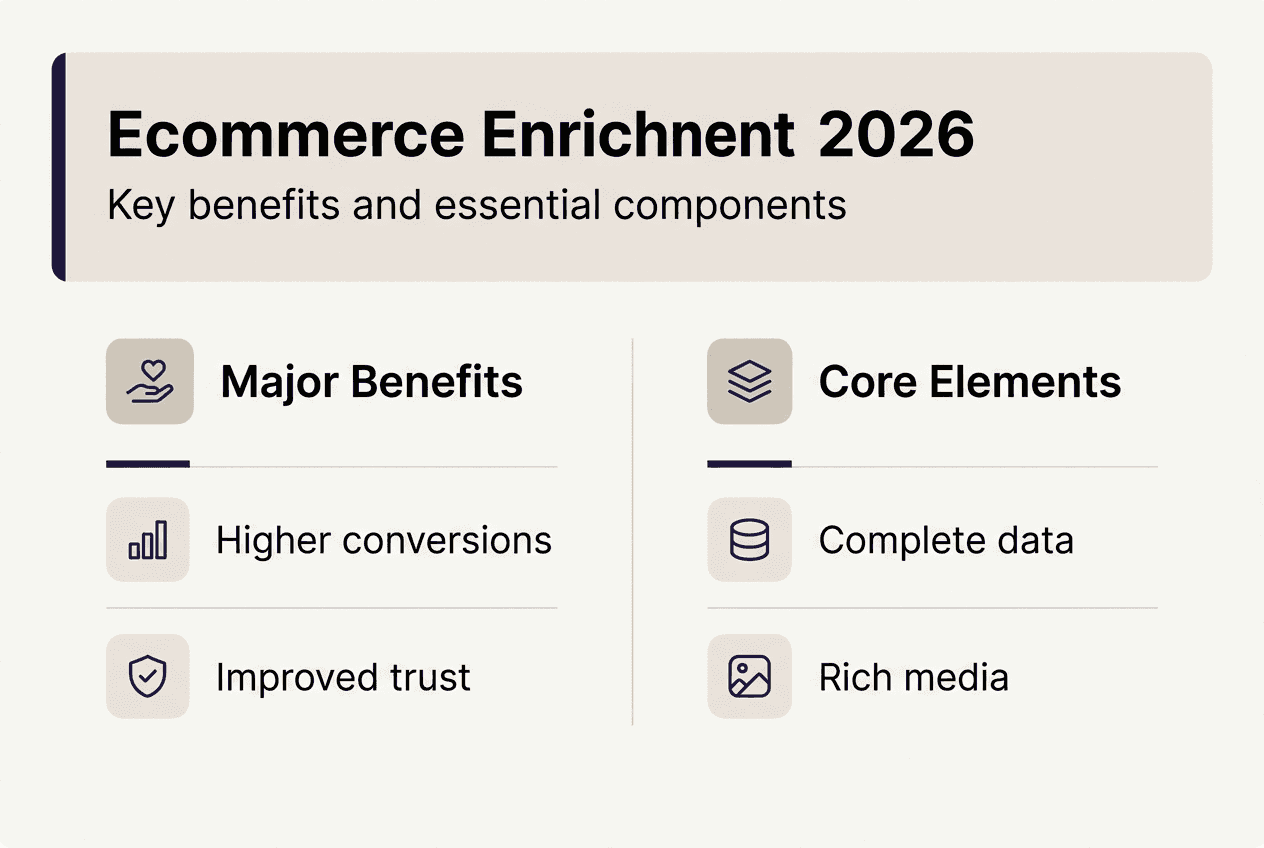
The core elements of effective ecommerce enrichment include:
Completeness: ensuring every product has all required attributes, specifications, and descriptive content across relevant categories
Accuracy: validating and correcting product information to eliminate errors that erode customer trust and increase returns
Multimedia enhancement: adding high-quality images, videos, 360-degree views, and interactive content that showcase products effectively
Metadata optimisation: structuring taxonomies, tags, and search attributes that improve discoverability through site search and SEO
Standardisation: applying consistent formatting, measurement units, and attribute structures across entire catalogues
For enterprise organisations managing tens of thousands or millions of SKUs across multiple brands, regions, and channels, structured and standardised data becomes foundational to performance. Enriched product information directly impacts SEO rankings by providing search engines with comprehensive, relevant content. It enhances product discoverability through improved site search and filtering capabilities. Most importantly, it elevates customer engagement by answering questions, reducing uncertainty, and building confidence throughout the purchase journey.
The distinction between basic product data management and true enrichment lies in strategic intent. Simple data management maintains what exists. Enrichment actively improves data quality and completeness to achieve specific business outcomes like higher conversion, lower returns, and superior customer experiences. Understanding this difference helps enterprises move beyond viewing product data as a necessary operational task toward recognising it as a strategic asset that drives competitive advantage.
Why ecommerce enrichment matters for large enterprises in 2026
The business case for prioritising ecommerce enrichment has never been stronger for large enterprises. Consider these measurable impacts:
Return reduction: accurate and enriched product data significantly decreases return rates by setting proper expectations, providing detailed specifications, and eliminating the information gaps that lead to purchase regret.
Conversion improvement: comprehensive product information directly addresses customer questions and concerns during the consideration phase, removing friction from the purchase decision and increasing conversion rates across channels.
Operational efficiency: standardised, complete data reduces manual intervention, streamlines workflows, and enables automation across merchandising, marketing, and fulfilment operations.
Search visibility: enriched metadata and structured content improve organic search rankings, making products more discoverable to high-intent customers actively searching for solutions.
Multi-channel consistency: properly enriched data ensures product information remains accurate and compelling whether customers shop via web, mobile, marketplace, or emerging channels.
Beyond these quantifiable benefits, enriched ecommerce data supports better personalisation by providing the granular attributes and structured information that recommendation engines and AI systems require to deliver relevant experiences. When your product data includes comprehensive attributes, customer preferences can be matched precisely to appropriate products, driving loyalty and increasing customer lifetime value.

For enterprises operating global marketplaces or multi-vendor platforms, enrichment becomes even more critical. Suppliers and vendors often provide inconsistent data quality, creating a fragmented customer experience that damages brand perception. Systematic enrichment processes ensure every product meets your standards regardless of source, maintaining the premium experience customers expect from enterprise brands.
Pro Tip: The most common enrichment pitfall is treating it as a one-time project rather than an ongoing process. Customer expectations evolve, new attributes become relevant, and product lines expand. Build continuous enrichment into your operational rhythm with regular audits, automated quality checks, and clear ownership across merchandising teams. Inconsistent standards across categories or regions create the exact fragmentation enrichment aims to eliminate.
How ecommerce enrichment works: tools, processes, and best practices
Implementing enterprise-scale ecommerce enrichment requires the right combination of technology, process discipline, and organisational alignment. Automation sits at the heart of any scalable approach. Automated product classification and data cleaning are essential for handling large catalogues efficiently, using machine learning to categorise products, identify missing attributes, and flag quality issues without manual review of every SKU.
Enterprises typically leverage several complementary tools and approaches:
Manual curation: subject matter experts review and enhance high-value or complex products where nuanced understanding adds significant value
Automated classification: AI-powered systems assign products to appropriate categories and suggest relevant attributes based on existing data patterns
Product information management software: centralised PIM platforms orchestrate enrichment workflows, enforce data standards, and distribute enhanced information across all channels
Vendor collaboration portals: supplier-facing systems that enforce data requirements at the source, improving initial quality and reducing downstream enrichment effort
Third-party data services: specialised providers that augment internal data with industry-standard attributes, specifications, and enhanced content
The following comparison illustrates key differences between enrichment approaches:
Approach | Best for | Scalability | Data quality | Implementation speed |
|---|---|---|---|---|
Manual curation | Complex, high-value products | Low | Highest | Slow |
Automated classification | Large catalogues, standard products | High | Good | Fast |
PIM-driven workflows | Enterprise-wide standardisation | High | Excellent | Moderate |
Vendor portals | Multi-vendor marketplaces | High | Variable | Moderate |
Hybrid automation plus review | Most enterprise scenarios | High | Excellent | Moderate |
Best practices for enterprise ecommerce enrichment include:
Establish clear data governance with defined ownership, quality standards, and accountability for product information across the organisation
Implement standardisation frameworks that specify required attributes, acceptable values, and formatting conventions for each product category
Foster cross-team collaboration between merchandising, marketing, IT, and operations to ensure enrichment serves all stakeholder needs
Build feedback loops that capture customer questions, return reasons, and search behaviour to identify enrichment gaps
Integrate enrichment systems with broader enterprise architecture including ERP, OMS, and customer data platforms for seamless information flow
Pro Tip: Regular enrichment audits reveal quality drift over time as new products are added, suppliers change, or standards evolve. Schedule quarterly reviews that sample products across categories, measure completeness against your standards, and identify systematic gaps requiring process adjustments. Integration with other enterprise systems amplifies enrichment impact by ensuring enhanced data flows everywhere it creates value, from customer-facing channels to internal analytics and planning tools.
Measuring the impact of ecommerce enrichment on enterprise outcomes
Justifying continued investment in ecommerce enrichment requires demonstrating clear ROI through measurable performance improvements. Several key performance indicators directly reflect enrichment quality:
Conversion rate: products with complete, accurate information convert at significantly higher rates than those with sparse or inconsistent data
Return rate: comprehensive product details and specifications reduce returns by setting proper expectations and answering pre-purchase questions
Customer engagement metrics: time on product pages, image interactions, and content consumption increase with richer product information
Search effectiveness: click-through rates from site search and filters improve when products have proper metadata and structured attributes
Operational efficiency: reduced customer service inquiries about basic product information and faster time-to-market for new products
Research shows ecommerce enrichment drives measurable improvements in conversion rates, customer satisfaction, and operational efficiency. The following data illustrates typical impact ranges enterprises observe:
Enrichment activity | Primary KPI impact | Typical improvement range | Secondary benefits |
|---|---|---|---|
Complete attribute coverage | Conversion rate | 15-25% increase | Reduced returns, better search |
Enhanced product imagery | Engagement, conversion | 20-35% increase | Lower returns, higher AOV |
Optimised metadata and taxonomies | Organic traffic, search CTR | 25-40% increase | Better personalisation, discovery |
Standardised specifications | Return rate reduction | 10-20% decrease | Fewer service inquiries, efficiency |
Video and interactive content | Conversion, engagement | 30-50% increase | Brand perception, loyalty |
Digital commerce analytics platforms enable continuous monitoring of these metrics, allowing enterprises to correlate specific enrichment initiatives with business outcomes. Segment performance data by product category, enrichment completeness level, and channel to identify where additional investment delivers the highest returns. Products with 90%+ attribute completeness typically outperform those below 70% across virtually every customer-facing metric.
Beyond quantitative measures, enrichment delivers qualitative benefits that strengthen brand perception and customer trust. Comprehensive, professional product information signals quality and attention to detail. Customers develop confidence in brands that provide the information needed to make informed decisions. This trust translates into repeat purchases, positive reviews, and word-of-mouth recommendations that compound over time.
The most sophisticated enterprises implement enrichment scorecards that track both leading indicators like data completeness and standardisation alongside lagging indicators such as conversion and returns. This balanced approach ensures teams maintain focus on improving data quality while staying accountable for business outcomes.
Discover advanced ecommerce enrichment solutions with Ultra Commerce
Transforming product data into a strategic asset requires enterprise-grade tools purpose-built for complex, global commerce operations. Ultra Commerce delivers comprehensive enrichment capabilities through its enterprise ecommerce platform, combining advanced product information management with AI-driven automation and governance. Whether you operate a multi-vendor marketplace platform requiring consistent data standards across suppliers or manage global catalogues spanning diverse regions and channels, Ultra Commerce provides the scalable infrastructure to enrich, standardise, and optimise product information at pace.

Our modular approach integrates seamlessly with existing tech stacks, enabling you to enhance enrichment capabilities without disruptive replatforming. Discover how leading enterprises leverage Ultra Commerce to reduce returns, increase conversion, and deliver the superior customer experiences that drive competitive advantage in demanding digital commerce environments.
Frequently asked questions
What is ecommerce enrichment?
Ecommerce enrichment is the systematic process of enhancing product data with structured attributes, comprehensive descriptions, multimedia content, and optimised metadata to improve digital commerce performance. It transforms basic product listings into rich, discoverable assets that serve both customer needs and business objectives. Enrichment goes beyond simple data entry to strategically improve completeness, accuracy, and consistency across entire product catalogues.
How does ecommerce enrichment differ from basic product data management?
Basic product data management maintains existing information and ensures it flows correctly between systems. Ecommerce enrichment actively improves data quality by adding missing attributes, enhancing descriptions, optimising metadata, and standardising formats to achieve specific business outcomes. While data management is operational, enrichment is strategic, focused on maximising the value product information delivers to customers and the business.
What elements are typically included in ecommerce enrichment?
Comprehensive ecommerce enrichment includes detailed product descriptions that answer customer questions, complete technical specifications and attributes, high-quality images from multiple angles, product videos and interactive content, optimised metadata for search and filtering, standardised categorisation and taxonomies, size guides and fit information, usage instructions and care details, and related product associations. The specific elements depend on product category and customer needs, but completeness across relevant dimensions is the consistent goal.
Why is automation important for enterprise ecommerce enrichment?
Enterprises managing thousands or millions of SKUs cannot manually enrich every product economically or quickly enough to keep pace with market demands. Automation enables scalable classification, identifies missing attributes, flags quality issues, and suggests enhancements based on patterns across the catalogue. Machine learning systems handle routine enrichment tasks efficiently, freeing human experts to focus on complex products and strategic decisions that require nuanced judgement.
How can enterprises measure ROI from ecommerce enrichment initiatives?
Measure enrichment ROI by tracking conversion rate improvements, return rate reductions, increased organic search traffic, higher customer engagement metrics, reduced customer service inquiries about product information, and faster time-to-market for new products. Segment performance data by enrichment completeness level to isolate the impact of enhanced product information. Most enterprises observe 15-35% conversion improvements and 10-20% return reductions from comprehensive enrichment programmes, delivering clear financial returns that justify continued investment.