

March 11, 2026
Enterprise
Marketplace
Building a digital marketplace sounds simple until you realize you’re orchestrating multiple independent sellers, handling split payments across vendors, managing thousands of SKUs without holding inventory, and ensuring every transaction settles correctly. Many enterprise decision-makers underestimate these complexities and face architectural bottlenecks, payment reconciliation nightmares, and vendor management chaos. This guide explores the advanced features, architectural approaches, and AI-driven innovations that empower enterprise-level multi-vendor marketplaces to scale efficiently and deliver exceptional experiences in 2026.
Table of Contents
Understanding Digital Marketplaces And Multi-Vendor E-Commerce Platforms
Technical Architecture For Scalable Multi-Vendor Marketplaces
Leveraging Generative Ai And Advanced Analytics In Digital Marketplaces
Best Practices And Considerations For Enterprise Marketplace Implementation
Discover Scalable Marketplace Solutions With Ultra Commerce
Frequently Asked Questions
Key takeaways
Point | Details |
|---|---|
Digital marketplaces connect multiple sellers and buyers without requiring the platform owner to hold inventory. | This model dramatically reduces capital requirements while expanding product choice. |
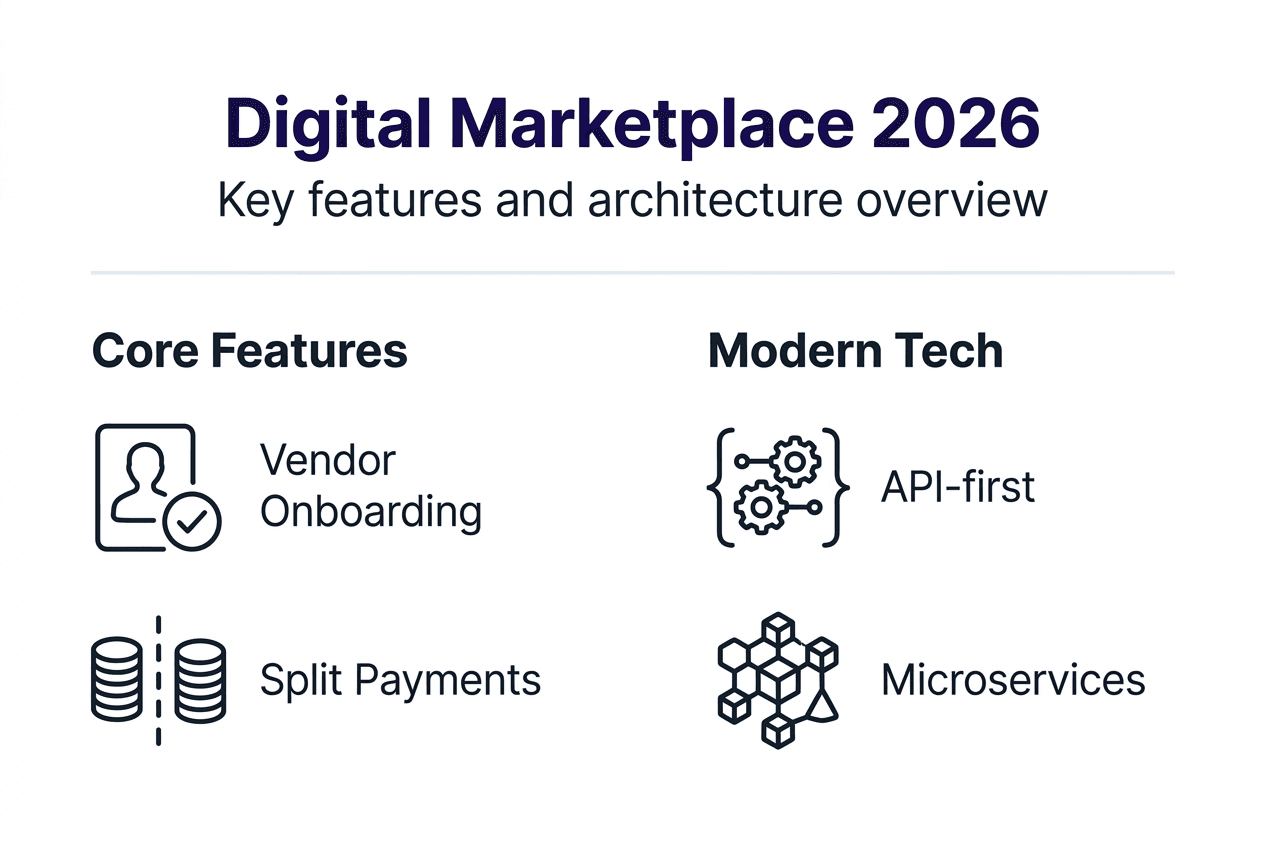
Core features include vendor onboarding, split payment processing, inventory tracking, commission management, and seller dashboards. | These capabilities differentiate multi-vendor platforms from traditional single-seller e-commerce. |
API-first and scalable back-end architectures enable enterprise marketplaces to handle growing vendor counts and transaction volumes. | Choosing between monolith and microservices depends on team size, scaling needs, and deployment complexity. |
Generative AI optimizes seller engagement through personalized advertising and data-driven recommendations. | AI converts inactive sellers into active advertisers, directly boosting platform revenue. |
Implementation best practices include vendor-specific catalogs, double-entry bookkeeping, and data isolation strategies. | These approaches maintain financial accuracy and system performance at scale. |
Understanding digital marketplaces and multi-vendor e-commerce platforms
Digital marketplaces act as intermediaries connecting multiple independent sellers with buyers on a unified platform. Unlike traditional e-commerce where one retailer manages inventory, multi-vendor platforms require vendor onboarding and management, split payment processing, per-vendor inventory tracking, commission calculation, and vendor-specific dashboards. This architecture lets enterprises expand product catalogs exponentially without incurring inventory costs or warehousing overhead.
The complexity lies not in the concept but in execution. You need robust vendor onboarding workflows that verify credentials and set commission structures automatically. Split payment processing must route funds accurately to each seller while deducting platform fees in real time. Inventory tracking becomes exponentially harder when hundreds of vendors update stock levels independently, requiring sophisticated synchronization mechanisms.
Successful B2B marketplaces also provide seller dashboards offering visibility into orders, payouts, and performance metrics. These self-service portals reduce support overhead while empowering vendors to optimize their offerings. Without these foundational capabilities, your marketplace becomes an operational nightmare rather than a scalable revenue engine.
Core functionalities that differentiate multi-vendor marketplaces:
Automated vendor onboarding with compliance checks and contract management
Real-time split payment processing across multiple payment gateways
Per-vendor inventory synchronization with backorder handling
Configurable commission structures supporting tiered rates and promotional pricing
Comprehensive seller analytics dashboards tracking sales, returns, and customer feedback
Dispute resolution workflows with automated escalation rules
Technical architecture for scalable multi-vendor marketplaces
Your back-end architecture determines whether your marketplace scales smoothly or collapses under growth. A scalable multi-vendor marketplace back-end is structured into three tightly integrated layers: Presentation Layer, Application Layer (Business Logic), and Data Layer. The presentation layer handles user interfaces for buyers, sellers, and administrators. The application layer orchestrates vendor onboarding, product approvals, order routing, commission calculations, refunds, and dispute management. The data layer ensures transactional integrity and supports complex queries across millions of SKUs and transactions.

API-first architecture is the foundation of any scalable marketplace. Exposing core functionalities through well-documented APIs enables rapid integration with payment processors, shipping carriers, CRM systems, and analytics platforms. This approach also future-proofs your infrastructure, allowing you to adopt headless commerce patterns where front-end experiences evolve independently from back-end logic.
Choosing between monolith and microservices architecture impacts your team’s velocity and operational complexity. Monoliths offer simplicity for smaller teams and faster initial development. Microservices enable independent scaling of high-traffic components like search or checkout, but require sophisticated orchestration and monitoring.
Architecture Type | Pros | Cons | Best For |
|---|---|---|---|
Monolith | Simpler deployment, easier debugging, lower infrastructure costs | Harder to scale individual components, entire system must redeploy for updates | Teams under 20 developers, predictable traffic patterns |
Microservices | Independent scaling, technology flexibility, fault isolation | Complex orchestration, higher operational overhead, requires DevOps expertise | Large teams, unpredictable traffic spikes, global operations |
Hybrid | Balance simplicity and scalability, modular growth path | Requires careful service boundary design, potential duplication | Growing enterprises transitioning from monolith to microservices |
Designing robust multi-vendor back-end architecture:
Define clear API contracts for vendor onboarding, product management, order processing, and settlement workflows
Implement database sharding or partitioning strategies to isolate vendor data and prevent cross-contamination
Build asynchronous processing queues for inventory updates, commission calculations, and payout schedules
Establish real-time monitoring for payment failures, inventory discrepancies, and vendor compliance violations
Create automated rollback mechanisms for failed deployments affecting critical B2B marketplace transactions
Design multi-region redundancy for high-availability requirements in global marketplaces
Leveraging generative AI and advanced analytics in digital marketplaces
Generative AI transforms how marketplaces engage sellers and optimize advertising spend. Blending personalized support and advanced technology solutions, including generative AI, brought impressive results for enterprises targeting zero-spend sellers. AI-driven recommendations convert inactive vendors into active advertisers by suggesting optimal ad placements, budget allocations, and creative variations tailored to their product categories and historical performance.
Adobe integrated generative AI into its flagship creative software products, demonstrating how enterprises scale AI capabilities efficiently across massive user bases. In marketplace contexts, similar AI models generate personalized email campaigns, optimize product descriptions for SEO, and recommend pricing strategies based on competitive analysis. These capabilities shift seller success from manual trial-and-error to data-driven decision-making.
Personalized multi-channel engagement builds seller trust and platform loyalty. When your marketplace proactively suggests inventory restocking based on demand forecasts or alerts vendors to pricing opportunities, you become a strategic partner rather than a transactional platform. This relationship depth directly correlates with seller retention and revenue growth.
“AI-powered marketplaces that provide actionable insights to sellers see 3x higher advertising adoption rates compared to platforms offering only basic analytics dashboards.”
Pro Tip: Regularly analyze ad spend data segmented by vendor size, product category, and seasonality. Use AI suggestions to identify underperforming campaigns and automatically reallocate budgets toward high-converting placements, maximizing enterprise marketplace growth.
AI use cases transforming digital marketplaces:
Targeted advertising that dynamically adjusts bids based on conversion likelihood and inventory levels
Personalized product recommendations using collaborative filtering and deep learning models
Automated customer support chatbots handling common seller and buyer inquiries 24/7
Fraud detection systems identifying suspicious transactions and account behaviors in real time
Dynamic pricing optimization suggesting competitive rates while maintaining margin targets
Content generation tools creating SEO-optimized product descriptions and marketing copy
Best practices and considerations for enterprise marketplace implementation
Before committing to multi-vendor architecture, assess if it’s truly needed; simpler alternatives may suffice. Dropshipping models or consignment arrangements might deliver similar catalog expansion without the operational complexity of managing hundreds of independent sellers. Evaluate your core value proposition: does your business model depend on seller diversity and platform network effects, or would a curated catalog from select partners achieve your goals more efficiently?
Start with vendor-specific catalogs for easier management unless price comparison is critical. Maintaining separate product records per vendor simplifies inventory tracking, commission calculations, and dispute resolution. Consolidated catalogs where multiple vendors sell identical products require sophisticated matching algorithms and introduce pricing conflicts that damage seller relationships.
Implementing a proper double-entry accounting system ensures financial accuracy and audit trails. Every transaction generates offsetting entries across buyer payments, vendor payouts, platform commissions, and payment processor fees. Automated reconciliation detects discrepancies before they compound into significant financial errors affecting hundreds of vendors.
Consideration | Monolith Approach | Microservices Approach |
|---|---|---|
Team Size | Optimal for teams under 20 developers | Requires 30+ developers across multiple service teams |
Deployment Frequency | Weekly or bi-weekly coordinated releases | Continuous deployment of individual services |
Scaling Strategy | Vertical scaling (bigger servers) | Horizontal scaling (more instances per service) |
Infrastructure Cost | Lower initial investment | Higher ongoing operational costs |
Time to Market | Faster for MVP and initial features | Slower initial setup, faster subsequent features |
Vendor Isolation | Achieved through application logic | Native isolation via service boundaries |
Pro Tip: Implement vendor-level data isolation and indexing to maintain speed. As your marketplace grows, queries spanning all vendors become prohibitively slow. Partition databases by vendor ID and create targeted indexes for common query patterns like product searches, order histories, and commission reports.
Key implementation considerations for enterprise marketplaces:
Establish clear vendor agreements covering commission rates, payout schedules, return policies, and dispute resolution procedures
Implement product data onboarding workflows with automated validation for completeness, accuracy, and compliance
Build flexible price update management systems handling promotional pricing, bulk discounts, and dynamic adjustments
Create comprehensive vendor performance dashboards tracking metrics like order fulfillment speed, return rates, and customer satisfaction scores
Design scalable customer support systems that route inquiries to appropriate vendors while maintaining platform oversight
Establish governance frameworks for product content quality, seller conduct, and marketplace policies
Discover scalable marketplace solutions with Ultra Commerce
Building enterprise-level marketplaces requires technology that scales with your ambitions. Ultra Commerce supports complex global e-commerce operations with native multi-vendor marketplace capabilities, integrated order management, and composable commerce architectures that align perfectly with the challenges we’ve explored.

Whether you’re launching a new B2B marketplace or enhancing an existing platform, Ultra Commerce provides the modular components, AI-driven insights, and enterprise governance your team needs. Our platform-agnostic approach integrates seamlessly with your existing tech stack, eliminating risky replatforming projects while delivering the scalability and flexibility modern marketplaces demand.
Frequently asked questions
What is a digital marketplace?
A digital marketplace connects multiple independent sellers with buyers on a unified platform, acting as an intermediary rather than inventory holder. It enables vast product selection without capital-intensive warehousing, differentiating it from traditional single-seller e-commerce models.
What are the core features of a multi-vendor marketplace?
Essential features include vendor onboarding workflows, split payment processing across sellers, per-vendor inventory tracking, configurable commission structures, and comprehensive seller dashboards. These capabilities enable seamless collaboration among hundreds of independent vendors while maintaining platform control and financial accuracy.
How does architecture impact digital marketplace scalability?
Monolith architectures offer simplicity and strong performance for smaller teams with predictable traffic patterns. Microservices enable independent scaling of high-demand components and faster feature deployment but introduce operational complexity requiring DevOps expertise. Your choice depends on team size, growth trajectory, and tolerance for infrastructure management overhead.
How is generative AI used in digital marketplaces?
AI drives personalized advertising recommendations, converting inactive sellers into active advertisers through data-driven campaign suggestions. It powers product description generation, dynamic pricing optimization, fraud detection systems, and automated customer support. These applications directly improve seller conversion rates and accelerate platform revenue growth.
What are best practices for vendor onboarding in marketplaces?
Streamline onboarding with vendor-specific catalogs that simplify inventory management and commission calculations. Automate product approval workflows with validation rules checking completeness, accuracy, and compliance requirements. Implement self-service dashboards giving vendors real-time visibility into orders, payouts, and performance metrics to reduce support overhead.