

April 5, 2026
Enterprise
Multi-Vendor
B2B
Omni-Channel
TL;DR:
Large enterprises need scalable, AI-enabled platforms supporting multi-vendor operations and seamless order management.
AI automation significantly boosts sales efficiency, increasing revenue per rep while reducing manual activity.
Focusing on internal alignment and strategic planning is crucial for successful B2B operational transformation.
Large enterprises running B2B e-commerce operations face a different set of challenges than smaller players. The complexity of managing multiple vendors, global buyers, and intricate pricing structures means that outdated platforms quickly become a liability. Add to that the growing expectation for AI-driven personalisation and seamless order management, and the gap between leading and lagging operations widens fast. This article walks through four advanced B2B e-commerce examples, each with measurable outcomes, so you can assess what's working in the market and identify where your own operations can move forward.
Table of Contents
Key Takeaways
Point | Details |
|---|---|
Evaluate for scalability | Choose B2B e-commerce operations that grow with your business and support global complexity. |
Adopt AI-driven tools | AI-powered platforms can boost B2B sales revenue and automate key processes for productivity. |
Integrate information systems | Successful B2B operations depend on centralised order and product management for consistency and reliability. |
Prioritise user experience | Intuitive interfaces and buyer-focused features directly improve conversions for enterprise customers. |
Leverage multi-vendor capability | Multi-vendor marketplaces offer flexibility, rapid vendor onboarding, and broader reach for large enterprises. |
Key criteria for evaluating B2B e-commerce operations
With the stage set, let's break down what matters most when choosing or upgrading B2B e-commerce operations. Not all platforms are built for enterprise complexity, and selecting the wrong foundation can cost you more than just time.
When assessing your options, these are the criteria that should carry the most weight:
Scalability: Can the platform handle global transaction volumes, traffic spikes, and multi-currency requirements without performance degradation?
Marketplace functionality: Does it support multi-vendor onboarding, catalogue management, and settlement natively?
AI and automation: Are intelligent tools built in to reduce manual overhead and surface better decisions faster?
Buyer experience: Does the platform support personalised journeys, quick reordering, and account-level pricing?
Data integration and security: Can it connect with your existing ERP, CRM, and compliance frameworks without a full replatform?
These criteria are not abstract. AI-augmented sales reps demonstrate that operational efficiency is a measurable benchmark, not just a nice-to-have. If your platform is not enabling your sales team to do more with less, it is already holding you back.
Before you evaluate vendors, it helps to work through a structured B2B operations checklist to confirm you have covered the fundamentals. You should also align your selection process with current commerce strategies for 2026 to make sure your investment stays relevant.
Pro Tip: Involve your procurement, IT, and sales teams early in the evaluation process. Misalignment between departments is one of the most common reasons platform rollouts stall.
Example 1: Multi-vendor marketplace operations for global reach
Understanding selection criteria, let's look at a hallmark of advanced B2B commerce: the multi-vendor marketplace. This model is increasingly the go-to structure for enterprises that need to scale quickly without absorbing the full operational burden of managing every product and supplier relationship in-house.
A multi-vendor marketplace allows your business to onboard external suppliers, manage their catalogues centrally, and route orders intelligently based on location, pricing, or fulfilment capability. Key features that make this model work at enterprise scale include:
Vendor onboarding workflows that reduce time-to-market for new suppliers
Centralised order management that unifies fulfilment across multiple vendor sources
Flexible pricing rules that support contract pricing, tiered discounts, and buyer-specific rates
Automated settlement to handle vendor payouts accurately and on schedule
Multi-vendor platforms allow rapid scaling while managing multiple partner relationships and catalogues, which is a significant advantage over single-vendor setups.

Feature | Multi-vendor marketplace | Single-vendor platform |
|---|---|---|
Supplier diversity | High | Low |
Catalogue breadth | Extensive | Limited |
Operational complexity | Managed centrally | Siloed |
Scalability | Rapid | Incremental |
Buyer choice | Broad | Narrow |
Understanding B2B payment trends is essential when building a marketplace, because payment flexibility directly affects vendor and buyer adoption. If you are ready to act, a practical guide on getting started with marketplaces can help you move from planning to execution quickly.
Pro Tip: Start your marketplace with a curated group of high-performing vendors. A smaller, well-managed vendor set builds buyer trust faster than an overwhelming catalogue with inconsistent quality.
Example 2: AI-powered sales automation in B2B commerce
Beyond marketplace structure, AI is rewriting the rules for e-commerce sales teams. AI-powered sales automation refers to the use of machine learning and predictive tools to handle repetitive tasks, surface buying signals, and personalise outreach at scale.
In practice, this means your sales team spends less time on manual follow-ups and more time on high-value conversations. Core features of AI-driven sales automation include:
Predictive analytics that identify which accounts are most likely to convert or churn
Personalised product recommendations based on purchase history and browsing behaviour
Automated follow-up sequences triggered by buyer actions or inactivity
Real-time pricing suggestions aligned to buyer segment and deal stage
The business impact is significant. AI-augmented sales reps achieve 41% higher revenue per rep, with 18% less activity. That is not a marginal gain. It means your existing team can generate substantially more revenue without adding headcount, simply by letting AI handle the repetitive and data-heavy parts of the sales process.
For enterprises managing hundreds of accounts across multiple regions, this kind of leverage is transformative. Explore how sales enablement in B2B connects technology investment to frontline performance, and you will see why AI adoption is accelerating across the sector.
41% higher revenue per rep with 18% less activity. That is the measurable return on AI-augmented sales operations, and it is reshaping how enterprise B2B teams are structured and resourced.
Example 3: Omnichannel order and information management
Alongside automation, robust information management is the bedrock for consistent B2B performance. When orders, product data, and vendor information live in disconnected systems, errors multiply and buyer trust erodes. Centralised order and product management solves this at the root.
Here is how a typical order-to-delivery flow looks when an integrated platform is in place:
Buyer places order through a self-service portal with account-specific pricing applied automatically.
OMS routes the order to the correct vendor or warehouse based on stock availability and location rules.
PIM validates product data to ensure accurate descriptions, compliance documentation, and specifications are attached.
Fulfilment is triggered with automated notifications sent to both the vendor and the buyer.
Post-delivery confirmation updates inventory records and triggers invoice generation without manual intervention.
Integrated platforms streamline orders, catalogue coherence, and vendor-buyer coordination, which reduces costly errors and shortens fulfilment cycles.
Management area | Before centralisation | After centralisation |
|---|---|---|
Order error rate | High | Significantly reduced |
Fulfilment cycle time | Slow, manual | Faster, automated |
Product data accuracy | Inconsistent | Standardised |
Vendor coordination | Fragmented | Unified |
Designing your platform around buyer-focused design principles ensures that the operational improvements you make on the back end translate into a better experience on the front end, where buyers actually feel the difference.
Example 4: Enhanced user experience for enterprise buyers
No advanced operation is complete without a focus on how users interact and transact. Enterprise buyers have high expectations. They want the same intuitive, efficient experience they get as consumers, but with the added complexity of account management, approval workflows, and contract pricing baked in.
Priority UX features for enterprise B2B platforms include:
Personalised dashboards that surface relevant products, recent orders, and account-specific promotions
Quick reorder functionality for repeat purchases, saving buyers significant time on routine procurement
Dynamic pricing display that shows contract rates, volume discounts, and real-time availability
Approval workflow integration so large purchases route through the correct internal sign-off process automatically
Mobile-optimised interfaces that support procurement on the go
"Platforms that prioritise streamlined UX see improved conversion rates and higher customer retention."
The distinction between enterprise-grade UX and an SMB-friendly solution is not just about aesthetics. Enterprise buyers manage complex procurement cycles involving multiple stakeholders, budget codes, and compliance requirements. A platform that handles this gracefully reduces friction at every stage of the buying journey. Explore how winning with B2B UX translates directly into commercial outcomes for enterprises that get it right.
What most B2B leaders overlook about operational innovation
Having seen the operational possibilities, let's examine a hard-won lesson from industry experience. Most B2B leaders approach platform upgrades as a technology problem. They evaluate features, compare pricing, and run proof-of-concept trials. What they often miss is that the biggest barrier to operational innovation is not the technology itself. It is the internal alignment required to use it well.
Incremental upgrades, patching one system at a time, rarely produce the step-change results enterprises are looking for. The organisations that see the most significant gains are those that treat operational overhaul as a strategic initiative, not an IT project. They invest in cross-team alignment, redefine workflows before they configure the platform, and build long-term vendor partnerships rather than chasing the cheapest licence.
The future of B2B e-commerce belongs to organisations that build with intention. Data-driven platforms only deliver their full value when the people using them understand the strategy behind the investment. That is the part most implementation plans leave out.
Pro Tip: Before you invest in new technology, map your current operational gaps with input from every team that touches the commerce process. The technology should solve real problems, not create new ones.
Take your B2B e-commerce operations to the next level
Ready to put these operations into practice? Here's where to start.
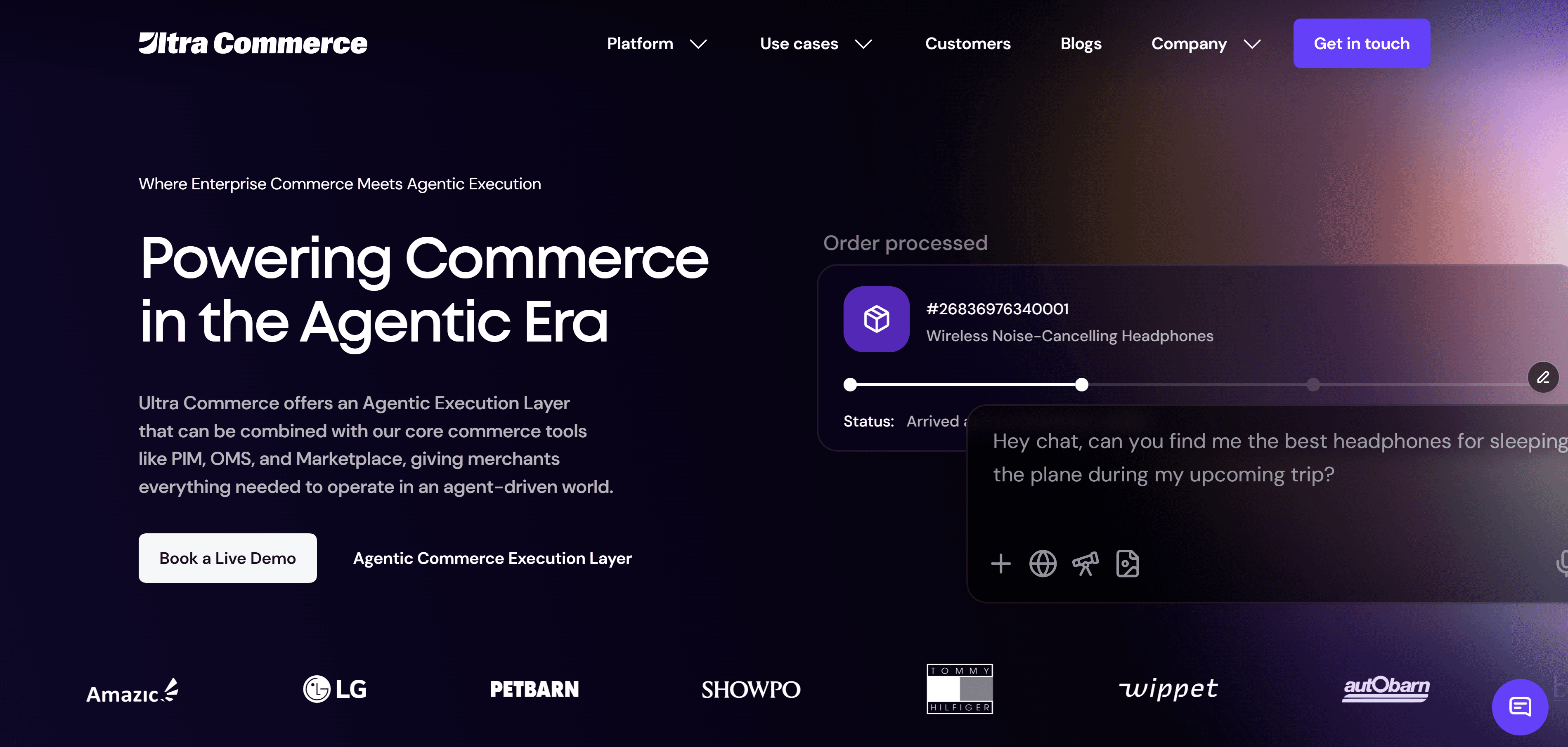
Ultra Commerce provides enterprise-grade tools purpose-built for the complexity you are managing. Whether you need a scalable enterprise ecommerce platform, a fully featured multi-vendor marketplace technology layer, or a reliable order management system to unify fulfilment across vendors and channels, the platform is designed to grow with your business without requiring a full replatform.
Explore our case studies to see how enterprises like yours have achieved measurable results, and schedule a demo to see how Ultra Commerce fits your specific operational model. The right partner makes the difference between a platform that works and one that transforms.
Frequently asked questions
What is a multi-vendor B2B e-commerce marketplace?
A multi-vendor B2B marketplace is an online platform where multiple suppliers sell their products or services to business buyers within a unified system. Multi-vendor platforms allow rapid scaling while managing multiple partner relationships and catalogues from a single operational hub.
How does artificial intelligence improve B2B e-commerce operations?
AI automates repetitive tasks, surfaces predictive buying insights, and increases revenue efficiency, with 41% higher revenue per rep reported for AI-augmented sales teams alongside 18% less activity required.
What are some essential systems for advanced B2B e-commerce?
Key systems include an order management system, product information management, and integrated payment solutions. Integrated platforms streamline orders, catalogue coherence, and vendor-buyer coordination for consistent, scalable performance.
Why is user experience important in B2B e-commerce?
Enterprise buyers expect personalised, frictionless procurement experiences that handle complex approval workflows and contract pricing. Platforms that prioritise streamlined UX see measurable improvements in both conversion rates and long-term customer retention.