
9:41
UltraChat 5
What's on your mind today?
Ready to take on any order.
Website content audit
Structure for clarity
Weekly performance report
Summarize key metrics
Ask anything


Agentic Commerce
Agentic Commerce
Agentic Commerce
Agentic Commerce
Agentic Commerce
Agentic Commerce
Agentic Commerce
The future of shopping
One prompt away.
The future of shopping
One prompt away.
The future of shopping
One prompt away.

SEND PRODUCT DATA
GET PRODUCT DATA

Vans Old Skool
245296542455212
Iconic skate style with durable canvas and suede, built for everyday wear.
CHECK AVAILABILITY
Warehouse:
SYDNEY: 34, MELBOURNE: 7, BRISBANE: 11, PERTH: 2
ENRICH DATA
Vans Old Skool
245296542455212
Iconic skate style with durable canvas and suede, built for everyday wear.
If AI can't understand your products, it can't sell them
Our execution layer makes your products visible to AI agents, enriching and structuring product data so machines can understand, recommend, and transact with confidence.
If AI can't understand your products, it can't sell them
Our execution layer makes your products visible to AI agents, enriching and structuring product data so machines can understand, recommend, and transact with confidence.
9:41
UltraChat 5
I need a new pair of shoes for a party this weekend.
Footlocker

Vans Old Skool
$45
9.2
Iconic skate style with durable canvas and suede, built for everyday wear.
6:00pm
6:30pm

Adidas Samba Og
$75
9.2
Timeless low-profile design with premium leather and a classic gum sole.
6:00pm
6:30pm
Here are a few standout pizzerias to keep on your radar before you decide. Each one brings a different mood to the table from cozy, brick oven classics to trendy spots with creative toppings.
Ask anything
Discovery
Make your products visible where AI agents decide.
Optimisation
Continuously improve relevance, performance, and outcomes.
Governance
Stay in control of data, rules, channels, and brand.
Execution
Turn agent decisions into real transactions at scale.
9:41
UltraChat 5
Nice, I like the Vans Old Skool! Please order them in my size.
All right, great choice! Now ordering Vans Old Skool in size 9. Total cost will be $45
Order Processed
Vans OId Skool
245296542455212
Payment complete
Thank you for your order. Your purchase is now processed and will arrive within 1–2 business days.
Ask anything
We Solve Agentic Commerce Execution
Our execution layer connects AI agents to your commerce stack, enabling discovery, optimisation, governance, and execution across agent-driven buying
We Solve Agentic Commerce Execution
Our execution layer connects AI agents to your commerce stack, enabling discovery, optimisation, governance, and execution across agent-driven buying
Projected global Agentic Commerce revenue by 2030.
$0TR
Agentic AI adoption by brands in 2028.
0%
of online shoppers expected to use AI shopping by 2030.
0%
Change needed to be an Early Mover
0
A Billion-Dollar Shift in Commerce
Agentic Commerce represents a billion-dollar revenue shift for merchants ready to lead.
A Billion-Dollar Shift in Commerce
Agentic Commerce represents a billion-dollar revenue shift for merchants ready to lead.
Agentic commerce is no longer a future concept.
It is a competitive advantage for businesses ready to move faster, operate smarter, and scale intelligence across their commerce ecosystem.
Agentic commerce is no longer a future concept.
It is a competitive advantage for businesses ready to move faster, operate smarter, and scale intelligence across their commerce ecosystem.
plug & play
plug & play
plug & play
fully agnostic
fully agnostic
fully agnostic
secure & governed
secure & governed
secure & governed
ai-optimized visibility
ai-optimized visibility
ai-optimized visibility
consumer ai interfaces
consumer ai interfaces
consumer ai interfaces
consumer ai interfaces
AI Chat
AI Chat
AI Chat
AI Chat

Gemini
Gemini, ChatGPT
Gemini
Gemini
Future AI Agents
Future AI Agents
Future AI Agents
Future AI Agents
Discovery to purchase in AI.
Discovery to purchase in AI.
Discovery to purchase in AI.
Discovery to purchase in AI.
Existing Merchant stack
Existing Merchant stack
Existing Merchant stack
Existing Merchant stack
Commerce Platforms
Commerce Platforms
Commerce Platforms
Commerce Platforms
Product Feeds
Product Feeds
Product Feeds
Product Feeds
PIM /ERP / OMS
PIM /ERP / OMS
PIM /ERP / OMS
PIM /ERP / OMS
Inventory & Pricing
Inventory & Pricing
Inventory & Pricing
Inventory & Pricing
No replatforming. No lock-in.
No replatforming. No lock-in.
No replatforming. No lock-in.
No replatforming. No lock-in.
Ultra Commerce Agentic Layers
Ultra Commerce Agentic Layers
Ultra Commerce Agentic Layers
Ultra Commerce Agentic Layers

Agnostic Connector
Connect to any system
Agnostic Connector
Connect to any system
Agnostic Connector
Connect to any system
Agnostic Connector
Connect to any system

AI Product Intelligence
Optimized Product Data
AI Business Optimizations
Sales improvement & Operational excellence
AI Product Intelligence
Optimized Product Data
AI Business Optimizations
Sales improvement & Operational excellence
AI Product Intelligence
Optimized Product Data
AI Business Optimizations
Sales improvement & Operational excellence
AI Product Intelligence
Optimized Product Data
AI Business Optimizations
Sales improvement & Operational excellence
LLM Exposure & Recommendations
Consumer AI interfaces
LLM Exposure & Recommendations
Consumer AI interfaces
LLM Exposure & Recommendations
Consumer AI interfaces
LLM Exposure & Recommendations
Consumer AI interfaces
AI Checkout & Payments
Seamless transactions
AI Checkout & Payments
Seamless transactions
AI Checkout & Payments
Seamless transactions
AI Checkout & Payments
Seamless transactions
intelligence
intelligence
intelligence
intelligence
decision
decision
decision
decision
execution
execution
execution
execution
AI agents are becoming the new buyers. 99.9% of the merchants are not ready.
As buying shifts from humans to AI agents, a new execution layer is required. Ultra Commerce is the agnostic execution layer for Agentic Commerce, turning agent decisions into real revenue without replatforming.
AI agents are becoming the new buyers. 99.9% of the merchants are not ready.
As buying shifts from humans to AI agents, a new execution layer is required. Ultra Commerce is the agnostic execution layer for Agentic Commerce, turning agent decisions into real revenue without replatforming.
AI agents are becoming the new buyers. 99.9% of the merchants are not ready.
As buying shifts from humans to AI agents, a new execution layer is required. Ultra Commerce is the agnostic execution layer for Agentic Commerce, turning agent decisions into real revenue without replatforming.
Hey chat, can you find me the best headphones for sleeping on the plane during my upcoming trip?
Order processed
#26836976340001
Wireless Noise-Cancelling Headphones
Status:
Arrived at the distribution centre
Hey chat, can you find me the best headphones for sleeping on the plane during my upcoming trip?
Order processed
#26836976340001
Wireless Noise-Cancelling Headphones
Status:
Arrived at the distribution centre
For Merchants
Get started today with agent-driven buying without replatforming, lock-in, or early-mover risk.
ERP
OMS
Payments
Logistics
ERP
OMS
Payments
Logistics
For SI Agencies
Deliver Agentic Commerce for your enterprise clients and unlock new revenue streams as AI reshapes ecommerce.
AEO
SEO
For Marketing Professionals
For Marketing Professionals
Expand beyond SEO and performance marketing by helping brands stay discoverable and chosen by AI agents.
Built without constraints: Agnostic by design.
Ultra Commerce connects seamlessly to any commerce stack and any AI agent. Our platform-agnostic architecture lets merchants stay flexible, avoid lock-in, and scale Agentic Commerce across channels, partners, and AI systems without replatforming or disruption of any ongoing operations.
Governance
Built-in governance defines what data AI agents can see, decide, and execute on: enforcing rules for pricing, availability, policies, and brand across B2C and B2B.
Governance
Built-in governance defines what data AI agents can see, decide, and execute on: enforcing rules for pricing, availability, policies, and brand across B2C and B2B.
Security
Enterprise-grade security protects data, transactions, and agent interactions end to end, with strict access control, isolation, and auditability.
Security
Enterprise-grade security protects data, transactions, and agent interactions end to end, with strict access control, isolation, and auditability.
Observability
Full visibility into agent behavior, decisions, and outcomes. Enabling monitoring, auditing, and continuous optimization across discovery, execution, and operations.
Observability
Full visibility into agent behavior, decisions, and outcomes. Enabling monitoring, auditing, and continuous optimization across discovery, execution, and operations.
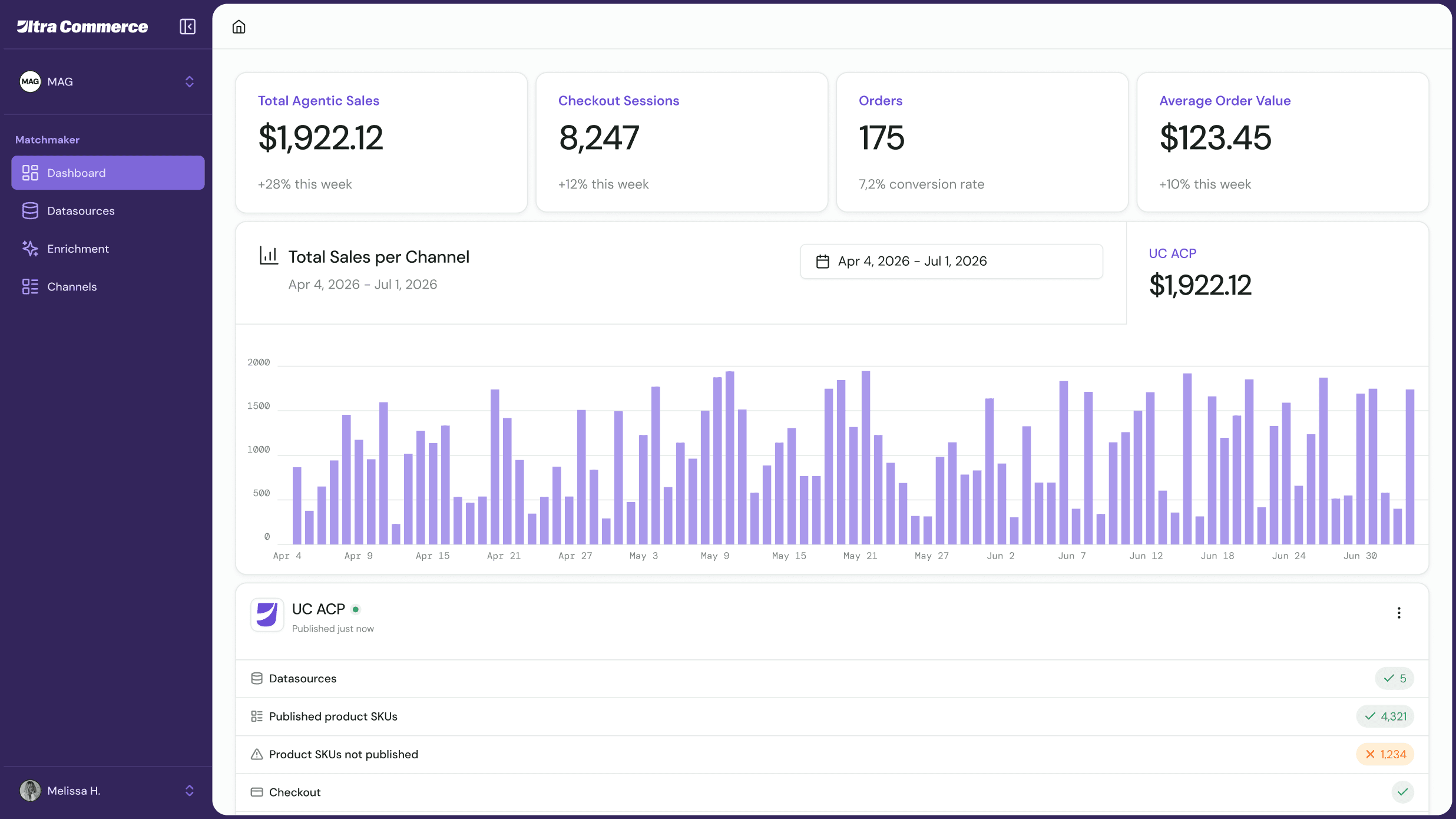
Merchant Dashboard: control your AI operations
Ultra Commerce connects systems, data, and AI agents through a single orchestration layer, controlled via the Merchant Dashboard. Merchants define the rules. Agents execute across discovery, transactions, and operations.
Merchant Dashboard: control your AI operations
Ultra Commerce connects systems, data, and AI agents through a single orchestration layer, controlled via the Merchant Dashboard. Merchants define the rules. Agents execute across discovery, transactions, and operations.
Merchant Dashboard: control your AI operations
Ultra Commerce connects systems, data, and AI agents through a single orchestration layer, controlled via the Merchant Dashboard. Merchants define the rules. Agents execute across discovery, transactions, and operations.

MAG
Matchmaker
Overview
Datasources
Enrichment
Channels
Orders
2
You
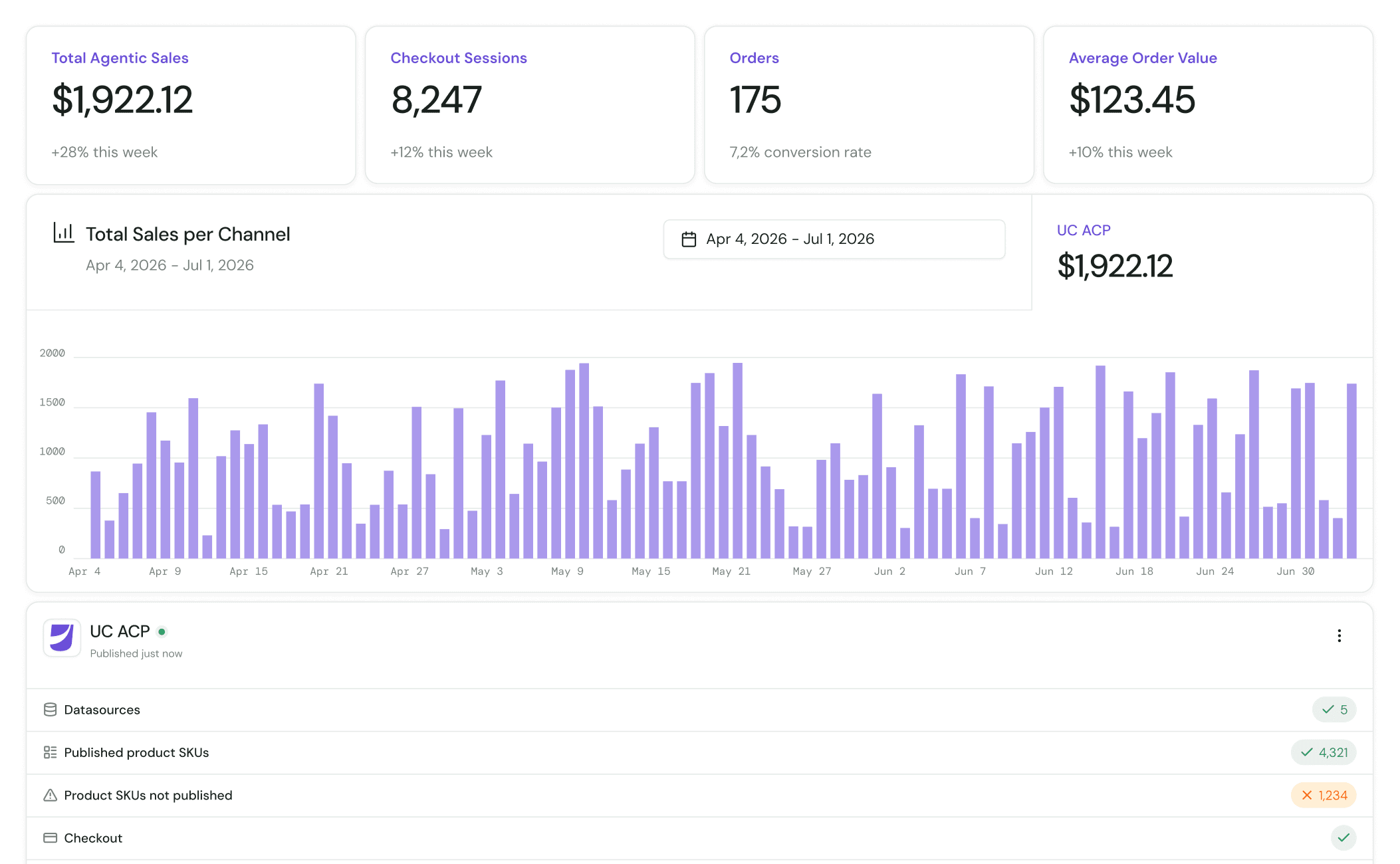
This visual is for demonstration purposes only. All numbers, figures, and data shown are illustrative and do not represent real values.
Enrichment & Distribution
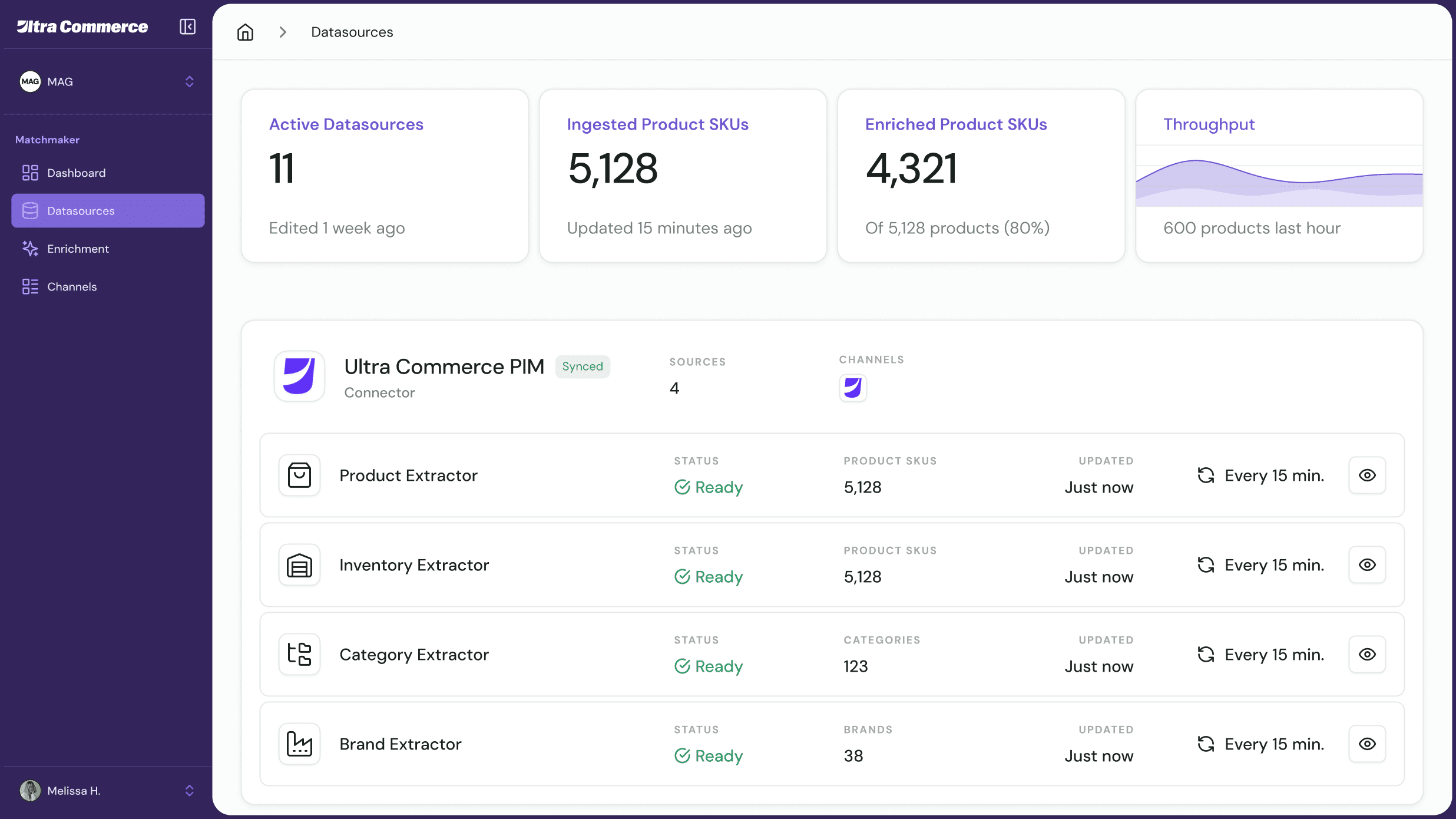
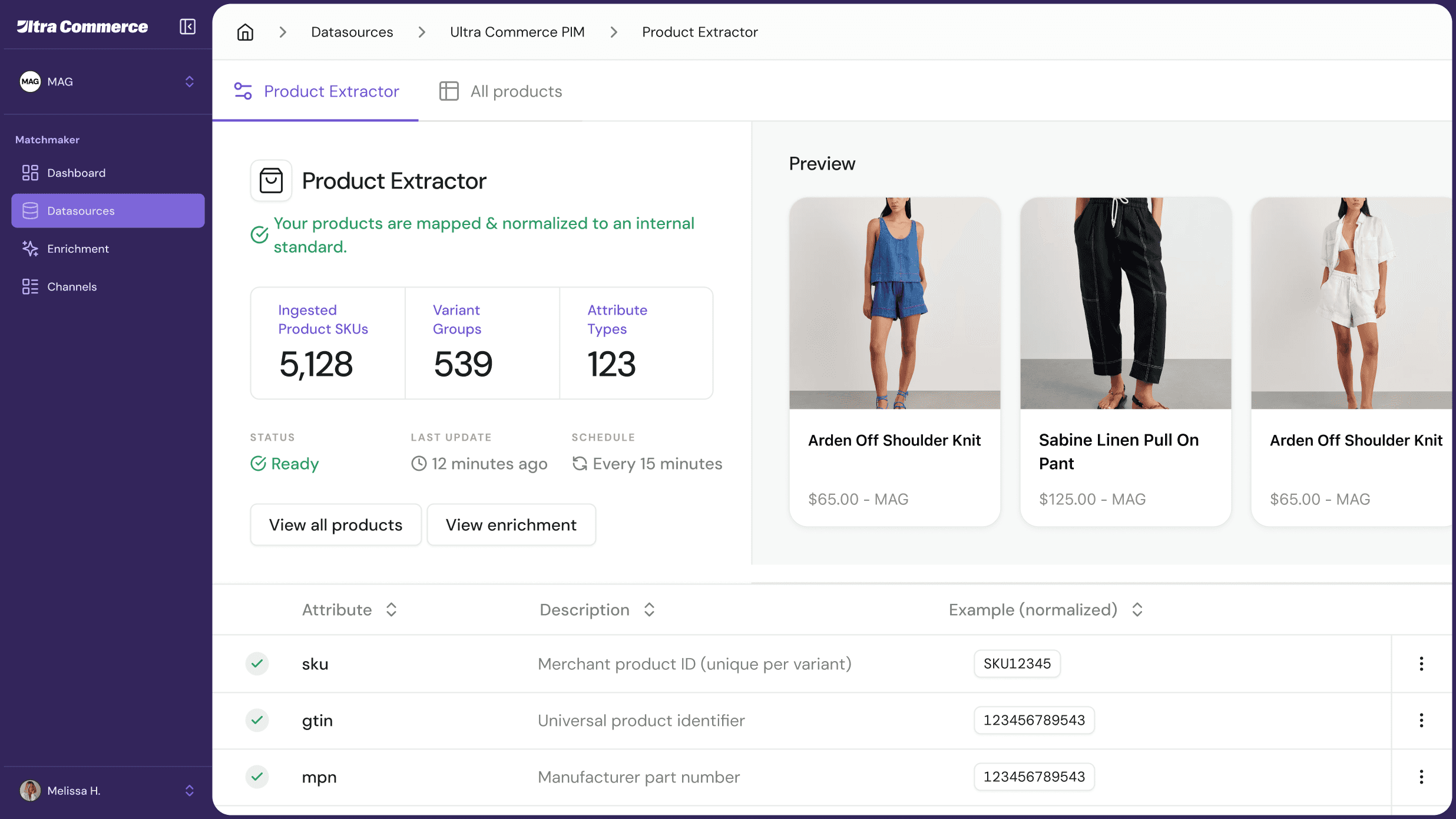
Make products understandable and usable by AI agents. Transforms product data into AI-ready intelligence so agents can discover, compare, and recommend accurately across channels.
Enrichment & Distribution
Make products understandable and usable by AI agents. Transforms product data into AI-ready intelligence so agents can discover, compare, and recommend accurately across channels.
Normalize and enrich product data for AI consumption
Control what data is exposed to which agents and channels
Ensure products remain visible as demand shifts to agents

Luciana – Long red gown
Luciana – Long red gown
Luciana – Long red gown
(Vermelho Tango) Bold color, sleek and slightly sexy cut
(Vermelho Tango) Bold color, sleek and slightly sexy cut
(Vermelho Tango) Bold color, sleek and slightly sexy cut
$ 1.573,60
$ 1.573,60
$ 1.573,60

Anne – Long black dress –
Anne – Long black dress –
Anne – Long black dress –
refined with interesting cut details for a soft edgy vibe
refined with interesting cut details for a soft edgy vibe
refined with interesting cut details for a soft edgy vibe
R$ 1.573,60
R$ 1.573,60
R$ 1.573,60

Malu – Printed midi –
Malu – Printed midi –
Malu – Printed midi –
not floor-length but stylish and artistic, more fashion-forward
not floor-length but stylish and artistic, more fashion-forward
not floor-length but stylish and artistic, more fashion-forward
R$ 1.573,60
R$ 1.573,60
R$ 1.573,60

Long black gown
Long black gown
Long black gown
Very elegant, clean lines, subtle modern edge
Very elegant, clean lines, subtle modern edge
Very elegant, clean lines, subtle modern edge
$ 1.573,60
$ 1.573,60
$ 1.573,60
Reasoning…
Reasoning…
Reasoning…
Utilizing tools for product search
Utilizing tools for product search
Utilizing tools for product search
I need to get started by using the necessary tools. First, I’ll call get_client_info to gather the information I need. After that, I’ll move on to search_products_smart. There’s no need for any additional questions at this point. Once I have the results, I’ll display the products as images in a horizontal markdown table, which should help make everything clear and visually appealing for the user.
I need to get started by using the necessary tools. First, I’ll call get_client_info to gather the information I need. After that, I’ll move on to search_products_smart. There’s no need for any additional questions at this point. Once I have the results, I’ll display the products as images in a horizontal markdown table, which should help make everything clear and visually appealing for the user.
I need to get started by using the necessary tools. First, I’ll call get_client_info to gather the information I need. After that, I’ll move on to search_products_smart. There’s no need for any additional questions at this point. Once I have the results, I’ll display the products as images in a horizontal markdown table, which should help make everything clear and visually appealing for the user.

Discovery Experience
Where AI agents decide what to buy. A discovery layer designed for agent-led exploration, evaluation, and decision-making.
Discovery Experience
Where AI agents decide what to buy. A discovery layer designed for agent-led exploration, evaluation, and decision-making.
Enable agent-led search, comparison, and recommendations
Adapt discovery logic in real time based on context and intent
Shift discovery from human browsing to machine reasoning
Sales Enablement*
Turn agent decisions into transactions. Executes purchases directly within AI and conversational interfaces.
Sales Enablement*
Turn agent decisions into transactions. Executes purchases directly within AI and conversational interfaces.
Convert agent decisions into checkout and payment flows
Support agent-to-agent and multi-party transactions
Sync orders seamlessly with merchant systems
Enable buying across chat, voice, and future agent channels
*not available in all regions

UltraStore
Auralis

Wireless Noise-Canceling Headphones
Auralis
Audio Accessories
1
Apple Pay
····1234
Alex Turner
123 Market Street,
New York, NY 10001, United States
USPS - Standard Shipping
Free · 2-3 business days
Subtotal
Shipping
Estimated Tax
$75.00
Free
$6.47
USPS – Standard Shipping
Total with estimated tax
$81.47
Pay now
By continuing, you agree to UltraStore’s terms and privacy policy. For more information on this product from the UltraStore seller, including warning, disclaimers and return policies, see here. You are ordering from an authorized reseller. OpenAI does not process yor order, collect payment, or handle fulfillment.
UltraStore
Auralis
Wireless Noise-Canceling Headphones
Auralis
Audio Accessories
1
Apple Pay
····1234
Alex Turner
123 Market Street,
New York, NY 10001, United States
USPS - Standard Shipping
Free · 2-3 business days
Subtotal
Shipping
Estimated Tax
$75.00
Free
$6.47
USPS – Standard Shipping
Total with estimated tax
$81.47
Pay now
By continuing, you agree to UltraStore’s terms and privacy policy. For more information on this product from the UltraStore seller, including warning, disclaimers and return policies, see here. You are ordering from an authorized reseller. OpenAI does not process yor order, collect payment, or handle fulfillment.
UltraStore
Auralis
Wireless Noise-Canceling Headphones
Auralis
Audio Accessories
1
Apple Pay
····1234
Alex Turner
123 Market Street,
New York, NY 10001, United States
USPS - Standard Shipping
Free · 2-3 business days
Subtotal
Shipping
Estimated Tax
$75.00
Free
$6.47
USPS – Standard Shipping
Total with estimated tax
$81.47
Pay now
By continuing, you agree to UltraStore’s terms and privacy policy. For more information on this product from the UltraStore seller, including warning, disclaimers and return policies, see here. You are ordering from an authorized reseller. OpenAI does not process yor order, collect payment, or handle fulfillment.
Operations & Optimisation
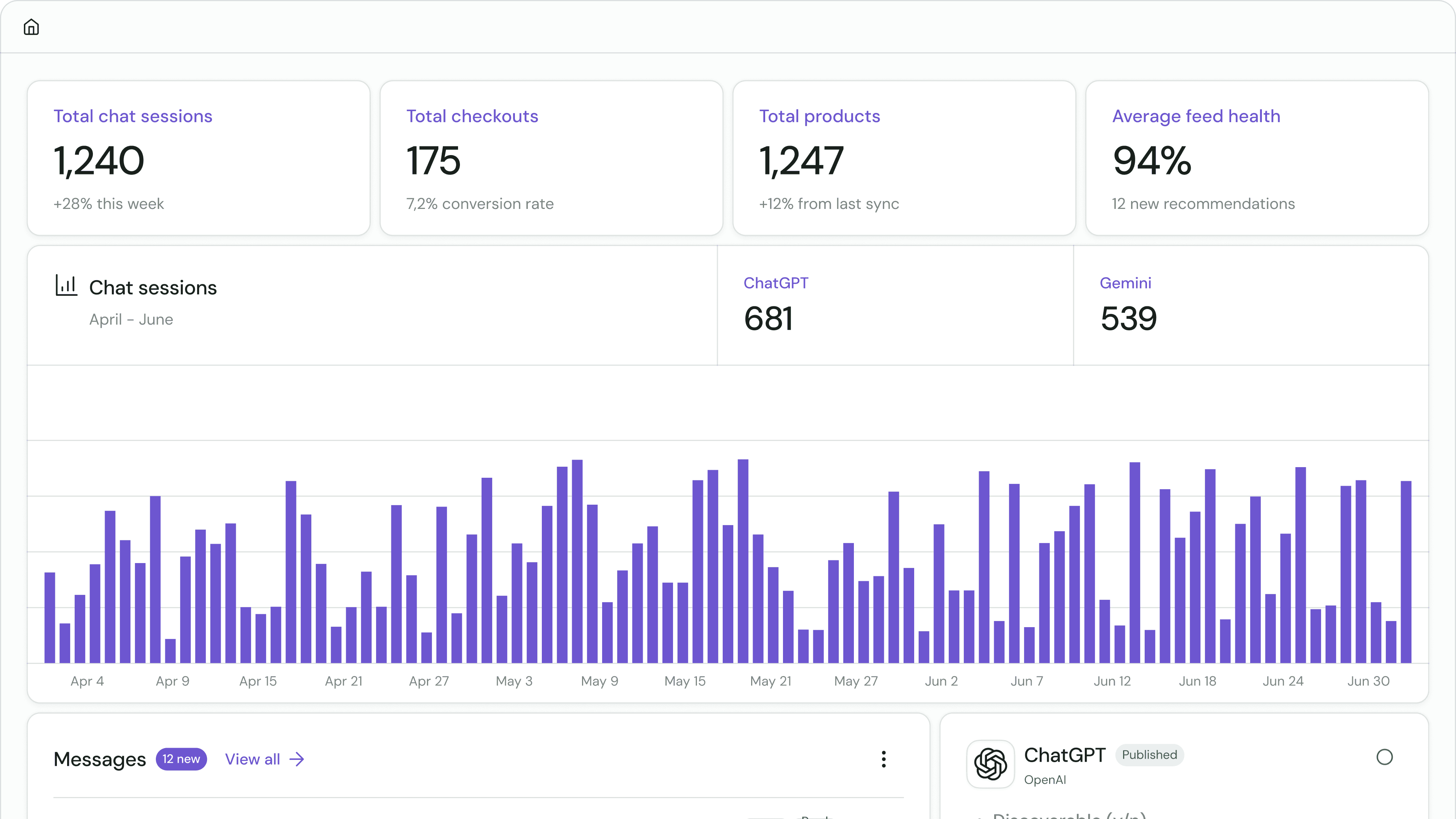
Continuously improve performance through internal AI agents. Internal agents monitor outcomes and recommend optimizations across the business.
Operations & Optimisation
Continuously improve performance through internal AI agents. Internal agents monitor outcomes and recommend optimizations across the business.
Surface insights across CX, pricing, fulfilment, and margins
Recommend actions to improve conversion and efficiency
Create a continuous feedback loop from agents back to merchants
Native ACP & UCP Integration
Built to support Agentic Commerce Protocol (ACP) and Universal Commerce Protocol (UCP), the execution layer standardizes how AI agents securely access structured product data, governance rules, pricing logic, and transactional endpoints.
Native ACP & UCP Integration
Built to support Agentic Commerce Protocol (ACP) and Universal Commerce Protocol (UCP), the execution layer standardizes how AI agents securely access structured product data, governance rules, pricing logic, and transactional endpoints.
Expose machine-readable product, policy, and pricing data via ACP/UCP-compliant endpoints
Ensure protocol-level interoperability between AI agents and commerce infrastructure
Overview
Datasources
Product Extractor
Enrichment
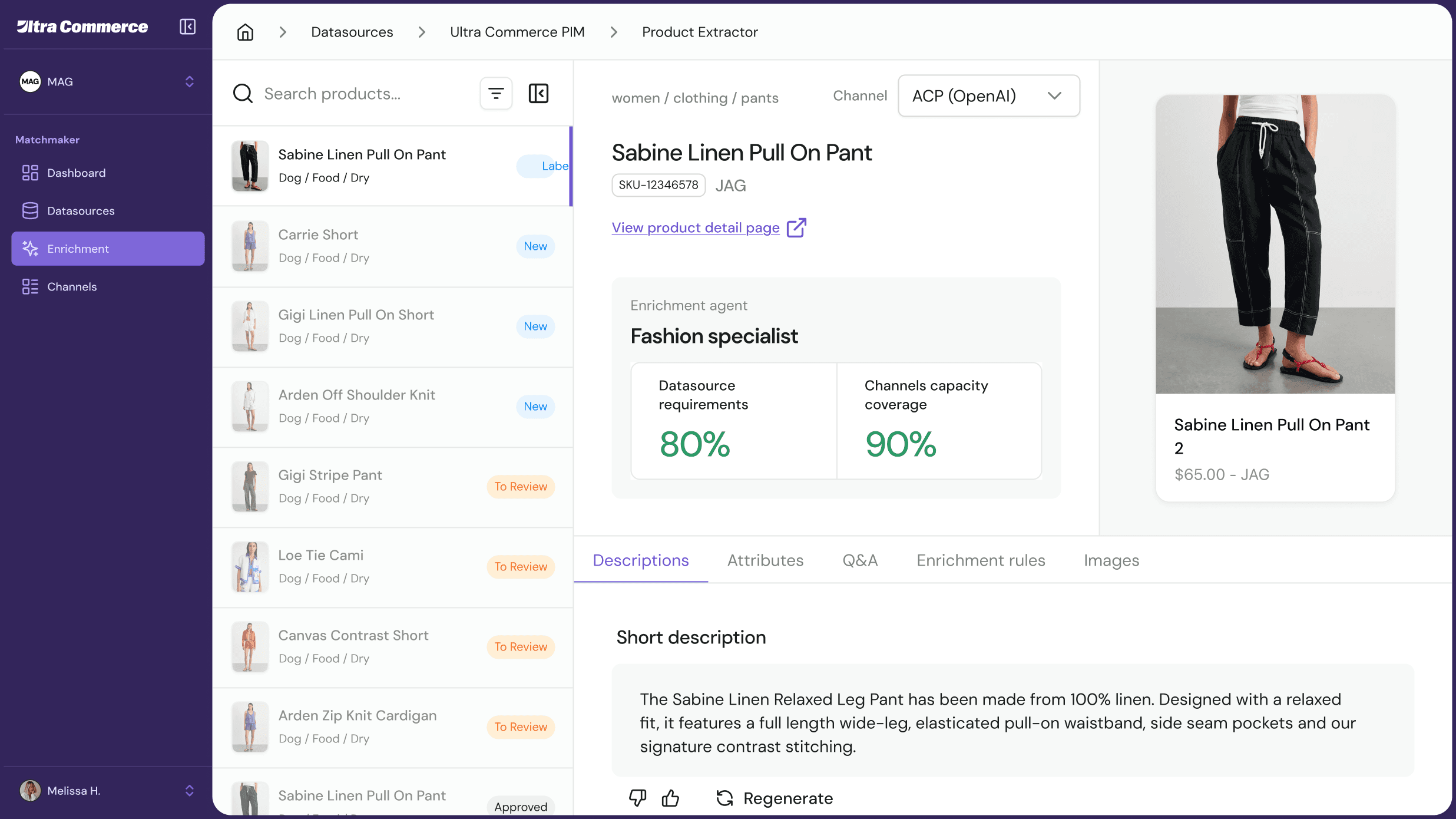
Channels
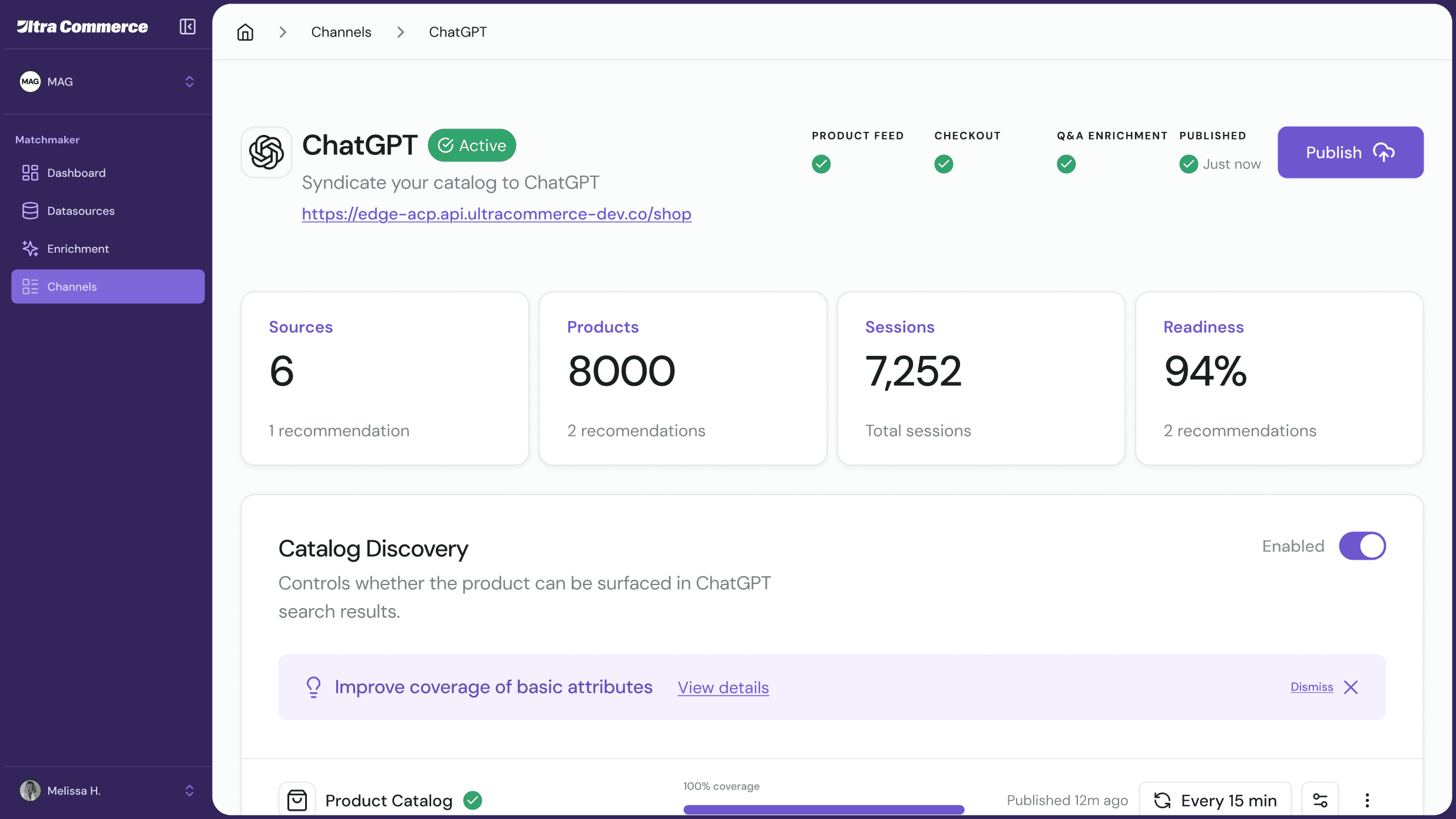
Overview
Datasources
Product Extractor
Enrichment
Channels
Overview
B2B
From EDI to AI-Driven Procurement
The Ultra Commerce Agentic Execution Layer enables AI agents to manage procurement workflows between buyers and suppliers. Instead of rigid EDI integrations, agents can interpret structured product data, apply procurement rules, generate orders, and execute transactions automatically. This creates a flexible, AI-driven procurement infrastructure that integrates with ERP systems, procurement platforms, and supply chain tools.
Buyer Systems
(ERP / Procurement / Inventory)
Procurement rules
Reorder thresholds
Buyer AI Agent
Agentic Execution Layer
Supplier AI Agent
Product data
Price books
Availability
Supplier Systems
(ERP / Manufacturing / Warehouse)
B2B
From EDI to AI-Driven Procurement
The Ultra Commerce Agentic Execution Layer enables AI agents to manage procurement workflows between buyers and suppliers. Instead of rigid EDI integrations, agents can interpret structured product data, apply procurement rules, generate orders, and execute transactions automatically. This creates a flexible, AI-driven procurement infrastructure that integrates with ERP systems, procurement platforms, and supply chain tools.
Buyer Systems
(ERP / Procurement / Inventory)
Procurement rules
Reorder thresholds
Buyer AI Agent
Agentic Execution Layer
Supplier AI Agent
Product data
Price books
Availability
Supplier Systems
(ERP / Manufacturing / Warehouse)
B2B
From EDI to AI-Driven Procurement
The Ultra Commerce Agentic Execution Layer enables AI agents to manage procurement workflows between buyers and suppliers. Instead of rigid EDI integrations, agents can interpret structured product data, apply procurement rules, generate orders, and execute transactions automatically. This creates a flexible, AI-driven procurement infrastructure that integrates with ERP systems, procurement platforms, and supply chain tools.
Buyer Systems
(ERP / Procurement / Inventory)
Procurement rules
Reorder thresholds
Buyer AI Agent
Agentic Execution Layer
Supplier AI Agent
Product data
Price books
Availability
Supplier Systems
(ERP / Manufacturing / Warehouse)
B2C
Preparing Products for AI-Driven Discovery
In B2C, product discovery is rapidly shifting from search engines and marketplaces to AI assistants and agents. Instead of browsing websites, consumers increasingly rely on AI systems to recommend, compare, and select products on their behalf. The Ultra Commerce Agentic Execution Layer ensures your products are visible and understandable in this new environment by transforming merchant data into AI-ready commerce intelligence.
Merchant Systems
(PIM / ERP / Product Feeds / CMS)
Product content
Attributes
Pricing & availability
COLLATE
Aggregate product data from multiple systems
into a unified, structured product layer
ENRICH
Enhance and structure data so AI agents
can understand products and context
DISTRIBUTE
Deliver machine-readable product intelligence
to AI agents, LLMs, and discovery platforms
Internal AI agent
External AI Agents & Assistants
(ChatGPT / Gemini / Copilot / Shopping Agents)
B2C
Preparing Products for AI-Driven Discovery
In B2C, product discovery is rapidly shifting from search engines and marketplaces to AI assistants and agents. Instead of browsing websites, consumers increasingly rely on AI systems to recommend, compare, and select products on their behalf. The Ultra Commerce Agentic Execution Layer ensures your products are visible and understandable in this new environment by transforming merchant data into AI-ready commerce intelligence.
Merchant Systems
(PIM / ERP / Product Feeds / CMS)
Product content
Attributes
Pricing & availability
COLLATE
Aggregate product data from multiple systems
into a unified, structured product layer
ENRICH
Enhance and structure data so AI agents
can understand products and context
DISTRIBUTE
Deliver machine-readable product intelligence
to AI agents, LLMs, and discovery platforms
Internal AI agent
External AI Agents & Assistants
(ChatGPT / Gemini / Copilot / Shopping Agents)
B2C
Preparing Products for AI-Driven Discovery and Transactions
In B2C, product discovery is rapidly shifting from search engines and marketplaces to AI assistants and agents. Instead of browsing websites, consumers increasingly rely on AI systems to recommend, compare, and select products on their behalf. The Ultra Commerce Agentic Execution Layer ensures your products are visible, understandable, and executable in this new environment by transforming merchant data into AI-ready commerce intelligence.
Merchant Systems
(PIM / ERP / Product Feeds / CMS)
Product data
Price books
Availability
COLLATE
ENRICH
DISTRIBUTE
AI Agents & LLMs
(ChatGPT / Gemini / Copilot)
Reccomendation
Product comparison
TRANSACT
Consumers buy directly inside the LLM via the Agentic Execution Layer
Merchant Systems
(Checkout / Payments / Order Management)
B2C
Preparing Products for AI-Driven Discovery and Transactions
In B2C, product discovery is rapidly shifting from search engines and marketplaces to AI assistants and agents. Instead of browsing websites, consumers increasingly rely on AI systems to recommend, compare, and select products on their behalf. The Ultra Commerce Agentic Execution Layer ensures your products are visible, understandable, and executable in this new environment by transforming merchant data into AI-ready commerce intelligence.
Merchant Systems
(PIM / ERP / Product Feeds / CMS)
Product data
Price books
Availability
COLLATE
ENRICH
DISTRIBUTE
AI Agents & LLMs
(ChatGPT / Gemini / Copilot)
Reccomendation
Product comparison
TRANSACT
Consumers buy directly inside the LLM via the Agentic Execution Layer
Merchant Systems
(Checkout / Payments / Order Management)
“Agentic Commerce doesn’t work without an execution layer. We built Ultra to be the system that AI agents can trust to understand products, respect rules, and complete transactions at scale.”

Roland Bastiaansen
CPO | Ultra Commerce
“Agentic Commerce doesn’t work without an execution layer. We built Ultra to be the system that AI agents can trust to understand products, respect rules, and complete transactions at scale.”
Roland Bastiaansen
CPO | Ultra Commerce
“Agentic Commerce doesn’t work without an execution layer. We built Ultra to be the system that AI agents can trust to understand products, respect rules, and complete transactions at scale.”
Roland Bastiaansen
CPO | Ultra Commerce

For Merchants
Be an early mover without the early-mover risk
Get ready for Agentic Commerce without replatforming, lock-in, or enterprise-level pricing. Start small, learn fast, and scale as AI agents become real buyers.

Bart Heinsius
Commerce Expert

For Partners
Bring Agentic Commerce to your customers
If you work with brands on commerce, growth, or technology, this is a new category you can lead. Partner with Ultra to explore, test, and deliver Agentic Commerce together.

Dave Crow
Partner Manager
Agentic Commerce explained
Answers to common questions about how agentic commerce works, how it differs from automation, and how Ultra Commerce enables it safely at enterprise scale.
What is Agentic Commerce?
Agentic Commerce uses AI agents to make autonomous decisions across commerce workflows such as pricing, product enrichment, fulfillment, and personalization. Instead of static rules, the system continuously adapts based on real-time data and goals.
How is Agentic Commerce different from traditional automation?
Traditional automation follows predefined rules. Agentic Commerce uses intelligent agents that observe, decide, and act dynamically, even when conditions change or new scenarios appear.
Is Agentic Commerce production-ready today?
Yes. Agentic Commerce is already being applied in areas like product data management, pricing optimization, order orchestration, and customer experience personalization within enterprise environments.
Where do AI agents operate in the Ultra Commerce platform?
Agents operate across PIM, OMS, orchestration, storefronts, and marketplaces, using shared data and APIs to make coordinated decisions across the entire commerce stack.
Do we lose control when using autonomous agents?
No. You define the boundaries, policies, and objectives. Agents act within those constraints and can always be monitored, audited, or overridden.
How does Agentic Commerce improve operational efficiency?
By handling exceptions, optimizations, and prioritization automatically, agents reduce manual workload, speed up decisions, and allow teams to focus on strategy instead of firefighting.
Can Agentic Commerce work with our existing systems?
Yes. Ultra Commerce is API-first and designed to integrate with legacy systems, ERPs, CRMs, data platforms, and third-party services.
Is Agentic Commerce secure and compliant?
Absolutely. All agent actions are governed by enterprise-grade security, permissions, audit logs, and compliance controls built into the platform.
Is this only for very large enterprises?
No. While enterprises gain the most scale benefits, any business dealing with complexity, multiple channels, or rapid growth can benefit from agentic capabilities.
How do we get started with Agentic Commerce?
Start with one domain such as product data, pricing, or fulfillment orchestration. Our team helps identify high-impact use cases and safely introduce agents into your existing stack.
Agentic Commerce explained
Answers to common questions about how agentic commerce works, how it differs from automation, and how Ultra Commerce enables it safely at enterprise scale.
What is Agentic Commerce?
Agentic Commerce uses AI agents to make autonomous decisions across commerce workflows such as pricing, product enrichment, fulfillment, and personalization. Instead of static rules, the system continuously adapts based on real-time data and goals.
How is Agentic Commerce different from traditional automation?
Traditional automation follows predefined rules. Agentic Commerce uses intelligent agents that observe, decide, and act dynamically, even when conditions change or new scenarios appear.
Is Agentic Commerce production-ready today?
Yes. Agentic Commerce is already being applied in areas like product data management, pricing optimization, order orchestration, and customer experience personalization within enterprise environments.
Where do AI agents operate in the Ultra Commerce platform?
Agents operate across PIM, OMS, orchestration, storefronts, and marketplaces, using shared data and APIs to make coordinated decisions across the entire commerce stack.
Do we lose control when using autonomous agents?
No. You define the boundaries, policies, and objectives. Agents act within those constraints and can always be monitored, audited, or overridden.
How does Agentic Commerce improve operational efficiency?
By handling exceptions, optimizations, and prioritization automatically, agents reduce manual workload, speed up decisions, and allow teams to focus on strategy instead of firefighting.
Can Agentic Commerce work with our existing systems?
Yes. Ultra Commerce is API-first and designed to integrate with legacy systems, ERPs, CRMs, data platforms, and third-party services.
Is Agentic Commerce secure and compliant?
Absolutely. All agent actions are governed by enterprise-grade security, permissions, audit logs, and compliance controls built into the platform.
Is this only for very large enterprises?
No. While enterprises gain the most scale benefits, any business dealing with complexity, multiple channels, or rapid growth can benefit from agentic capabilities.
How do we get started with Agentic Commerce?
Start with one domain such as product data, pricing, or fulfillment orchestration. Our team helps identify high-impact use cases and safely introduce agents into your existing stack.
Agentic Commerce explained
Answers to common questions about how agentic commerce works, how it differs from automation, and how Ultra Commerce enables it safely at enterprise scale.
What is Agentic Commerce?
Agentic Commerce uses AI agents to make autonomous decisions across commerce workflows such as pricing, product enrichment, fulfillment, and personalization. Instead of static rules, the system continuously adapts based on real-time data and goals.
How is Agentic Commerce different from traditional automation?
Traditional automation follows predefined rules. Agentic Commerce uses intelligent agents that observe, decide, and act dynamically, even when conditions change or new scenarios appear.
Is Agentic Commerce production-ready today?
Yes. Agentic Commerce is already being applied in areas like product data management, pricing optimization, order orchestration, and customer experience personalization within enterprise environments.
Where do AI agents operate in the Ultra Commerce platform?
Agents operate across PIM, OMS, orchestration, storefronts, and marketplaces, using shared data and APIs to make coordinated decisions across the entire commerce stack.
Do we lose control when using autonomous agents?
No. You define the boundaries, policies, and objectives. Agents act within those constraints and can always be monitored, audited, or overridden.
How does Agentic Commerce improve operational efficiency?
By handling exceptions, optimizations, and prioritization automatically, agents reduce manual workload, speed up decisions, and allow teams to focus on strategy instead of firefighting.
Can Agentic Commerce work with our existing systems?
Yes. Ultra Commerce is API-first and designed to integrate with legacy systems, ERPs, CRMs, data platforms, and third-party services.
Is Agentic Commerce secure and compliant?
Absolutely. All agent actions are governed by enterprise-grade security, permissions, audit logs, and compliance controls built into the platform.
Is this only for very large enterprises?
No. While enterprises gain the most scale benefits, any business dealing with complexity, multiple channels, or rapid growth can benefit from agentic capabilities.
How do we get started with Agentic Commerce?
Start with one domain such as product data, pricing, or fulfillment orchestration. Our team helps identify high-impact use cases and safely introduce agents into your existing stack.

Big ideas start with a quick chat.

If you’re ready to learn more, schedule a demo or get started – I’m here for you!
Bart Heinsius - Commerce Expert
Big ideas start with a quick chat.
If you’re ready to learn more, schedule a demo or get started – I’m here for you!
Bart Heinsius - Commerce Expert
Big ideas start with a quick chat.
If you’re ready to learn more, schedule a demo or get started – I’m here for you!
Bart Heinsius - Commerce Expert
Platform
Use Cases
Company
Compare
Platform
Use Cases
Company
Compare
Platform
Use Cases
Company
Compare